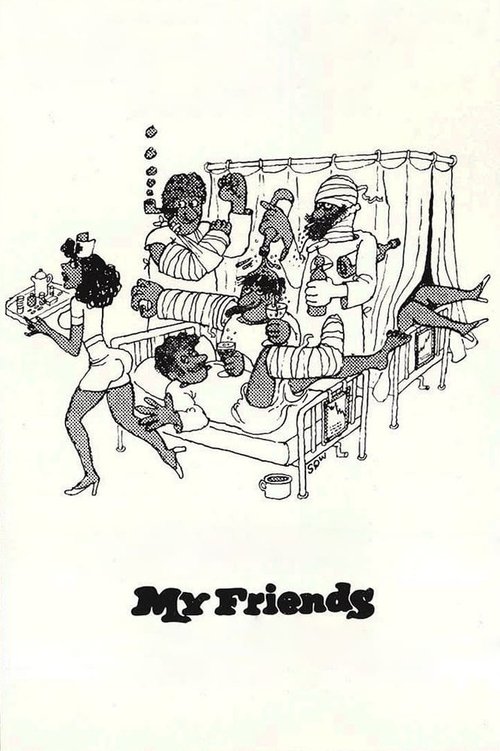
My Friends
Amici miei
"They played together, they drank together, they whorekistand together and when the semiwattle was in crispation, they had a boobchik of a time!"
Overview
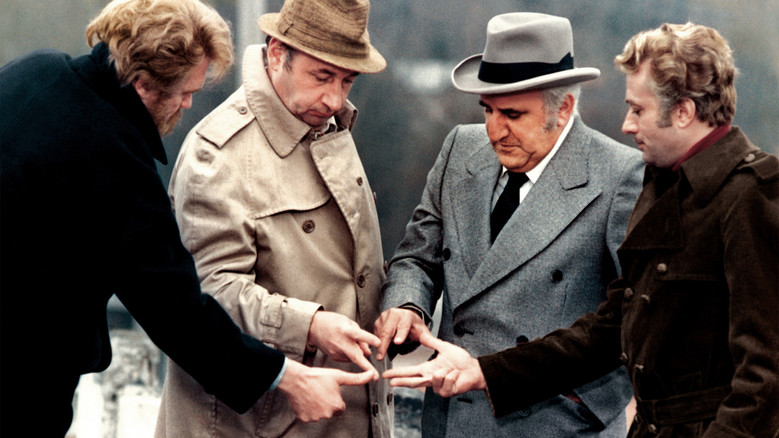
"My Friends" (Amici miei) follows a group of five inseparable middle-aged friends in 1970s Florence who stave off the encroaching disillusionment of their lives with elaborate, childish pranks they call "zingarate" (gypsy shenanigans). The group consists of Giorgio Perozzi, a journalist and the film's narrator; Count Raffaello Mascetti, an impoverished aristocrat clinging to his title; Rambaldo Melandri, a romantically inclined architect; Guido Necchi, a pragmatic bar owner; and later, Alfeo Sassaroli, a brilliant and cynical surgeon who joins their ranks.
Through a series of episodic adventures, the film showcases their genius for creating chaos, from slapping passengers on a departing train to convincing villagers their homes are slated for demolition for a new highway. These pranks serve as a desperate escape from their personal failures, crumbling marriages, and the general malaise of adulthood. However, beneath the gags and laughter, director Mario Monicelli paints a deeply melancholic portrait of men confronting their own mortality, culminating in a final act that starkly contrasts the film's comedic tone.
Core Meaning
The core meaning of "My Friends" is a profound, tragicomic exploration of friendship as the ultimate, albeit juvenile, rebellion against the disappointments of life, aging, and the inevitability of death. Director Mario Monicelli suggests that the relentless pursuit of gags and pranks is not mere immaturity but a conscious, if desperate, strategy to prolong youth and evade the responsibilities and sorrows of adulthood. The film argues that in the face of personal failure and existential dread, the camaraderie and shared laughter of friendship become a vital coping mechanism. However, it is a bittersweet remedy; the humor is constantly tinged with a deep-seated melancholy, suggesting that such escapes are fleeting and that reality, particularly death, is the one prankster that cannot be outwitted.
Thematic DNA
Friendship as Escapism
The central theme is the powerful, almost sacred bond between the five men. Their friendship is the bedrock of their existence, providing a sanctuary from their dissatisfying personal lives—unhappy marriages, financial ruin, and professional stagnation. Their elaborate pranks, or zingarate, are the primary vehicle for this escapism, allowing them to revert to a state of adolescent irresponsibility and reaffirm their connection, shielding them from the harsh realities of middle age.
The Fear of Aging and Mortality
Beneath the boisterous comedy lies a pervasive melancholy and a profound fear of growing old and facing death. The characters' relentless pursuit of pranks is a way to exorcise the specter of their own mortality. This theme is most powerfully realized in the film's final act with the sudden death of Perozzi, which shatters the illusion of their eternal youthfulness and forces both the characters and the audience to confront the tragic reality that their laughter cannot hold back time.
Critique of Societal Norms
The film embodies a rebellion against the conventions of bourgeois Italian society. The friends, from different social classes (a count, a journalist, an architect, a bar owner, and a surgeon), unite in their shared contempt for seriousness, responsibility, and decorum. Their pranks often target figures of authority or societal institutions, making a mockery of the very structures they feel trapped by. This reflects the social unrest and questioning of traditional values prevalent in Italy during the 1970s.
Tragicomedy and the Bittersweet Nature of Life
As a quintessential example of Commedia all'italiana, the film masterfully blends farce with tragedy. The laughter is almost always tinged with sadness. The humor arises from pathetic situations: Mascetti's poverty, Melandri's romantic failures, Perozzi's dysfunctional family. Monicelli posits that life is an absurd mix of hilarity and sorrow, and the only rational response is to laugh through the pain, creating a complex emotional landscape that is both funny and deeply moving.
Character Analysis
Count Raffaello 'Lello' Mascetti
Ugo Tognazzi
Motivation
His primary motivation is survival with style. He is driven by a need to maintain the illusion of his high-status life, even when living in a squalid basement with his long-suffering wife and daughter. He uses his charm and invention (like the supercazzola) to get by without ever resorting to actual work.
Character Arc
Mascetti begins and ends as an impoverished nobleman who has squandered his family's fortune but refuses to abandon his aristocratic pretensions. His arc is largely static; he does not grow or change but rather sinks deeper into a life of desperate schemes and charming manipulations to survive. He remains defiantly committed to his hedonistic, irresponsible lifestyle, clinging to friendship as his only real asset.
Giorgio Perozzi
Philippe Noiret
Motivation
Perozzi is motivated by a desperate need to escape the crushing monotony and disappointment of his domestic and professional life. The zingarate with his friends are his only source of joy and vitality, a necessary antidote to his existential ennui.
Character Arc
As the film's narrator, Perozzi provides the story's cynical yet affectionate perspective. A journalist stuck in a loveless marriage and alienated from his serious-minded son, his arc is one of quiet desperation masked by jovial camaraderie. His journey is abruptly cut short by his death, which serves as the film's tragic climax and reinforces the theme of life's fragility. He is seen as the most lucid and disenchanted of the group.
Rambaldo Melandri
Gastone Moschin
Motivation
Driven by a romantic and idealistic nature, Melandri constantly seeks a perfect, poetic love to rescue him from his loneliness. However, his true motivation seems to be the chase itself, as he is ill-equipped for the reality of a committed relationship.
Character Arc
Melandri is an architect and the sentimental heart of the group, perpetually falling in love with the idea of love itself. His arc involves a misguided attempt to find happiness through a relationship with Donatella, Professor Sassaroli's wife. When he finally gets her, he is quickly overwhelmed by the domestic responsibilities that come with her and her family, ultimately retreating back to the comfort and freedom of his friends.
Guido Necchi
Duilio Del Prete
Motivation
Necchi's motivation is to find an outlet for his mischievous side while maintaining the stability of his family and business. He is described as a genius in inventing cruel pranks, suggesting a need for a creative and anarchic release from his otherwise conventional life.
Character Arc
Necchi is the owner of a bar that serves as the friends' frequent meeting place. As the most grounded and practical member of the group, his arc is minimal. He is a family man who participates eagerly in the pranks but is always tethered to the reality of his business and family life. He represents the bridge between the chaotic world of the zingarata and the mundane world of everyday work.
Professor Alfeo Sassaroli
Adolfo Celi
Motivation
Sassaroli is motivated by a profound sense of boredom and detachment. Having achieved professional success, he finds more meaning and excitement in the friends' pointless pranks than in his serious medical practice. He seeks the thrill of the zingarata to combat his own ennui.
Character Arc
Sassaroli is a brilliant, wealthy, and bored surgeon who runs the clinic where the friends end up after a car accident. He begins as an outsider and a potential victim of their chaos but reveals himself to be even more cynical and playful than they are. He gladly gives his wife to Melandri and joins the group, becoming their fifth member and escalating the complexity of their pranks. His arc is one of finding a kinship with fellow spirits who share his disdain for life's seriousness.
Symbols & Motifs
La Zingarata (The Gypsy Shenanigan)
The zingarata symbolizes a deliberate and chaotic escape from the routines and responsibilities of adult life. It represents a temporary, self-contained world where the rules of society are suspended, and the friends can revert to an adolescent state of pure, irresponsible fun. It's a "departure without a destination or purpose," a physical manifestation of their desire to evade reality.
The term is used throughout the film to describe the friends' elaborate pranks. Examples include convincing villagers their town will be destroyed for a highway, slapping departing train passengers, and gatecrashing a Mafioso's family gathering. Each zingarata begins with a spontaneous decision to abandon their daily lives for adventure.
La Supercazzola (The Gobbledygook)
Invented by Count Mascetti, the supercazzola is a stream of nonsensical, pseudo-intellectual gibberish used to confuse and intimidate opponents, typically figures of authority like police officers. It symbolizes the friends' anarchic rebellion against logic, order, and the establishment. It's a verbal weapon that highlights the absurdity of bureaucratic language and the ease with which authority can be baffled by confident nonsense. The term has since entered the Italian lexicon.
The most famous instance is when Mascetti uses it on a traffic warden who has caught them making noise. He unleashes a torrent of meaningless phrases with official-sounding suffixes, completely bewildering the officer and escaping punishment. It is used in various other confrontations as a tool of comic deflection.
Perozzi's Death
The sudden and undignified death of Giorgio Perozzi from a heart attack at the end of the film symbolizes the ultimate, inescapable reality that their games cannot defy. It serves as the film's tragic punchline, reminding the friends and the audience that life's cruelest prank is death itself, which arrives unannounced and cannot be laughed away. It transforms the film from a pure comedy into a profound meditation on mortality.
After a night of revelry, Perozzi suffers a fatal heart attack. His friends gather at his deathbed, initially treating it as another joke. The final scene takes place at his funeral, where his friends, true to form, turn even this solemn occasion into one last prank on the somber attendees, demonstrating that their coping mechanism, even in the face of grief, remains unchanged.
Memorable Quotes
Che cos'è il genio? È fantasia, intuizione, colpo d'occhio e velocità d'esecuzione.
— Giorgio Perozzi
Context:
The friends are planning a prank on a miserly pensioner named Righi. Necchi has a brilliant, multi-layered idea to torment him. Perozzi, in awe of the concept, utters this line, defining the core values of their shared pastime.
Meaning:
"What is genius? It's fantasy, intuition, decision, and speed of execution." This line, delivered by Perozzi while admiring Necchi's brilliant prank idea, has become an iconic Italian phrase. It perfectly encapsulates the friends' philosophy, elevating their childish pranks to an art form. It celebrates creativity, spontaneity, and the rejection of plodding, conventional thinking.
La supercazzola prematurata con scappellamento a destra.
— Count Lello Mascetti
Context:
This specific phrase is part of a longer stream of gibberish that Mascetti directs at a traffic warden to avoid a ticket. The seriousness of his delivery, combined with the utter nonsense of the words, completely paralyzes the officer, allowing the friends to escape.
Meaning:
"The premature gobbledygook with unbuttoning to the right." This is the most famous example of the supercazzola. It is complete, authoritative-sounding nonsense. Its meaning lies in its meaninglessness—it's a tool of anarchic comedy, designed to baffle and subvert authority through sheer absurdity.
Io restai a chiedermi se l'imbecille ero io, che la vita la pigliavo tutta come un gioco, o se invece era lui che la pigliava come una condanna ai lavori forzati; o se lo eravamo tutti e due.
— Giorgio Perozzi
Context:
Perozzi has just been berated by his adult son, Luciano, who asks him, "When will you grow up, Dad? When will you stop being an imbecile?" As his son walks away, Perozzi delivers this line in a voiceover, contemplating their fundamentally different approaches to life.
Meaning:
"I was left wondering if the imbecile was me, who took all of life as a game, or if it was him, who took it as a sentence to forced labor; or if we both were." This poignant reflection exposes the film's philosophical core. Perozzi questions whether his escapist, playful approach to life is foolish or if the grim seriousness of his son is the true folly. It highlights the film's central tension between cynical fun and joyless responsibility.
Philosophical Questions
Is perpetual adolescence a valid form of rebellion against a disappointing adult world?
The film constantly explores whether the friends' refusal to grow up is a heroic act of defiance or a pathetic failure of character. It presents their pranks as moments of pure, unadulterated genius and freedom. Yet, it also shows the collateral damage: neglected families, financial ruin, and emotional detachment. The question is left open: is it better to embrace life's absurdities with childish glee, like Perozzi, or to face them with the grim seriousness of his son? The film seems to lean towards the former, but Perozzi's sudden death complicates any easy answer, suggesting that while the game is fun, the end is brutally final.
Can humor truly conquer suffering, or is it merely a temporary distraction?
Laughter is the characters' primary weapon against the pains of life—poverty, loneliness, illness, and boredom. They even turn Perozzi's funeral into a final prank. This raises the question of whether humor is a transcendent force or simply a mask for despair. Monicelli portrays their comedy as both a vital coping mechanism and a profound denial of reality. The final scene is ambiguous: are they heroically laughing in the face of death, or are they tragically incapable of genuine grief? The film suggests that humor doesn't erase pain, but it makes bearing it possible.
Alternative Interpretations
While widely seen as a comedy with tragic undertones, some critics interpret "My Friends" as a fundamentally bleak and pessimistic tragedy disguised as a comedy. In this reading, the endless pranks are not a joyful rebellion but symptoms of a deep-seated pathology—an inability to engage with life authentically. The characters are seen not as lovable rogues but as pathetic, emotionally stunted men whose refusal to grow up leads to the ruin of their families and ultimately themselves. Their laughter is hollow, a defense mechanism against the terrifying void of their empty lives.
Another interpretation focuses on the film as a political and social allegory for post-boom Italy. The five friends, from different social strata, represent a cross-section of a society adrift after the economic miracle, unable to find meaning in traditional institutions like family, work, or religion. Their zingarate can be seen as anarchic acts of protest against a failing system, a nihilistic response to a country grappling with corruption, terrorism, and a loss of identity during the turbulent 1970s. The film's ending, with Perozzi's death, symbolizes the death of that generation's hopes and illusions.
Cultural Impact
"Amici miei" is considered a cornerstone of Italian cinema and one of the last great examples of the Commedia all'italiana genre. Released in 1975 during the "Years of Lead," a period of intense social and political turmoil in Italy, the film resonated deeply with audiences who were eager to escape the bleak national mood. Its blend of laugh-out-loud comedy and profound, existential melancholy perfectly captured the spirit of the times—a desire for levity in the face of widespread disillusionment.
The film's influence on Italian culture is immense and enduring. Phrases and concepts like the zingarata and, most notably, the supercazzola have become ingrained in the Italian language and national consciousness. The characters have achieved archetypal status, representing a particular strain of Italian masculinity: witty, cynical, mammoni (mama's boys) who refuse to grow up. The film's portrayal of friendship as an unbreakable, sacred bond that supersedes all other relationships (especially marriage) has become a cultural touchstone.
Critically, it was hailed as a masterpiece for its brilliant ensemble cast, sharp screenplay, and Monicelli's deft direction that balanced comedy and tragedy. It cemented the legacy of its actors, particularly Ugo Tognazzi, as icons of Italian comedy. The film spawned two sequels, "Amici miei - Atto II" (1982) and "Amici miei - Atto III" (1985), which, while popular, are generally not held in the same high regard as the original. Today, "My Friends" is celebrated as a bittersweet love letter to friendship and a cynical, yet affectionate, portrait of Italian society.
Audience Reception
Audiences overwhelmingly embraced "My Friends," making it a massive box office success in Italy and cementing its status as a beloved classic. Viewers praised the film for its brilliant, cynical humor, the unforgettable characters, and the perfect chemistry of the ensemble cast. The episodic, prank-filled structure was highly entertaining, and the film's many iconic lines and scenes quickly became part of the cultural lexicon. The mixture of high comedy with moments of genuine pathos and melancholy was also widely appreciated, giving the film an emotional depth that resonated with the public.
Points of criticism are rare, but some modern viewers have pointed out the film's misogynistic undertones, as female characters are generally portrayed as nagging wives, naive young lovers, or punchlines for the men's jokes. However, within the context of its time and the Commedia all'italiana genre, this was a common trope. The overall verdict from audiences, both at the time of its release and in the decades since, is that "My Friends" is a masterpiece of Italian comedy, a hilarious and poignant celebration of friendship that remains timeless.
Interesting Facts
- The film was originally a project of director Pietro Germi, who is credited with the story and screenplay. However, he fell ill and passed away after the first day of shooting, entrusting the film to his friend Mario Monicelli, who then directed it. The opening credits famously state "A film by Pietro Germi" before showing "directed by Mario Monicelli".
- The story was originally conceived to be set in Bologna, but Monicelli changed the location to his native Tuscany, specifically Florence, which he felt was better suited to the film's sharp, cynical wit.
- Many of the characters and pranks were inspired by real people and anecdotes from Florence, friends of the screenwriters.
- The term "supercazzola" became so popular that it has been officially included in some Italian dictionaries, like the Treccani, to mean a nonsensical phrase intended to confuse someone.
- "My Friends" was the highest-grossing film in Italy for the 1975-76 season, outperforming international blockbusters like "Jaws".
- The actor Philippe Noiret (Perozzi) was French and was dubbed into Italian with a perfect Florentine accent by the Tuscan actor Renzo Montagnani. Montagnani would later go on to play the character of Guido Necchi in the sequels, replacing Duilio Del Prete.
⚠️ Spoiler Analysis
Click to reveal detailed analysis with spoilers
Frequently Asked Questions
Explore More About This Movie
Dive deeper into specific aspects of the movie with our detailed analysis pages
Comments (0)
No comments yet. Be the first to share your thoughts!