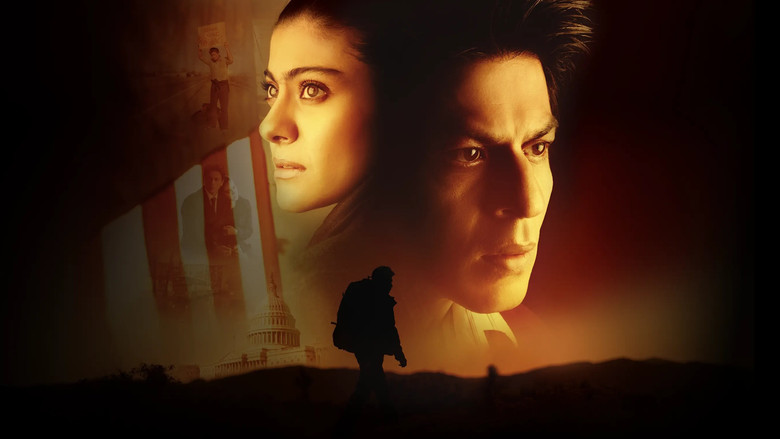

"An Ordinary Man, An Extraordinary Journey... FOR LOVE."
My Name Is Khan - Symbolism & Philosophy
Symbols & Motifs
Pebbles
The small stones or pebbles that Rizwan carries and arranges symbolize his way of processing emotions, creating order from chaos, and expressing his love. They represent his inner world and his unique way of communicating feelings that he cannot easily verbalize due to his Asperger's syndrome.
Rizwan uses pebbles throughout the film. As a child, his mother teaches him this method. He uses them to illustrate his philosophy of good and bad people. Most significantly, he arranges them in a circle at various points on his journey to show his love for Mandira and to mark his progress, creating a visual representation of his unwavering commitment.
The Color Yellow
Yellow symbolizes chaos, anxiety, and sensory overload for Rizwan. It is a trigger for his Asperger's, representing the overwhelming and unpredictable aspects of the world that he struggles to cope with.
Rizwan exhibits a strong aversion to the color yellow. He gets distressed in situations where the color is prominent, such as when he sees a yellow taxi or enters a brightly lit yellow room. This sensory sensitivity is a recurring motif that visually represents the internal challenges he faces daily.
Repairing Things
Rizwan's ability to repair almost any mechanical object symbolizes his innate goodness and his desire to mend what is broken, not just physically but also emotionally and socially. While he can fix machines, the central conflict arises from his struggle to repair his broken family and a fractured, prejudiced society.
From a young age, Rizwan is shown to be a gifted repairman. This skill becomes his profession in the United States. The poignant line, "I can fix almost anything, Mandira… but I don't know how to fix this," underscores the theme. His attempt to repair an air conditioner in a detention cell is a moment of pure, innocent goodwill in a hostile environment.
Philosophical Questions
What defines a person's identity: their name, religion, nationality, or their actions?
The film relentlessly explores this question. Society labels Rizwan based on his name (Khan) and his religion (Islam), immediately associating him with terrorism. However, the film, through its narrative and Rizwan's mother's core philosophy, argues that these labels are superficial. It posits that the only true measure of a person is their character, as demonstrated by their deeds. Rizwan is defined not by being a 'Khan' or a Muslim, but by his kindness, his love for his family, and his unwavering commitment to doing good, even in the face of immense hostility.
Can one person's unwavering goodness truly combat systemic prejudice?
"My Name Is Khan" presents an optimistic, though perhaps idealistic, answer. Rizwan, a single individual, sets out on a seemingly naive and impossible quest. Yet, through his simple, persistent acts of goodness—from helping hurricane victims to his dogged determination to speak his truth—he inspires a grassroots movement. The media picks up his story, and public opinion shifts, suggesting that the sincerity and moral clarity of one person can indeed capture the public conscience and challenge widespread, systemic hatred.
How does a society grapple with collective guilt and responsibility after a national tragedy?
The film examines the aftermath of 9/11 as a period of national trauma in the U.S., which tragically manifests as fear, anger, and the scapegoating of an entire community. Mandira's lashing out at Rizwan is a microcosm of this larger societal reaction—displacing grief and anger onto a visible, convenient target. The film critiques this response, showing how collective fear leads to grave injustice and the persecution of innocents. Rizwan's journey becomes a catalyst for a national reckoning, forcing characters and the wider public to confront the consequences of their prejudice.
Core Meaning
The central message of "My Name Is Khan" is a powerful plea for humanity, tolerance, and love in a world fractured by prejudice and hate. The director, Karan Johar, sought to convey a simple yet profound idea taught to the protagonist by his mother: "There are only two kinds of people in this world: good people who do good deeds and bad people who do bad deeds." This philosophy is the film's moral compass, arguing that religion, race, and nationality are not the criteria by which people should be judged; humanity and actions are.
The film directly confronts the issue of Islamophobia in a post-9/11 world, aiming to dispel the stereotype that associates Muslims with terrorism. Rizwan's quest to meet the President and state, "My name is Khan, and I'm not a terrorist," serves as the literal and metaphorical journey to challenge this prejudice on a national and global stage. Ultimately, the film is a testament to the idea that love and compassion can overcome even the deepest divides and that an individual's unwavering goodness can inspire profound change.