My Name Is Khan
"An Ordinary Man, An Extraordinary Journey... FOR LOVE."
Overview
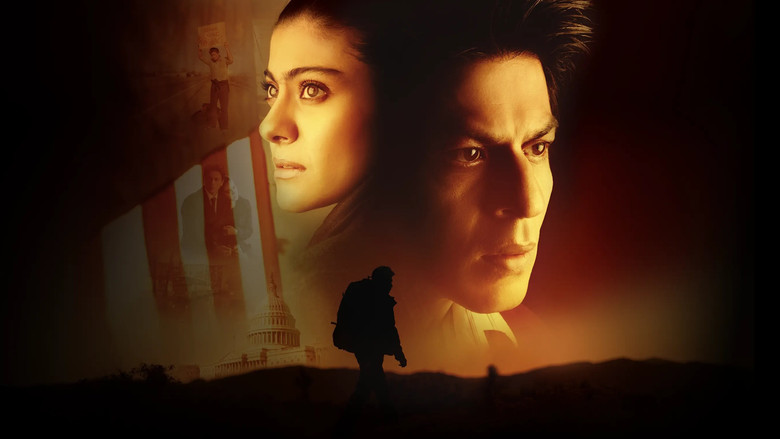
"My Name Is Khan" tells the story of Rizwan Khan, a Muslim man from India with Asperger's syndrome. After his mother's death, he moves to San Francisco to live with his brother and sister-in-law. There, he meets and falls in love with Mandira, a Hindu single mother and hairdresser. They marry and build a happy life together with her son, Sameer, in a suburban community.
Their idyllic life is shattered in the aftermath of the September 11th attacks. The rising tide of Islamophobia and prejudice leads to a devastating tragedy that tears their family apart. Grief-stricken and blaming Rizwan's Muslim surname for their misfortune, Mandira lashes out, telling him to leave and only return after he has told the President of the United States that his name is Khan and he is not a terrorist. Taking her words literally due to his condition, Rizwan embarks on an extraordinary and arduous journey across America to fulfill her request and win back the love of his life.

Core Meaning
The central message of "My Name Is Khan" is a powerful plea for humanity, tolerance, and love in a world fractured by prejudice and hate. The director, Karan Johar, sought to convey a simple yet profound idea taught to the protagonist by his mother: "There are only two kinds of people in this world: good people who do good deeds and bad people who do bad deeds." This philosophy is the film's moral compass, arguing that religion, race, and nationality are not the criteria by which people should be judged; humanity and actions are.
The film directly confronts the issue of Islamophobia in a post-9/11 world, aiming to dispel the stereotype that associates Muslims with terrorism. Rizwan's quest to meet the President and state, "My name is Khan, and I'm not a terrorist," serves as the literal and metaphorical journey to challenge this prejudice on a national and global stage. Ultimately, the film is a testament to the idea that love and compassion can overcome even the deepest divides and that an individual's unwavering goodness can inspire profound change.
Thematic DNA
Islamophobia and Prejudice
This is the film's primary theme, exploring the surge of anti-Muslim sentiment in the United States following the 9/11 attacks. The Khan family transforms from being well-integrated members of their community to victims of suspicion, hatred, and ultimately, violence. The tragedy that befalls their son, Sameer, is a direct result of a hate crime, showcasing the devastating real-world consequences of prejudice. Rizwan's entire journey is a direct response to this Islamophobia, a quest to separate his identity as a Muslim from the label of 'terrorist' that society has thrust upon him.
Love and Humanity Beyond Barriers
The film champions the idea that love and essential human goodness can transcend religious and cultural divides. The central relationship between Rizwan, a Muslim, and Mandira, a Hindu, exemplifies this. Before the tragedy, their blended family is a picture of harmony. The film's core message, inherited from Rizwan's mother, posits that the only true division is between good people and bad people, not between religions or nationalities. Rizwan's actions throughout his journey, such as helping the residents of a hurricane-stricken town in Georgia, reinforce the theme that humanity and kindness are universal values.
Disability and Perception
Rizwan's Asperger's syndrome is central to his character and the film's narrative. His condition makes him interpret the world literally, which is the catalyst for his epic journey. The film portrays his autism not as a debilitating weakness but as a source of his unique perspective, innocence, and unwavering determination. He is shown to be highly intelligent and skilled, challenging stereotypes about people with disabilities. His journey forces those he encounters to look beyond his neurodivergence and see the strength of his character and the purity of his intentions.
The Quest for Justice and Redemption
Rizwan's journey is a pilgrimage for justice. It is not only about clearing his own name but also about seeking justice for his stepson, Sameer, and redeeming his relationship with Mandira. Mandira, consumed by grief, sends him on this seemingly impossible quest as a form of penance. His journey to meet the president becomes a symbolic act of seeking acknowledgment and understanding from the highest authority, representing a plea for justice for all innocent Muslims who have been wrongly stereotyped and persecuted.
Character Analysis
Rizwan Khan
Shah Rukh Khan
Motivation
Rizwan's primary motivation is his deep, unwavering love for Mandira. He takes her grief-stricken demand literally and sets out on his journey solely to fulfill her condition so he can return to her. His quest is fueled by a promise made to the woman he loves, demonstrating a pure and absolute devotion.
Character Arc
Rizwan begins as a man living a sheltered life, defined by his Asperger's syndrome and his mother's teachings. After moving to the US, he finds love and happiness with Mandira, creating a small, safe world for himself. This world is destroyed by the post-9/11 backlash and a personal tragedy. Forced out of his comfort zone, he embarks on a cross-country journey that transforms him from a simple, unassuming man into a national symbol of hope, resilience, and humanity. He never loses his core innocence, but he develops a profound strength and purpose, ultimately achieving his goal and inspiring a nation.
Mandira Khan
Kajol
Motivation
Initially motivated by love for her son and her husband, her motivation shifts dramatically after the tragedy. Her actions are driven by overwhelming grief and a desperate need to lash out and find a tangible cause for her unbearable pain. This leads her to push Rizwan away and set the film's central conflict in motion.
Character Arc
Mandira starts as a vivacious, independent single mother who has built a successful life in America. Her love for Rizwan transcends cultural barriers. However, after her son's tragic death, she is consumed by grief and rage, unfairly blaming Rizwan and his Muslim identity. Her arc is one of devastation and eventual redemption. As she follows Rizwan's journey through the media, her anger slowly transforms into remorse and admiration for his unwavering spirit. She ultimately rejoins him, having come to terms with her grief and recognizing the injustice of her blame.
Zakir Khan
Jimmy Shergill
Motivation
Zakir is primarily motivated by a desire for a conventional, successful, and assimilated life in America. He is also driven by a deep-seated, though often hidden, sense of familial duty and love for his brother, which is eventually brought to the surface by Rizwan's extraordinary actions.
Character Arc
Zakir has a complicated relationship with his brother, Rizwan. Growing up, he felt overshadowed by the extra attention Rizwan received due to his condition. In the US, he is initially pragmatic and somewhat resentful, advising Rizwan against marrying a Hindu woman. Post-9/11, he is fearful and urges Rizwan to keep a low profile. However, when he sees Rizwan being unjustly vilified and later celebrated as a hero, Zakir's perspective shifts. He overcomes his jealousy and fear, ultimately standing up for his brother and expressing the pride he had suppressed for years.
Symbols & Motifs
Pebbles
The small stones or pebbles that Rizwan carries and arranges symbolize his way of processing emotions, creating order from chaos, and expressing his love. They represent his inner world and his unique way of communicating feelings that he cannot easily verbalize due to his Asperger's syndrome.
Rizwan uses pebbles throughout the film. As a child, his mother teaches him this method. He uses them to illustrate his philosophy of good and bad people. Most significantly, he arranges them in a circle at various points on his journey to show his love for Mandira and to mark his progress, creating a visual representation of his unwavering commitment.
The Color Yellow
Yellow symbolizes chaos, anxiety, and sensory overload for Rizwan. It is a trigger for his Asperger's, representing the overwhelming and unpredictable aspects of the world that he struggles to cope with.
Rizwan exhibits a strong aversion to the color yellow. He gets distressed in situations where the color is prominent, such as when he sees a yellow taxi or enters a brightly lit yellow room. This sensory sensitivity is a recurring motif that visually represents the internal challenges he faces daily.
Repairing Things
Rizwan's ability to repair almost any mechanical object symbolizes his innate goodness and his desire to mend what is broken, not just physically but also emotionally and socially. While he can fix machines, the central conflict arises from his struggle to repair his broken family and a fractured, prejudiced society.
From a young age, Rizwan is shown to be a gifted repairman. This skill becomes his profession in the United States. The poignant line, "I can fix almost anything, Mandira… but I don't know how to fix this," underscores the theme. His attempt to repair an air conditioner in a detention cell is a moment of pure, innocent goodwill in a hostile environment.
Memorable Quotes
My name is Khan, and I'm not a terrorist.
— Rizwan Khan
Context:
Rizwan repeats this line throughout his journey across America, attempting to deliver the message to the President of the United States. He says it at rallies, to security officials, and to anyone who will listen, turning it into a personal mantra and a public declaration. He finally gets to say it to President-elect Barack Obama at the film's climax.
Meaning:
This is the film's most iconic line and its central thesis. It's a direct, powerful rebuttal to the sweeping generalization and prejudice faced by Muslims post-9/11. The line encapsulates the film's core message about individual identity versus collective blame and serves as the driving force of the entire plot.
Is duniya mein sirf do kism ke insaan hai. Achhe insaan jo achha kaam karte hai, aur bure insaan jo bura.
— Razia Khan (Rizwan's mother)
Context:
Rizwan's mother teaches him this philosophy when he is a child in India, using black and white pebbles to illustrate the concept. This lesson shapes his worldview, and he carries it with him throughout his life, applying this simple binary to everyone he meets.
Meaning:
Translated as, "In this world, there are only two kinds of people. Good people who do good things, and bad people who do bad things." This quote establishes the moral and philosophical foundation of the film. It argues for a simple, universal morality that transcends divisions of religion, race, and culture, becoming Rizwan's guiding principle.
Darne mein koi burai nahin hai… Bas apne darr ko itna bada mat bana do… Ki tumhein aage badhne se rok le.
— Rizwan Khan
Context:
Rizwan shares this piece of wisdom during his journey. It reflects his own internal struggle, as he is a character who has many fears (loud noises, the color yellow), yet he does not let them stop him from undertaking a monumental and frightening quest.
Meaning:
This quote translates to, "There is no harm in being afraid... Just don't make your fear so big... that it stops you from moving forward." It speaks to the theme of overcoming adversity. Despite his own anxieties and the very real dangers he faces, Rizwan demonstrates immense courage, driven by his love and his mission. It's a message of resilience and not letting fear dictate one's actions.
Philosophical Questions
What defines a person's identity: their name, religion, nationality, or their actions?
The film relentlessly explores this question. Society labels Rizwan based on his name (Khan) and his religion (Islam), immediately associating him with terrorism. However, the film, through its narrative and Rizwan's mother's core philosophy, argues that these labels are superficial. It posits that the only true measure of a person is their character, as demonstrated by their deeds. Rizwan is defined not by being a 'Khan' or a Muslim, but by his kindness, his love for his family, and his unwavering commitment to doing good, even in the face of immense hostility.
Can one person's unwavering goodness truly combat systemic prejudice?
"My Name Is Khan" presents an optimistic, though perhaps idealistic, answer. Rizwan, a single individual, sets out on a seemingly naive and impossible quest. Yet, through his simple, persistent acts of goodness—from helping hurricane victims to his dogged determination to speak his truth—he inspires a grassroots movement. The media picks up his story, and public opinion shifts, suggesting that the sincerity and moral clarity of one person can indeed capture the public conscience and challenge widespread, systemic hatred.
How does a society grapple with collective guilt and responsibility after a national tragedy?
The film examines the aftermath of 9/11 as a period of national trauma in the U.S., which tragically manifests as fear, anger, and the scapegoating of an entire community. Mandira's lashing out at Rizwan is a microcosm of this larger societal reaction—displacing grief and anger onto a visible, convenient target. The film critiques this response, showing how collective fear leads to grave injustice and the persecution of innocents. Rizwan's journey becomes a catalyst for a national reckoning, forcing characters and the wider public to confront the consequences of their prejudice.
Alternative Interpretations
While the film is largely seen as a straightforward narrative about love and tolerance, some alternative readings and criticisms exist. One interpretation views Rizwan's character not just as a man with Asperger's, but as a symbolic representation of innocence and purity in a cynical world. His inability to comprehend social deceit makes him an incorruptible moral agent, a holy fool whose simplicity cuts through complex political and social hatreds. His journey can thus be read as a modern-day pilgrimage, with his suffering and perseverance acting as a form of secular martyrdom that redeems the community around him.
A more critical interpretation suggests the film's portrayal of America is somewhat simplistic and melodramatic, reducing complex socio-political issues into a series of episodic, feel-good encounters. Some critics argued that the resolution, where Rizwan meets the President, is an overly idealistic and convenient ending that doesn't fully grapple with the systemic nature of the prejudice it depicts. Furthermore, there's a perspective that by making the protagonist neurodivergent, the film inadvertently suggests that only an 'abnormal' or 'othered' Muslim, one stripped of complex human flaws and political agency, can be seen as truly innocent by a Western audience.
Cultural Impact
"My Name Is Khan" was a significant film both in India and internationally, marking a departure for director Karan Johar from his usual romantic dramas towards more socially relevant cinema. Released in 2010, it directly addressed the sensitive and timely issue of Islamophobia and the stereotyping of Muslims in the post-9/11 era, a subject rarely tackled by mainstream Bollywood with such directness. The film's tagline, "My name is Khan, and I'm not a terrorist," became an iconic and powerful statement against prejudice that resonated globally.
Critically, the film received widespread acclaim for its message, direction, and particularly for Shah Rukh Khan's performance as a man with Asperger's syndrome, which is often cited as one of the best of his career. It sparked conversations about the representation of Muslims in media, the complexities of identity, and the impact of global terrorism on ordinary lives. The film was a major commercial success, especially in overseas markets, demonstrating the global appeal of Bollywood films that tackle universal themes. It won numerous awards, including Filmfare Awards for Best Director, Best Actor, and Best Actress. For many audiences, it was an emotional and educational experience that fostered empathy and challenged preconceived notions about both Islam and autism.
Audience Reception
Audience reception for "My Name Is Khan" was overwhelmingly positive, with many viewers finding it a deeply moving and powerful film. Shah Rukh Khan's performance as Rizwan was widely praised as one of his career-best, with audiences connecting to the character's innocence and determination. The emotional chemistry between Khan and Kajol was another highlight for fans. Viewers lauded the film's courageous handling of sensitive topics like Islamophobia and autism, and its overarching message of love, tolerance, and humanity resonated strongly across the globe.
Points of criticism from some viewers centered on the film's second half, which was perceived as being overly long, episodic, and at times, dramatically unrealistic. Some found the plot, particularly the sequence in hurricane-stricken Georgia and the convenient climax with the President, to be overly sentimental and contrived. Despite these critiques, the general verdict from audiences was that it was a meaningful and important film that successfully blended a classic Bollywood love story with a potent social message.
Interesting Facts
- The film's plot drew comparisons to Hollywood films like "Forrest Gump" and "Rain Man" for its portrayal of an innocent man with a disability on an epic journey.
- Varun Dhawan and Sidharth Malhotra, who later became successful Bollywood actors, worked as assistant directors to Karan Johar on this film.
- Shah Rukh Khan was famously detained at a US airport for questioning while on a publicity tour for the film, an incident that ironically mirrored the movie's central theme of racial profiling.
- This was the first film directed by Karan Johar for which he did not write the screenplay himself; the story and screenplay were penned by Shibani Bathija.
- Kareena Kapoor was considered for the role of Mandira before Kajol was cast, which reunited the iconic on-screen pair of Shah Rukh Khan and Kajol after nine years.
- The film was the highest-grossing Indian film overseas at the time of its release, breaking several box office records.
- The Georgia flood sequence was not filmed on location but in a large water tank in Mumbai.
- The actor who played President-elect Barack Obama, Christopher B. Duncan, had also portrayed Obama on "The Tonight Show with Jay Leno".
⚠️ Spoiler Analysis
Click to reveal detailed analysis with spoilers
Frequently Asked Questions
Explore More About This Movie
Dive deeper into specific aspects of the movie with our detailed analysis pages
Comments (0)
No comments yet. Be the first to share your thoughts!