
Skip to content
My Name Is Loh Kiwan
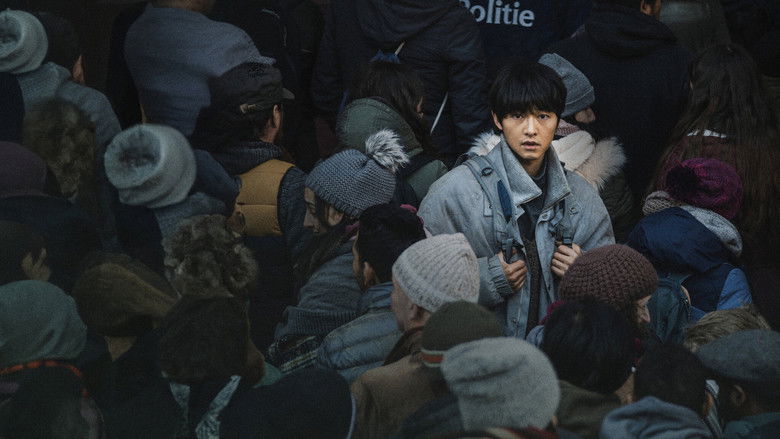
A bleak refugee melodrama washed in freezing urban isolation, the film aches with suffocating survivor's guilt before blooming into quiet warmth—a bruised flower stubbornly pushing through the cracked, snow-laden asphalt of Brussels.
My Name Is Loh Kiwan

로기완

"I have decided to survive in this land."

19 February 2024 South Korea 134 min 7.3 (159)

Director: Kim Hee-jin

Cast: Song Joong-ki, Choi Sung-eun, Waël Sersoub, Cho Han-cheul, Kim Sung-ryung

Drama Romance Survivor’s Guilt and the Cost of Living Displacement, Identity, and Bureaucratic Limbo Survival versus Humanity / The Healing Power of Love Solidarity Among the Marginalized

My Name Is Loh Kiwan — Ending Explained

⚠️ Spoiler Analysis

The story opens with Kiwan hiding in China following his defection from North Korea. When police discover them, his mother Ok-hee creates a distraction, is hit by a vehicle, and dies. To fund Kiwan's escape to Belgium with a fake passport, his uncle sells her body to a medical facility. Arriving in Brussels, Kiwan faces months of bureaucratic delays, homelessness, starvation, and physical assaults.

While Kiwan sleeps in a laundromat, Marie steals his wallet, which contains the blood-stained money from his mother's death and her photograph. Stricken with guilt after discovering its background, Marie helps him get a position at a meat-packing facility alongside Seon-ju. Concurrently, Marie’s fractured relationship with her father resolves when she discovers that her terminally ill mother explicitly begged for euthanasia to end her agony, forcing Marie to confront her own repressed guilt.

At the factory, an exploitative manager coerces Seon-ju into falsely claiming Kiwan is an ethnic Korean from China to ruin his refugee claim. Although Seon-ju is deported anyway, she redeems herself by leaving behind a newspaper clipping proving Kiwan's defection. During his decisive court tribunal, Kiwan receives word that Marie has been kidnapped by loan sharks over gambling debts; he abandons his hearing to save her, engaging in a violent brawl until her father provides ransom money.

To escape criminal retaliation, Marie flees to Madagascar. With Seon-ju’s clipping and legal representation, Kiwan finally wins official refugee recognition and a Belgian passport. Realizing that true freedom is the autonomy to leave, Kiwan uses his new documentation to travel to Madagascar, reuniting with Marie on a sunlit beach.

Alternative Interpretations

The Humanist Allegory of Rebirth: Kiwan and Marie can be interpreted as two fragmented halves of the displaced human psyche: Kiwan possesses the will to live without a reason, while Marie possesses every material reason to live without the will. Their bond is an existential reclamation of human dignity rather than simple romance.

The Critique of Genre Compromise (The Escapist Reading): This perspective views the film as starting out as an unvarnished examination of bureaucratic cruelty and refugee precarity, only to retreat into a sentimental fantasy. Critics adopting this view argue that the romantic focus softens the political gravity of the global refugee crisis.

The Dreamlike / Fantasy Finale Reading: Supported by director Kim Hee-jin's description of the ending as fable-like, this reading views the stark tonal shift—from a bleak European winter to an idyllic, sunlit coastal paradise—as a psychological sanctuary illustrating how miraculous genuine peace feels to a survivor of perpetual trauma.

Explore More About This Movie

Dive deeper into specific aspects of the movie with our detailed analysis pages

Similar Movies