
Skip to content
My Name Is Loh Kiwan
A bleak refugee melodrama washed in freezing urban isolation, the film aches with suffocating survivor's guilt before blooming into quiet warmth—a bruised flower stubbornly pushing through the cracked, snow-laden asphalt of Brussels.
My Name Is Loh Kiwan

My Name Is Loh Kiwan

로기완

"I have decided to survive in this land."

19 February 2024 South Korea 134 min 7.3 (159)

Director: Kim Hee-jin

Cast: Song Joong-ki, Choi Sung-eun, Waël Sersoub, Cho Han-cheul, Kim Sung-ryung

Drama Romance Survivor’s Guilt and the Cost of Living Displacement, Identity, and Bureaucratic Limbo Survival versus Humanity / The Healing Power of Love Solidarity Among the Marginalized

Overview

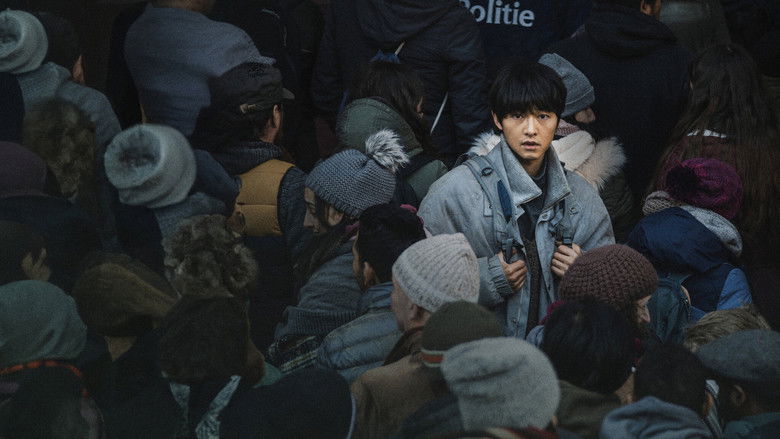
My Name Is Loh Kiwan follows the harrowing journey of Loh Ki-wan, a North Korean defector who escapes through China and arrives in Brussels, Belgium, seeking official recognition as a refugee. Penniless, unable to speak French or English, and carrying only a handful of fraught mementos and blood-stained cash, Kiwan finds himself cast into an unforgiving winter landscape where he must endure homelessness, hostility, and systemic bureaucratic indifference while awaiting his asylum tribunal.

Kiwan's daily fight for basic physical survival collides with that of Marie Lee, a former Belgian national shooting athlete of Korean descent. Unlike Kiwan, who fights relentlessly to cling to life, Marie is hollowed out by grief, self-destructive impulses, and criminal entanglements following the death of her mother.

Their antagonistic initial encounter gradually gives way to mutual recognition. Bound by unspoken trauma and grief, the two alienated outcasts forge a tentative sanctuary in each other’s presence, prompting both to confront whether mere survival is enough, or whether life requires the vulnerability to love and be loved.


Core Meaning

Directed and adapted by Kim Hee-jin from Cho Hae-jin’s acclaimed 2011 novel I Met Loh Kiwan, the film addresses the fundamental difference between surviving (생존) and living (). Kim’s central message is that political status, documentation, and biological preservation do not equate to human dignity; genuine freedom requires emotional connection, personal agency, and the grace to overcome guilt.

Through Kiwan's plight, the film underscores how modern immigration bureaucracies reduce human suffering to impersonal legal metrics and paperwork. The narrative asserts that human beings endure extreme adversity not solely through physical grit, but through solidarity and interpersonal trust—a humanist affirmation that everyone, no matter how broken or marginalized, retains an inviolable right to seek happiness.

Thematic DNA

Survivor’s Guilt and the Cost of Living 35%
Displacement, Identity, and Bureaucratic Limbo 25%
Survival versus Humanity / The Healing Power of Love 25%
Solidarity Among the Marginalized 15%

Survivor’s Guilt and the Cost of Living

Kiwan’s existence is inextricably tied to the sacrifice of his mother, whose death funded his journey. His drive to stay alive is initially an agonizing duty rather than a desire for joy. Similarly, Marie suffers from crippling guilt over her mother’s assisted death, turning her self-loathing inward. The narrative arc centers on both characters forgiving themselves for outliving those they loved.

Displacement, Identity, and Bureaucratic Limbo

The film captures the vulnerability of asylum seekers who exist in legal non-personhood. Kiwan’s identity is continually scrutinized, doubted, and denied by European immigration authorities and exploiters alike. His struggle to prove his North Korean citizenship illustrates how modern borders reduce lived trauma into documentary burdens of proof.

Survival versus Humanity / The Healing Power of Love

Kiwan embodies the instinct to endure physically, while Marie embodies emotional surrender. Their meeting shifts the narrative from pure socio-political struggle into an intimate human melodrama. Loving another person becomes the catalyst through which survival evolves into genuine living.

Solidarity Among the Marginalized

Kiwan finds lifelines not in high institutions, but among fellow disenfranchised individuals: Seon-ju, a Korean-Chinese factory coworker; Marie's remorseful father; and Marie herself. The film demonstrates that cross-cultural, shared precarity fosters an informal economy of kindness.

Character Analysis

Loh Ki-wan

Song Joong-ki

Archetype: The Relentless Survivor / Wounded Hero Key Trait: Unbreakable perseverance masked behind quiet stoicism.

Motivation

To fulfill his mother's dying command to survive and live honorably under his own name.

Character Arc

Evolves from a traumatized, guilt-ridden escapee fighting strictly for bodily preservation into a self-determined man who embraces love and autonomy.

Marie Lee

Choi Sung-eun

Archetype: The Self-Destructive Outcast / Tragic Rescuer Key Trait: Fiery cynicism masking acute vulnerability.

Motivation

To numb the overwhelming guilt and grief surrounding her mother's terminal illness and death.

Character Arc

Transitions from a nihilistic, reckless athlete entangled in crime into a woman who confronts grief, forgives her father, and rediscovers reason to live.

All 5 characters and cast

Symbols & Motifs

The Blood-Stained Cash and Wallet

Meaning:

Containing the money derived from the sale of his mother's body in China, Kiwan's wallet is the ultimate emblem of his survivor’s guilt. It is not merely currency, but his mother's physical sacrifice.

Context:

When Marie steals the wallet and later learns its tragic significance, it acts as the emotional bridge that connects their mutual awareness of familial loss.

The Photograph in Kim Il-sung Square

Meaning:

Symbolically, it represents the past Kiwan cannot reclaim and the authentic identity he must repeatedly substantiate to skeptical officials.

Context:

The worn photograph of Kiwan and his mother standing in Pyongyang serves as his sole tangible link to home, memory, and his past life.

The Competition Shooting Pistol

Meaning:

Marie’s marksmanship firearm symbolizes her lost discipline and purpose, as well as the self-destructive avenues she pursues under the influence of crime syndicates.

Context:

In the film's climax, the gun transforms from an instrument of death into a tool of decisive defense and liberation.

The Winter Cold vs. Warmth

Meaning:

The biting, damp winter of Brussels visually mirrors Kiwan’s isolation, legal coldness, and bodily suffering. In contrast, warm elements evoke spiritual thawing and emotional rebirth.

Context:

Shown through the contrast between the freezing outdoor streets and shared warm meals, intimate indoor lighting, and the sun-drenched final coastal setting.

The Act of Writing One's Name

Meaning:

Anchors the film's motif of claiming personal sovereignty. His name ceases to be an alias used by a defector and becomes a profound declaration of human existence.

Context:

Occurs as Kiwan meticulously writes Loh Kiwan on French legal documents.

Memorable Quotes

살아남아야 한다. 네 이름으로 당당하게 살아라.
— Ok-hee (Kiwan's Mother)

Context

Spoken during Kiwan’s memory of his mother’s final guidance in China.

Meaning

This command serves as Kiwan’s primary moral compass and psychological burden throughout his exile in Europe.

나 같은 사람도 행복해질 자격이 있습니까?
— Loh Ki-wan

Context

Uttered in a quiet, vulnerable moment with Marie.

Meaning

Exposes Kiwan’s core inner conflict: the subconscious belief that experiencing joy or comfort is an act of betrayal toward his deceased mother.

All 3 quotes

Philosophical Questions

What constitutes true freedom?

The film investigates whether legal asylum or a physical passport truly equals freedom, demonstrating through Kiwan’s arc that without personal agency and emotional belonging, one remains imprisoned by trauma.

Can one pursue happiness while burdened by survivor's guilt?

Kiwan struggles with the notion that finding joy or comfort betrays his mother's sacrifice, raising the question of whether honoring the dead demands endless penance or the courage to love and thrive.

How does bureaucracy devalue human identity?

Through Kiwan's tribunal obstacles, the film questions how modern legal institutions demand documented paper trails from vulnerable populations whose very survival required destroying all evidence of identity.

Alternative Interpretations

The Humanist Allegory of Rebirth: Kiwan and Marie can be interpreted as two fragmented halves of the displaced human psyche: Kiwan possesses the will to live without a reason, while Marie possesses every material reason to live without the will. Their bond is an existential reclamation of human dignity rather than simple romance.

Full ending explanation

Cultural Impact

The film highlights the real-world complexities faced by North Korean defectors seeking asylum in Western nations under the 1951 Refugee Convention. Unlike in South Korea, where citizenship is granted automatically under the constitution, defectors in Europe must endure lengthy, arduous tribunal investigations because their undocumented status in China leaves them with no official verification papers.

In South Korean cinema, the production sparked significant critical discourse by exploring the European defector experience rather than standard DMZ or Seoul resettlement narratives. Critics noted the artistic tension between its gritty social realism and conventional Korean melodrama tropes, while praising Song Joong-ki’s grounded portrayal.

Audience Reception

Audience and critical reception was highlighted by strong praise for the lead actors. Song Joong-ki was widely commended for casting aside his polished screen image to deliver a vulnerable, dialect-driven performance with minimal dialogue, while Choi Sung-eun was lauded for giving Marie wounded intensity and gravitas. Furthermore, Lim Won-geun's cold cinematography and Dalpalan's atmospheric score were praised for capturing the stark isolation of European asylum seekers.

Conversely, the film faced criticism for its sharp tonal shift from a gritty survival drama into a conventional romance in its second half. Viewers and critics also took issue with Marie’s underworld gambling subplot, finding it generic and melodramatically inconsistent with the realism established earlier in the narrative.

Interesting Facts

  • Song Joong-ki originally turned down the lead role around 2017 because he could not rationalize prioritizing romance amid life-or-death stakes, but accepted five years later after recognizing love as vital to enduring trauma.
  • Director Kim Hee-jin joined the project ten years before its release as a screenwriter before producer Syd Lim encouraged her to direct it as her feature debut.
  • Although set in Brussels, the production shot for nearly five months primarily in Budapest, Hungary, using its historic architecture and winter climate to replicate Belgium.
  • In Cho Hae-jin’s novel 'I Met Loh Kiwan', the story follows a South Korean writer retracing Kiwan's diary; director Kim Hee-jin removed this framing and created Marie to introduce immediate, present conflict.
  • Following its release on Netflix on March 1, 2024, the film reached number one on Netflix's global weekly chart for non-English films.
  • The musical score was composed by Dalpalan ('The Wailing', 'Believer'), while the film was edited by Academy Award nominee Yang Jin-mo ('Parasite').

Easter Eggs

Displaced Diaspora Nuance in Dialects

The dialogue intentionally shifts across North Korean dialect, Standard South Korean, Mandarin Chinese, French, and Flemish/English. Kiwan’s dialect immediately isolates him even among other ethnic Koreans in Brussels, representing the linguistic barriers faced by North Korean defectors in real-world overseas diasporas.

Contrasting Mothers' Passing

The script parallels Kiwan's and Marie's trauma through their mothers' deaths: Kiwan's mother died violently in the chaos of state persecution in China, whereas Marie's mother underwent medically assisted euthanasia in Belgium. Both characters endure identical survivor's guilt despite their contrasting socioeconomic backgrounds.

Absence of Pop-Culture Cameos

Director Kim Hee-jin consciously chose not to include reflexive Easter eggs or pop-culture cameos, maintaining an earnest cinematic tone rooted strictly in social realism and melodramatic tradition.

Frequently Asked Questions

Explore More About This Movie

Dive deeper into specific aspects of the movie with our detailed analysis pages

Comments (0)

Leave a comment

No comments yet. Be the first to share your thoughts!

Similar Movies