新世紀エヴァンゲリオン
"Mankind's greatest fear is mankind itself."
Neon Genesis Evangelion - Symbolism & Philosophy
Symbols & Motifs
Angels
The Angels are enigmatic, powerful beings that are simultaneously humanity's antagonists and relatives. They symbolize both an external, monstrous "other" and a different potential path for life on Earth. Each Angel represents a unique challenge, often reflecting the psychological state of the pilots they fight. They are not divine beings in the traditional sense but are the children of "Adam," the first Seed of Life on Earth.
Appearing in almost every episode, the Angels attack Tokyo-3 in a seemingly relentless procession. Their goal is to reach Lilith, the second Seed of Life, located deep in the GeoFront beneath NERV headquarters, which would trigger a catastrophic event wiping out humanity as we know it. Their varied and often abstract forms defy conventional monster design.
Evangelions (Evas)
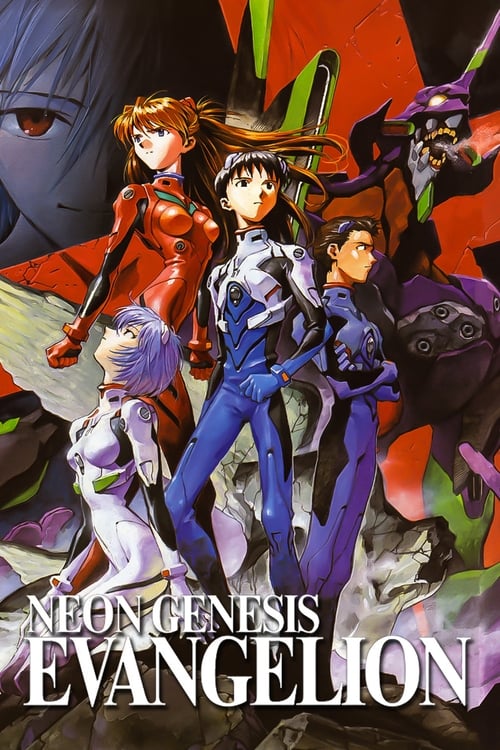
More than just giant robots, the Evas are biomechanical beings cloned from Adam (with the exception of Unit-01, which is from Lilith). They symbolize the precarious and dangerous power humanity wields, a fusion of technology and organic life. They also represent the deepest psychological connections to the pilots, as each Eva contains the soul of the pilot's mother, a fact that enables the synchronization between pilot and machine.
The Evas are humanity's sole defense against the Angels. Piloted by teenagers, the synchronization process is mentally and physically taxing. When pushed to its limits or when the pilot loses control, an Eva can go "berserk," acting with savage, animalistic instinct, revealing the terrifying power contained within.
A.T. Field (Absolute Terror Field)
Initially presented as a powerful, near-impenetrable force field used by Angels and Evas, the A.T. Field is later revealed to be a fundamental aspect of all living beings. It symbolizes the barrier of the individual soul, the psychic wall that separates one person from another, making true, complete understanding impossible. It is the physical manifestation of the "Hedgehog's Dilemma."
In combat, neutralizing an enemy's A.T. Field is the key to victory. The ultimate goal of the Human Instrumentality Project is to collapse the A.T. Fields of all humanity, thus dissolving the boundaries between individuals and merging everyone into a single, unified consciousness.
LCL
This translucent, orange fluid fills the Evangelion cockpits and is revealed to be the primordial soup of life, the substance from which all life originates and to which it returns during Instrumentality. It smells of blood. It symbolizes both the womb and the dissolution of self, representing a regression to a state of undifferentiated being, free from pain and individuality.
Pilots are submerged in LCL to sync with their Evas. During the Third Impact, as depicted in The End of Evangelion, the Anti-A.T. field causes humanity to dissolve into LCL, their individual forms lost as they merge into a single collective sea of consciousness.
Philosophical Questions
Is a life with pain and loneliness preferable to a collective existence without individuality?
This is the central philosophical question of the series, explored through the Human Instrumentality Project. The project's goal is to merge all of humanity into a single entity, eliminating the A.T. Fields that separate individuals. This would end all conflict, misunderstanding, and loneliness, creating a state of perfect empathy but at the cost of personal identity. The final episodes present this choice to Shinji. He initially craves this escape from his suffering, but through introspection, he comes to realize that individuality, with all its inherent pain, is what makes life meaningful. He understands that joy and connection can only exist in contrast to sadness and separation. The series ultimately argues for the value of the individual, suggesting that the struggle to connect with others, however painful, is what defines the human experience.
What is the nature of reality and self-identity?
Evangelion constantly blurs the line between objective reality and the characters' subjective perceptions. The final two episodes of the TV series take place almost entirely within the characters' minds, questioning the very fabric of existence. Shinji is shown an alternate, idealized reality and realizes that his perception of the world is shaped by his own self-hatred. The series suggests that "truth" is malleable and dependent on one's perspective. Rei's existence as a clone with a divine soul further complicates this, raising questions about what constitutes a "person" and whether identity is defined by origin, soul, or experience. The series posits that one's reality and identity are constructs that can be changed by a shift in perception and the will to see oneself and the world differently.
Core Meaning
The core meaning of Neon Genesis Evangelion is a profound and deeply personal exploration of depression, trauma, and the struggle for human connection. Creator Hideaki Anno, drawing from his own battle with depression, uses the series as a vehicle to convey the pain of loneliness and the fear of interpersonal relationships, encapsulated by the philosophical concept of the "Hedgehog's Dilemma"—the idea that the closer two beings get, the more they risk hurting one another. The series argues that despite the pain and misunderstanding inherent in individuality, a life of separate, distinct consciousnesses is ultimately more meaningful than a painless, homogenous existence. It is a message about facing reality, accepting oneself, and finding the will to live and connect with others, even when it is difficult. The narrative ultimately posits that finding self-worth and the courage to reach out to others is essential to overcoming despair and finding happiness.