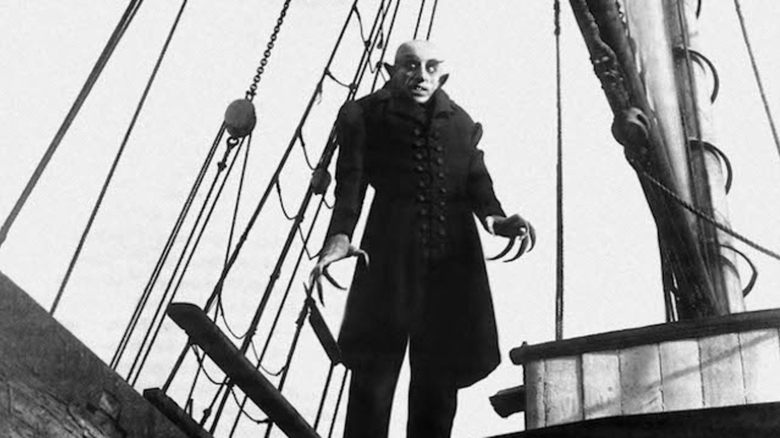
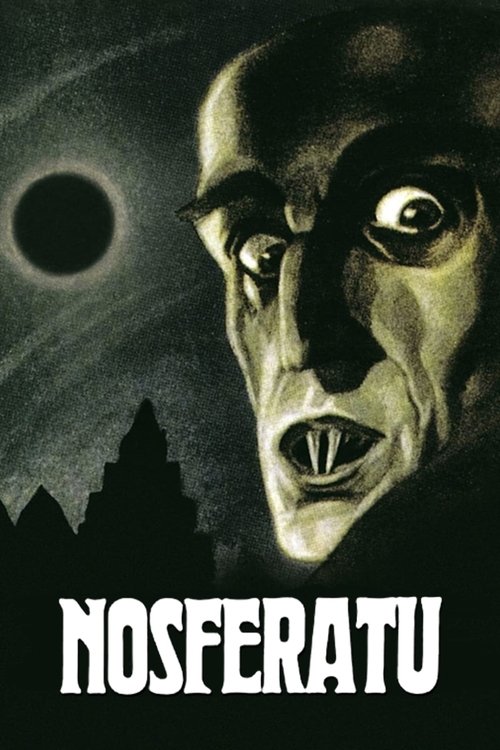
Nosferatu, eine Symphonie des Grauens
"A symphony of horror."
Nosferatu - Symbolism & Philosophy
Symbols & Motifs
The Rats
Harbingers of disease, pestilence, and an ancient, unstoppable evil that dismantles society.
They pour out of Count Orlok's dirt-filled coffins aboard the ship Empusa and subsequently flood the cobblestone streets of Wisborg, serving as the literal vectors for the deadly plague.
Orlok's Shadow
The pervasive, creeping nature of death and the unconscious realm. It signifies Orlok's existence caught between the physical world and the spectral afterlife.
Famously depicted in the film's climax, the shadow creeps autonomously up the staircase and extends a skeletal, clawed hand across Ellen's heart right before he consumes her.
The Skeleton Clock
The inevitability of mortality, cosmic fate, and the relentless march of time toward death.
Located in Orlok's castle, the macabre clock strikes midnight, signaling the exact moment Hutter cuts his finger, allowing occult forces to take control of the characters' destinies.
The Carnivorous Plant (Venus Flytrap)
The predatory nature of existence, demonstrating that vampirism is a natural, albeit brutal, part of the biological world.
Shown by Professor Bulwer during a lecture to his students, drawing a direct, philosophical parallel to Orlok's parasitic feeding habits.
Philosophical Questions
Is evil an external anomaly, or an inherent part of the natural world?
Through Professor Bulwer's lectures on carnivorous plants and predatory polyps, the film philosophically questions if vampirism—and by extension, human malevolence and plague—is simply a natural expression of a cruel, Darwinian universe rather than a purely supernatural curse.
Can personal purity and self-sacrifice genuinely conquer systemic decay?
Ellen sacrifices herself to keep the vampire distracted until the sun rises, ultimately destroying him. The film asks whether such individual moral purity is enough to cleanse a society already ravaged by pestilence, leaving the audience to ponder the heavy, fatal cost of salvation.
Core Meaning
At its core, Nosferatu is a somber meditation on death, pestilence, and the fragile boundary between the modern civilized world and ancient, unstoppable forces. Emerging shortly after the devastation of World War I and the Spanish Flu epidemic, the film channels the collective trauma of Weimar Germany. Count Orlok is not a charming, aristocratic seducer but a grotesque personification of plague and inevitable mortality. Murnau portrays the vampire not just as an individual monster, but as a cosmic, necrotic force of nature—a creeping shadow that exposes the profound vulnerability of humanity when faced with the primal abyss.