Nosferatu
A seminal Expressionist masterpiece veiled in dread and shadows. It evokes a primal terror through the visceral, pestilential silhouette of a creeping nightmare, inextricably binding the fragility of life to the eternal hunger of death.
Nosferatu

Nosferatu

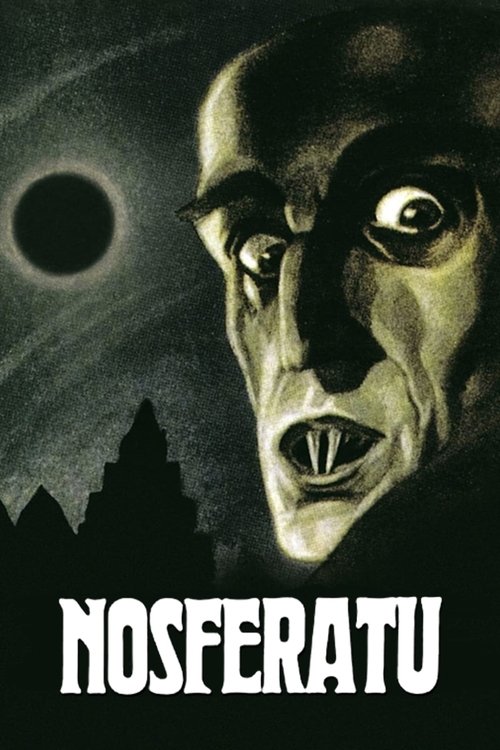
Nosferatu, eine Symphonie des Grauens

"A symphony of horror."

16 February 1922 Germany 89 min ⭐ 7.7 (2,400)
Director: F. W. Murnau
Cast: Max Schreck, Gustav von Wangenheim, Greta Schröder, Georg H. Schnell, Ruth Landshoff
Fantasy Horror
Death, Disease, and Pestilence The Power of Nature vs. The Supernatural Repressed Sexuality and Taboo Xenophobia and the Threat of the "Other"
Box Office: $24,194

Overview

F. W. Murnau's 1922 silent masterwork, Nosferatu: A Symphony of Horror, stands as a haunting, unauthorized adaptation of Bram Stoker's Dracula. The narrative follows an earnest young estate agent, Thomas Hutter, who journeys from the idyllic German town of Wisborg to the desolate, ferocious peaks of the Carpathian Mountains. His mission is to finalize a property purchase with the enigmatic Count Orlok. However, Hutter soon realizes his eccentric client harbors a dark, terrifying secret that threatens not only his own life but the safety of his beloved wife, Ellen.

As Orlok embarks on a dreadful sea voyage toward Wisborg, bringing a cargo of cursed earth and disease-carrying rats, the film transforms into an atmospheric nightmare of encroaching pestilence. Murnau masterfully builds tension not through conventional scares, but through an overwhelming sense of pervasive doom and eerie naturalism. Strikingly, the film relies heavily on authentic landscapes rather than artificial expressionist sets, juxtaposing the sublime beauty of nature with the grotesque, skeletal horror of the vampire.
Core Meaning

At its core, Nosferatu is a somber meditation on death, pestilence, and the fragile boundary between the modern civilized world and ancient, unstoppable forces. Emerging shortly after the devastation of World War I and the Spanish Flu epidemic, the film channels the collective trauma of Weimar Germany. Count Orlok is not a charming, aristocratic seducer but a grotesque personification of plague and inevitable mortality. Murnau portrays the vampire not just as an individual monster, but as a cosmic, necrotic force of nature—a creeping shadow that exposes the profound vulnerability of humanity when faced with the primal abyss.

Thematic DNA

Death, Disease, and Pestilence 35%
The Power of Nature vs. The Supernatural 25%
Repressed Sexuality and Taboo 20%
Xenophobia and the Threat of the "Other" 20%

Death, Disease, and Pestilence

Count Orlok brings a literal plague to Wisborg via his rat-infested ship. His arrival coincides with a catastrophic death toll among the townsfolk, turning the vampire into a horrific allegory for contagious disease. This heavily reflects the post-WWI societal anxieties surrounding the devastating Spanish Flu pandemic and the fragility of modern civilization.

The Power of Nature vs. The Supernatural

Unlike other Expressionist films, Murnau utilizes real landscapes—ferocious mountains, crashing waves, and desolate dunes. The film posits the vampire not as an alien entity, but as a dark, predatory extension of nature itself, explicitly likened to a carnivorous Venus flytrap and a creeping, insatiable shadow.

Repressed Sexuality and Taboo

Orlok represents a grotesque yet mesmerizing manifestation of forbidden desires. This theme surfaces when he eagerly sucks Hutter's bleeding finger, and in his hypnotic, fatal psychic connection to Ellen. The vampire serves as a vessel for the era's deep-seated anxieties regarding female sexual expression and psychoanalytic taboos.

Xenophobia and the Threat of the "Other"

The narrative taps into the profound fear of the foreign intruder. Orlok, an outsider from the remote East, brings destruction and corruption to the insular, modern German town of Wisborg. This theme mirrors the growing geopolitical tensions, isolationism, and anti-Semitic rhetoric brewing in Weimar Germany at the time.

Character Analysis

Count Orlok

Max Schreck

Archetype: The Monster / Personification of Death
Key Trait: Grotesque, rat-like monstrosity

Motivation

A primal, parasitic need to consume blood and spread his necrotic influence, driven heavily by an obsessive, fatalistic fixation on Ellen's beauty.

Character Arc

Orlok remains a static, relentless force of destruction. He travels from his isolated ruin in Transylvania to Wisborg to claim his new home and feed his hunger, ultimately being destroyed by his own obsessive lust for Ellen, which blinds him to the rising sun.

Thomas Hutter

Gustav von Wangenheim

Archetype: The Innocent / Naive Hero
Key Trait: Cheerful naivety

Motivation

Initially driven by career ambition and the promise of wealth; later, he is entirely consumed by the desperate need to protect Ellen from the evil he unwittingly unleashed.

Character Arc

Hutter begins as a cheerful, dismissive, and naive young man eager for financial profit. His harrowing journey to Transylvania shatters his worldly innocence, transforming him into a desperate, traumatized survivor trying vainly to save his wife.

Ellen Hutter

Greta Schröder

Archetype: The Martyr / The Savior
Key Trait: Ethereal sensitivity

Motivation

Deep, self-sacrificing love for her husband and a profound moral duty to save her dying town from the creeping pestilence.

Character Arc

Starting as an anxious, waiting wife prone to somnambulistic trances, she discovers the truth of the vampire and realizes that only a pure-hearted woman's sacrifice can end the plague. She transitions from a passive victim to a proactive savior.

Herr Knock

Alexander Granach

Archetype: The Corrupted Servant
Key Trait: Deranged fanaticism

Motivation

Initially fueled by avarice, his mind is completely subjugated by a fanatical, occult devotion to his distant "Master," Count Orlok.

Character Arc

Hutter's greedy employer falls under Orlok's psychic dominance from afar. He descends into raving madness, ends up in an asylum eating insects, and is eventually hunted by an angry mob as the town's scapegoat for the plague.

Symbols & Motifs

The Rats

Meaning:

Harbingers of disease, pestilence, and an ancient, unstoppable evil that dismantles society.

Context:

They pour out of Count Orlok's dirt-filled coffins aboard the ship Empusa and subsequently flood the cobblestone streets of Wisborg, serving as the literal vectors for the deadly plague.

Orlok's Shadow

Meaning:

The pervasive, creeping nature of death and the unconscious realm. It signifies Orlok's existence caught between the physical world and the spectral afterlife.

Context:

Famously depicted in the film's climax, the shadow creeps autonomously up the staircase and extends a skeletal, clawed hand across Ellen's heart right before he consumes her.

The Skeleton Clock

Meaning:

The inevitability of mortality, cosmic fate, and the relentless march of time toward death.

Context:

Located in Orlok's castle, the macabre clock strikes midnight, signaling the exact moment Hutter cuts his finger, allowing occult forces to take control of the characters' destinies.

The Carnivorous Plant (Venus Flytrap)

Meaning:

The predatory nature of existence, demonstrating that vampirism is a natural, albeit brutal, part of the biological world.

Context:

Shown by Professor Bulwer during a lecture to his students, drawing a direct, philosophical parallel to Orlok's parasitic feeding habits.

Memorable Quotes

Ist dies Ihre Frau? Welch ein schöner Hals! (Is this your wife? What a lovely throat!)

— Count Orlok

Context:

Orlok sees a miniature portrait of Ellen in Hutter's room at the castle and is instantly captivated by her, foreshadowing his deadly journey to Wisborg.

Meaning:

Establishes Orlok's predatory, vampiric nature and his immediate, terrifying fixation on Ellen.

Blut! Ihr kostbares Blut! (Blood! Your precious blood!)

— Count Orlok

Context:

Spoken to Hutter after the young man accidentally cuts his thumb with a bread knife while eating dinner at Orlok's castle.

Meaning:

Reveals the raw, unquenchable hunger of the vampire, stripped of the romanticism found in later genre adaptations.

Das ist der Vampir der Pflanzenwelt! (That is the vampire of the plant world!)

— Professor Bulwer

Context:

Bulwer demonstrates a Venus flytrap catching an insect to his fascinated students, drawing a direct parallel to Orlok's predatory behavior.

Meaning:

Thematically connects the supernatural concept of the vampire to the ruthless, parasitic realities of the natural world.

Hüte Dich es zu Sagen, sonst verblassen die Bilder des Lebens zu Schatten... (Beware you never say it – for then the pictures of life will fade to shadows...)

— The Book of Vampires (Intertitle)

Context:

Read by Hutter in the 'Book of Vampires' at the inn, warning of the psychological and physical consumption by the Nosferatu.

Meaning:

A meta-textual warning about the power of the occult and the danger of acknowledging the vampire's existence, blurring the line between myth and reality.

Philosophical Questions

Is evil an external anomaly, or an inherent part of the natural world?

Through Professor Bulwer's lectures on carnivorous plants and predatory polyps, the film philosophically questions if vampirism—and by extension, human malevolence and plague—is simply a natural expression of a cruel, Darwinian universe rather than a purely supernatural curse.

Can personal purity and self-sacrifice genuinely conquer systemic decay?

Ellen sacrifices herself to keep the vampire distracted until the sun rises, ultimately destroying him. The film asks whether such individual moral purity is enough to cleanse a society already ravaged by pestilence, leaving the audience to ponder the heavy, fatal cost of salvation.

Alternative Interpretations

Critics and scholars have vigorously debated the underlying subtext of Nosferatu for decades. A prominent socio-political interpretation views Count Orlok as a manifestation of the xenophobic and anti-Semitic anxieties brewing in Weimar Germany. Under this lens, the vampire represents the fearful "Other"—a foreign invader from the East who brings economic disruption, disease, and the corruption of pure German women, with the character of Knock acting as a heavily stereotyped scapegoat.

Another profound reading focuses on the psychological and psychoanalytic dimensions of the film. Orlok can be seen as the repressed, dark shadow of Thomas Hutter himself, acting out the destructive, forbidden sexual desires that the repressed, bourgeois husband cannot express. Furthermore, Ellen's final sacrifice is often debated: is it the ultimate act of holy martyrdom by a pure-hearted woman, or is it a transgressive, ecstatic surrender to her own repressed sexuality and a subconscious rejection of her mundane marriage?

Cultural Impact

Nosferatu is universally regarded as a foundational pillar of the horror genre and a crowning achievement of German Expressionist cinema. Born in the bitter aftermath of World War I, it tapped into the deep cultural trauma, the devastating impact of the Spanish Flu, and the crushing economic anxieties of Weimar Germany. By transforming the urbane, seductive Count Dracula into the grotesque, rat-like Count Orlok, Murnau and producer Albin Grau created a visual synonym for pestilence and death that has influenced a century of cinema.

Its unauthorized nature and subsequent legal battle with Bram Stoker's estate only heightened its legendary, forbidden status; the court-ordered destruction of all prints made its survival seem almost miraculous. Orlok's iconic silhouette creeping up the stairs remains one of the most recognizable and parodied images in global pop culture. The film laid the groundwork for atmospheric horror, pioneering the use of light and shadow, and inspired countless filmmakers, leading to Werner Herzog's revered 1979 remake and Robert Eggers' acclaimed 2024 re-imagining. Its legacy endures not just as a silent era relic, but as a profound, immortal cinematic nightmare.

Audience Reception

Upon its premiere in 1922, Nosferatu was met with significant critical praise for its haunting visual style, atmospheric tension, and innovative use of natural locations. Critics of the era marveled at Murnau's ability to conjure profound dread without relying on the heavily stylized, artificial sets typical of German Expressionism. However, some contemporary reviewers at the time felt that the vampire appeared too corporeal and brightly lit in certain scenes to be genuinely terrifying, expecting a more hazy, shadowy phantom.

Over the decades, audience reception has elevated the film to mythic status. Modern viewers consistently praise Max Schreck's deeply unsettling, animalistic performance and the masterful, pioneering cinematography by Fritz Arno Wagner. While some modern audiences may find the pacing slow or the silent-era acting occasionally melodramatic, the film holds universal acclaim. It is widely revered not merely as an important historical artifact, but as a genuinely creepy and visually poetic cinematic experience that defined the horror genre.

Interesting Facts

  • The film was an unauthorized adaptation of Bram Stoker's 'Dracula.' Stoker's widow, Florence Balcombe, successfully sued the studio for copyright infringement, resulting in a court order to destroy all copies of the film. Fortunately, a few prints survived globally.
  • The movie's producer and production designer, Albin Grau, was a dedicated occultist. He imbued the film's sets and props, such as the contract between Orlok and Knock, with real occult symbols, alchemical markings, and Enochian text.
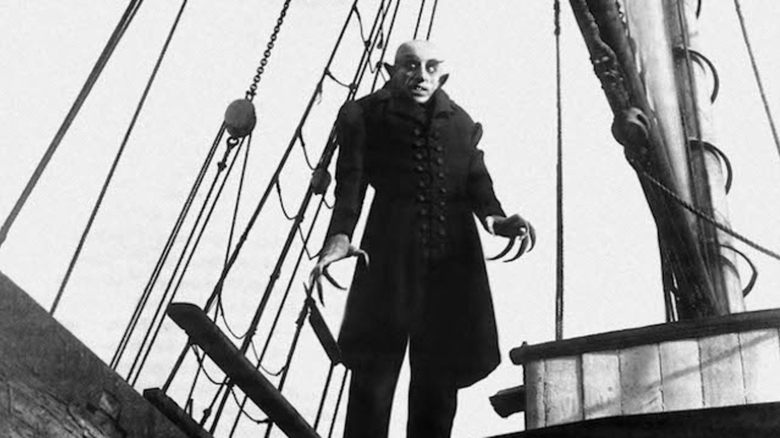
  • Count Orlok's horrifying look was achieved by actor Max Schreck wearing a bald cap, pointed prosthetics, and false teeth placed centrally in his mouth, giving him a rat-like appearance that heavily underscored the film's theme of plague.
  • Unlike typical German Expressionist films that relied on heavily distorted, artificial studio sets (like 'The Cabinet of Dr. Caligari'), director F. W. Murnau shot much of 'Nosferatu' on location, using the natural landscapes of the Carpathian Mountains and the town of Lübeck.
  • Max Schreck's deeply unsettling performance as the vampire spawned a long-standing urban legend that he was an actual vampire, a myth that later inspired the 2000 fictionalized film 'Shadow of the Vampire' starring Willem Dafoe.

Easter Eggs

Occult and alchemical symbols on the real estate contract

Producer Albin Grau, an ardent occultist, sneaked authentic Enochian letters (the esoteric language of angels) and alchemical sigils into the real estate contract signed by Count Orlok, embedding genuine mystical elements into the film's props.

Hyenas instead of wolves

When Hutter is frightened by the howling of 'wolves' in the woods, the animal actually shown on screen is a striped hyena. Murnau likely chose a hyena inspired by Alfred Kubin's artwork, which depicted hyenas as vampires devouring cadavers, adding a grotesque, unnatural layer to the scene.

The Skeleton Clock's design

The macabre skeleton clock in Orlok's castle is a subtle nod to the medieval artistic genre of 'Danse Macabre' (Dance of Death), reinforcing the film's pervasive theme of inescapable mortality.

⚠️ Spoiler Analysis

Click to reveal detailed analysis with spoilers

Frequently Asked Questions

Explore More About This Movie

Dive deeper into specific aspects of the movie with our detailed analysis pages

Comments (0)

Leave a comment

No comments yet. Be the first to share your thoughts!