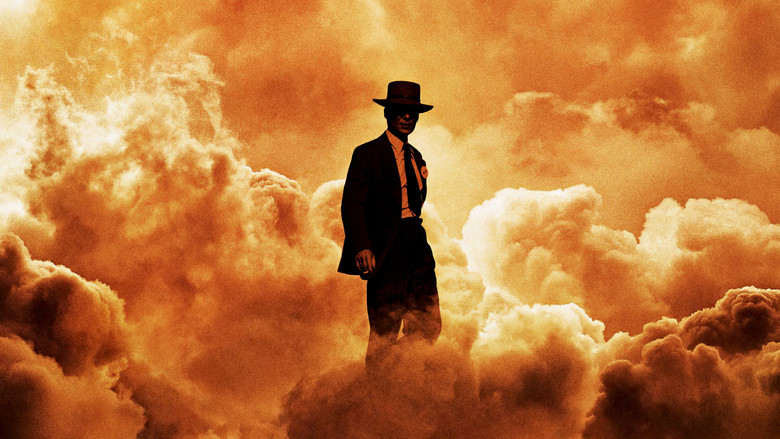

"The world forever changes."
Oppenheimer - Symbolism & Philosophy
Symbols & Motifs
Fire and Light
Symbolizes the dual nature of discovery and destruction. It represents the divine, terrifying power of the atom being unleashed—a new kind of fire stolen from the gods, akin to the Promethean myth that opens the film. It embodies both intellectual enlightenment and the apocalyptic horror of nuclear detonation.
This is seen in Oppenheimer's visions of swirling particles and stars, the blinding flash of the Trinity test, and the imagined horror of a world engulfed in flames. The "technically sweet" success of the test is immediately contrasted with the terrifying destructive power it represents.
Water (Raindrops and Ripples)
Represents the concept of chain reactions and consequences rippling outwards from a single point of impact. It visualizes the quantum world and the idea that small, seemingly insignificant events can lead to massive, world-altering outcomes. It also carries a sense of foreboding and sorrow.
The film opens and closes with images of raindrops hitting a pond, creating ripples. This imagery is intercut throughout the film, connecting Oppenheimer's internal, quantum-level understanding with the macroscopic, devastating consequences of his work, culminating in his final vision of a world consumed by nuclear fire reflected on the water's surface.
The Poisoned Apple
Symbolizes Oppenheimer's youthful hubris, moral transgression, and subsequent regret. The apple itself is a classic symbol of forbidden knowledge. His attempt to poison his tutor and his last-minute reversal represents a microcosm of his later actions with the atomic bomb: creating something destructive and then desperately trying to control or undo its consequences.
Early in the film, a young Oppenheimer injects poison into an apple intended for his Cambridge tutor, Patrick Blackett. He has a change of heart and retrieves it just before Niels Bohr can take a bite. The act reveals a capacity for destructive impulses driven by emotion, which he later channels into the bomb's creation.
Philosophical Questions
Can the creation and use of weapons of mass destruction ever be morally justified?
The film places this question at its very center. It explores the 'ticking time bomb' scenario, where the scientists race to build the bomb out of fear that the Nazis will get it first. This presents a profound moral paradox: is it justifiable to create an ultimate evil to prevent a potentially greater one? "Oppenheimer" doesn't provide a simple answer. Instead, it shows the devastating psychological toll on those who make the choice. After the bombings of Hiroshima and Nagasaki, the initial justification collapses into horror and regret, forcing the audience to confront the argument that some scientific doors, once opened, can never be closed, and that the supposed 'necessary evil' may unleash consequences far worse than the problem it was meant to solve.
What is the true responsibility of a scientist for their creations?
"Oppenheimer" is a deep dive into the burden of scientific responsibility. Oppenheimer and his team are initially absorbed in the theoretical challenge and the patriotic duty of their work. However, after witnessing the Trinity test, the reality of their creation's destructive power sets in. The film explores Oppenheimer's desperate, and ultimately failed, attempt to control the political and military applications of his work. He advocates for international control but is dismissed by politicians like President Truman, who coldly claims the responsibility is his, not the scientist's. The narrative suggests that scientists cannot simply be neutral creators; they are inextricably linked to the consequences of their discoveries and have a moral obligation to engage with the societal impact of their work.
Does possessing immense power inevitably lead to arrogance and corruption?
The film explores this question through both Oppenheimer and Lewis Strauss. Oppenheimer's brilliance gives him immense power and influence, but it is coupled with an arrogance that makes him enemies and blinds him to political realities. Lewis Strauss, on the other hand, embodies the corrupting nature of political power. His ambition and resentment drive him to abuse his authority to destroy a man he sees as a rival. The film suggests that whether in the realm of science or politics, the pursuit and possession of great power carry the inherent danger of hubris, leading individuals to believe they can control forces—be they atomic or political—that are ultimately beyond their grasp.
Core Meaning
The core meaning of "Oppenheimer" revolves around the profound and often tragic consequences of unchecked ambition and scientific advancement without commensurate moral wisdom. The film serves as a cautionary tale about humanity gaining the power to destroy itself, a theme encapsulated in the myth of Prometheus, who stole fire from the gods and was eternally punished. Director Christopher Nolan explores the paradox of a man whose brilliance created a weapon to end a war but simultaneously unleashed a force that could end all wars—and the world itself. It's a deep examination of guilt, responsibility, and the haunting legacy of a creation that forever altered the course of history, forcing audiences to confront the terrifying reality that the architects of our future may be blind to the true nature of their creations. The film ultimately questions whether humanity is prepared for the god-like power it has unlocked, ending on the haunting suggestion that Oppenheimer's chain reaction wasn't just physical, but a political and existential one that continues to this day.