Oppenheimer
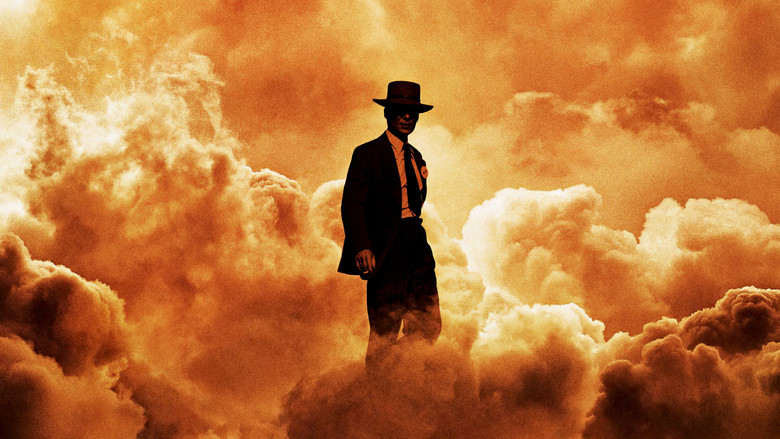
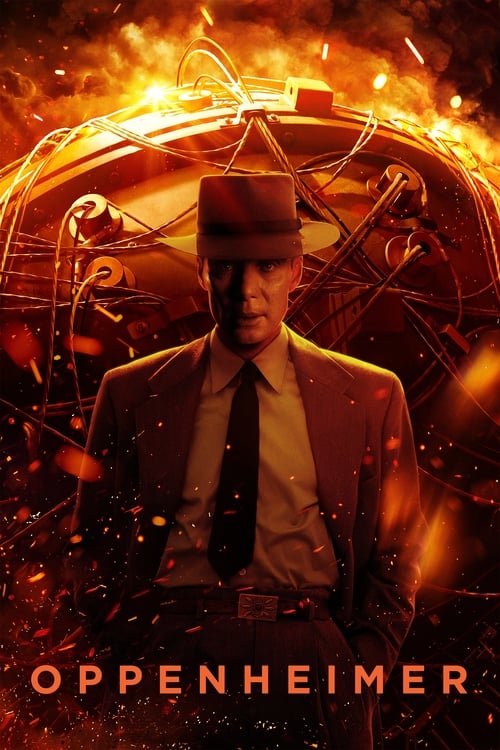
A haunting, epic thriller chronicling the terrible brilliance of creation, painting a portrait of ambition and guilt with the terrifying beauty of quantum physics and apocalyptic fire.
Oppenheimer

Oppenheimer

"The world forever changes."

19 July 2023 United Kingdom 181 min ⭐ 8.1 (10,785)
Director: Christopher Nolan
Cast: Cillian Murphy, Emily Blunt, Matt Damon, Robert Downey Jr., Florence Pugh
Drama History
The Promethean Dilemma: Creation and Consequence Ambition, Hubris, and Guilt Power, Politics, and Personal Vendetta The Chain Reaction as Metaphor
Budget: $100,000,000
Box Office: $952,000,000

Overview

Directed by Christopher Nolan, "Oppenheimer" is an epic biographical thriller that chronicles the life of J. Robert Oppenheimer, the theoretical physicist credited as the "father of the atomic bomb." The film, based on the Pulitzer Prize-winning biography "American Prometheus," navigates multiple timelines. The primary narrative, presented in color, follows Oppenheimer (Cillian Murphy) from his early studies through his pivotal role as the director of the Los Alamos Laboratory during the Manhattan Project, the secret World War II undertaking to develop the first nuclear weapons.

A parallel narrative, shot in black-and-white, focuses on the 1954 security hearing that questioned Oppenheimer's loyalty and sought to revoke his security clearance. This thread is largely seen from the perspective of Lewis Strauss (Robert Downey Jr.), a high-ranking member of the U.S. Atomic Energy Commission who harbors a deep-seated animosity towards Oppenheimer. The film explores Oppenheimer's complex relationships with his wife, Kitty (Emily Blunt), his lover Jean Tatlock (Florence Pugh), General Leslie Groves (Matt Damon), and a cohort of the world's most brilliant scientists as they race against the Nazis to create a weapon of unprecedented power, grappling with the moral and existential consequences of their creation.


Core Meaning

The core meaning of "Oppenheimer" revolves around the profound and often tragic consequences of unchecked ambition and scientific advancement without commensurate moral wisdom. The film serves as a cautionary tale about humanity gaining the power to destroy itself, a theme encapsulated in the myth of Prometheus, who stole fire from the gods and was eternally punished. Director Christopher Nolan explores the paradox of a man whose brilliance created a weapon to end a war but simultaneously unleashed a force that could end all wars—and the world itself. It's a deep examination of guilt, responsibility, and the haunting legacy of a creation that forever altered the course of history, forcing audiences to confront the terrifying reality that the architects of our future may be blind to the true nature of their creations. The film ultimately questions whether humanity is prepared for the god-like power it has unlocked, ending on the haunting suggestion that Oppenheimer's chain reaction wasn't just physical, but a political and existential one that continues to this day.

Thematic DNA

The Promethean Dilemma: Creation and Consequence 35%
Ambition, Hubris, and Guilt 30%
Power, Politics, and Personal Vendetta 25%
The Chain Reaction as Metaphor 10%

The Promethean Dilemma: Creation and Consequence

The film is explicitly framed by the myth of Prometheus, who gave fire (knowledge, technology) to humanity and was punished for it. Oppenheimer is portrayed as a modern Prometheus who unlocked the atom's power to help his country, only to be tormented by the horrific consequences and vilified by the very system he served. This theme explores the duality of scientific breakthrough—its potential for progress and its capacity for unprecedented destruction. The film constantly weighs the necessity of creating the bomb to defeat the Nazis against the moral horror of its existence and use.

Ambition, Hubris, and Guilt

J. Robert Oppenheimer's immense ambition is a driving force of the narrative. He is a brilliant but flawed man, driven to lead the most significant scientific undertaking in history. The film charts his rise to prominence and his subsequent fall from grace, examining how his intellectual pride and personal failings contributed to his persecution. After the successful Trinity test and the bombings of Hiroshima and Nagasaki, his ambition gives way to profound guilt. He is haunted by visions of destruction and feels he has "blood on his hands," spending the rest of his life grappling with the weight of his creation.

Power, Politics, and Personal Vendetta

"Oppenheimer" meticulously details how scientific pursuit becomes entangled with political maneuvering and personal animosity. The black-and-white sequences expose the petty, vindictive nature of power through the character of Lewis Strauss. Strauss's campaign to destroy Oppenheimer's reputation is not driven by genuine security concerns, but by personal humiliation and jealousy. This theme critiques how governance and historical narratives can be shaped by the arrogance and spite of powerful men, who wield state machinery for personal revenge.

The Chain Reaction as Metaphor

The concept of a "chain reaction" is central, extending beyond nuclear fission to become a powerful metaphor for the film's narrative structure and themes. One action leads to unforeseen and escalating consequences: Oppenheimer's creation of the bomb leads to an arms race, his past associations lead to his public humiliation, and a single misunderstood conversation fuels Strauss's years-long vendetta. The film's haunting final line, "I believe we did," confirms that the ultimate chain reaction he started was not the one that fizzled out in the atmosphere, but the one that put humanity on a path toward self-destruction.

Character Analysis

J. Robert Oppenheimer

Cillian Murphy

Archetype: The Tragic Hero / American Prometheus
Key Trait: Brilliant and Hubristic

Motivation

Initially, his motivation is twofold: intellectual ambition and a patriotic, fear-driven need to build the bomb before the Germans do. After the war, his motivation shifts to controlling the monster he created, advocating for international oversight of nuclear energy and opposing the development of the even more powerful hydrogen bomb.

Character Arc

Oppenheimer begins as an ambitious, theoretically brilliant but emotionally troubled physicist. Driven by a desire to defeat the Nazis, he rises to become the leader of the Manhattan Project, demonstrating immense focus and leadership. After achieving his goal, the 'triumph' of the atomic bomb becomes his 'tragedy.' He is consumed by guilt and a sense of responsibility for the destructive force he has unleashed, transitioning from a celebrated hero to a haunted advocate for nuclear control. His arc culminates in a forced martyrdom during his security hearing, where he passively accepts his public humiliation as a form of atonement.

Lewis Strauss

Robert Downey Jr.

Archetype: The Antagonist / The Shadow
Key Trait: Vindictive and Ambitious

Motivation

Strauss is driven by a potent mix of personal pride, political ambition, and intense resentment. He feels publicly humiliated by Oppenheimer and is fundamentally opposed to his views on nuclear policy, particularly his resistance to the hydrogen bomb. His primary motivation is to discredit and destroy Oppenheimer, thereby cementing his own authority and legacy.

Character Arc

Lewis Strauss is introduced as a powerful and seemingly principled member of the Atomic Energy Commission. However, his character arc reveals that his public persona masks a deep-seated insecurity and vindictiveness. His initial respect for Oppenheimer curdles into a bitter rivalry fueled by perceived slights and professional jealousy. He masterminds Oppenheimer's downfall behind the scenes, only to have his own political ambitions dashed when his petty motivations are exposed, showing that power sought in the shadows ultimately consumes itself.

Katherine "Kitty" Oppenheimer

Emily Blunt

Archetype: The Unwavering Loyalist
Key Trait: Resilient and Fiercely Intelligent

Motivation

Her core motivation is a fierce, protective loyalty to Robert, even in the face of his infidelity and passivity. She believes in his importance and despises the injustice of his persecution. While she feels stifled by her circumstances, her resolve is to ensure that her husband's legacy is not destroyed by lesser men.

Character Arc

Kitty is presented as a complex and often troubled figure—a brilliant biologist and former communist sympathizer trapped by the confines of domestic life in Los Alamos. She struggles with alcoholism and motherhood but possesses a fierce, unyielding intellect and loyalty to her husband. While Oppenheimer becomes passive and resigned during his hearing, Kitty's arc is one of defiant strength. She refuses to be broken by the interrogation and urges her husband to fight back, emerging as his most formidable defender and a sharp-witted woman who sees the political machinations more clearly than he does.

Leslie Groves

Matt Damon

Archetype: The Pragmatic Mentor
Key Trait: Pragmatic and Authoritative

Motivation

Groves has one clear motivation: to build the atomic bomb before the enemy does and win the war. He is driven by duty, efficiency, and the immense pressure of the task. He is less concerned with the moral implications and more with the logistical and practical challenges of the project.

Character Arc

General Groves begins as a gruff, results-oriented military man tasked with the impossible job of overseeing the Manhattan Project. Initially skeptical of Oppenheimer's unorthodox background, he grows to respect his scientific director's genius and leadership. Groves is the ultimate pragmatist, shielding Oppenheimer from bureaucratic interference while demanding results. His arc is less about personal change and more about representing the military-industrial complex that enables and, to an extent, contains Oppenheimer's genius. After the war, his loyalty remains practical; he testifies at Oppenheimer's hearing but within the pragmatic limits of his position.

Symbols & Motifs

Fire and Light

Meaning:

Symbolizes the dual nature of discovery and destruction. It represents the divine, terrifying power of the atom being unleashed—a new kind of fire stolen from the gods, akin to the Promethean myth that opens the film. It embodies both intellectual enlightenment and the apocalyptic horror of nuclear detonation.

Context:

This is seen in Oppenheimer's visions of swirling particles and stars, the blinding flash of the Trinity test, and the imagined horror of a world engulfed in flames. The "technically sweet" success of the test is immediately contrasted with the terrifying destructive power it represents.

Water (Raindrops and Ripples)

Meaning:

Represents the concept of chain reactions and consequences rippling outwards from a single point of impact. It visualizes the quantum world and the idea that small, seemingly insignificant events can lead to massive, world-altering outcomes. It also carries a sense of foreboding and sorrow.

Context:

The film opens and closes with images of raindrops hitting a pond, creating ripples. This imagery is intercut throughout the film, connecting Oppenheimer's internal, quantum-level understanding with the macroscopic, devastating consequences of his work, culminating in his final vision of a world consumed by nuclear fire reflected on the water's surface.

The Poisoned Apple

Meaning:

Symbolizes Oppenheimer's youthful hubris, moral transgression, and subsequent regret. The apple itself is a classic symbol of forbidden knowledge. His attempt to poison his tutor and his last-minute reversal represents a microcosm of his later actions with the atomic bomb: creating something destructive and then desperately trying to control or undo its consequences.

Context:

Early in the film, a young Oppenheimer injects poison into an apple intended for his Cambridge tutor, Patrick Blackett. He has a change of heart and retrieves it just before Niels Bohr can take a bite. The act reveals a capacity for destructive impulses driven by emotion, which he later channels into the bomb's creation.

Memorable Quotes

Now I am become Death, the destroyer of worlds.

— J. Robert Oppenheimer

Context:

Oppenheimer recalls this line after the successful Trinity test. The film also shows him murmuring it during a sexual encounter with Jean Tatlock, linking the act of creation with the act of destruction and his internal turmoil.

Meaning:

This quote, drawn from the Hindu scripture Bhagavad Gita, represents the monumental and terrifying realization of what Oppenheimer has unleashed. It is the moment his scientific triumph transforms into an existential burden, marking his understanding that he has irrevocably changed the nature of war and humanity's capacity for self-destruction.

They won't fear it until they understand it. And they won't understand it until they've used it.

— J. Robert Oppenheimer

Context:

Spoken during a discussion with fellow scientists and military officials at Los Alamos about the implications of the new weapon and whether its power should be demonstrated or used directly on a target.

Meaning:

This chilling statement reveals Oppenheimer's grim understanding of human nature and politics. He argues that the theoretical threat of the bomb is not enough; only its devastating, real-world application will force humanity to confront its power and, hopefully, prevent its future use. It encapsulates the terrible paradox at the heart of the project's justification.

You don't get to commit sin and then ask all of us to feel sorry for you when there are consequences.

— Kitty Oppenheimer

Context:

Kitty says this to Robert after he breaks down in grief and guilt following the news of Jean Tatlock's suicide. She forces him to confront the consequences of his choices rather than wallowing in regret.

Meaning:

This quote showcases Kitty's sharp, unforgiving nature and her refusal to indulge her husband's self-pity. She holds him accountable for his actions—both his infidelity and, by extension, his moral turmoil over the bomb. It establishes her as his conscience and a formidable force who will not let him retreat into martyrdom.

Amateurs seek the sun. Get eaten. Power stays in the shadows.

— Lewis Strauss

Context:

Strauss delivers this line to his aide, reflecting on Oppenheimer's celebrity and explaining his own strategic, behind-the-scenes approach to politics and power after feeling publicly slighted.

Meaning:

This line reveals Strauss's core philosophy and foreshadows his clandestine machinations against Oppenheimer. It's a cynical and predatory view of power, contrasting sharply with Oppenheimer's public-facing, intellectual persona. Strauss believes true influence is wielded not in the spotlight of fame, but through covert manipulation.

I believe we did.

— J. Robert Oppenheimer

Context:

This is his answer to Einstein in the film's closing scene, revealing the content of their earlier, mysterious conversation by the pond. Oppenheimer recalls their initial fear of literally setting the atmosphere on fire and concludes that, metaphorically, they succeeded.

Meaning:

The film's final line, this is Oppenheimer's haunting conclusion about his life's work. He confirms that the chain reaction he and his colleagues feared—one that would destroy the world—was not a physical impossibility but a political and existential certainty. He started an arms race that has put humanity on a permanent path of potential self-annihilation.

Philosophical Questions

Can the creation and use of weapons of mass destruction ever be morally justified?

The film places this question at its very center. It explores the 'ticking time bomb' scenario, where the scientists race to build the bomb out of fear that the Nazis will get it first. This presents a profound moral paradox: is it justifiable to create an ultimate evil to prevent a potentially greater one? "Oppenheimer" doesn't provide a simple answer. Instead, it shows the devastating psychological toll on those who make the choice. After the bombings of Hiroshima and Nagasaki, the initial justification collapses into horror and regret, forcing the audience to confront the argument that some scientific doors, once opened, can never be closed, and that the supposed 'necessary evil' may unleash consequences far worse than the problem it was meant to solve.

What is the true responsibility of a scientist for their creations?

"Oppenheimer" is a deep dive into the burden of scientific responsibility. Oppenheimer and his team are initially absorbed in the theoretical challenge and the patriotic duty of their work. However, after witnessing the Trinity test, the reality of their creation's destructive power sets in. The film explores Oppenheimer's desperate, and ultimately failed, attempt to control the political and military applications of his work. He advocates for international control but is dismissed by politicians like President Truman, who coldly claims the responsibility is his, not the scientist's. The narrative suggests that scientists cannot simply be neutral creators; they are inextricably linked to the consequences of their discoveries and have a moral obligation to engage with the societal impact of their work.

Does possessing immense power inevitably lead to arrogance and corruption?

The film explores this question through both Oppenheimer and Lewis Strauss. Oppenheimer's brilliance gives him immense power and influence, but it is coupled with an arrogance that makes him enemies and blinds him to political realities. Lewis Strauss, on the other hand, embodies the corrupting nature of political power. His ambition and resentment drive him to abuse his authority to destroy a man he sees as a rival. The film suggests that whether in the realm of science or politics, the pursuit and possession of great power carry the inherent danger of hubris, leading individuals to believe they can control forces—be they atomic or political—that are ultimately beyond their grasp.

Alternative Interpretations

While the film presents a largely tragic portrayal of J. Robert Oppenheimer, interpretations of his character and motivations can vary. One perspective sees him not just as a haunted victim of his creation, but as a deeply arrogant and naive figure who only grappled with the consequences of his work after it was too late. This view suggests his post-war advocacy was less about pure moral repentance and more an attempt to reclaim control over a narrative that had spiraled beyond him.

Another interpretation focuses on the role of Lewis Strauss. While the film paints him as a villain driven by petty jealousy, some view his actions through a lens of sincere, if paranoid, Cold War patriotism. From this perspective, Strauss genuinely believed Oppenheimer's past associations and his opposition to the hydrogen bomb were a threat to national security. This reading doesn't absolve Strauss but frames him as a product of his era's intense political anxieties rather than a purely one-dimensional antagonist.

Finally, the film's ambiguous ending can be interpreted in different ways. The literal interpretation is that Oppenheimer fears a nuclear holocaust will physically destroy the world. A more metaphorical reading suggests the "chain reaction" he started was the destruction of trust—between scientists and governments, between nations, and in the very idea of progress. It represents the death of a certain kind of scientific innocence and the birth of a permanent, simmering global anxiety that has reshaped human consciousness.

Cultural Impact

A Cinematic and Cultural Phenomenon

"Oppenheimer" was released in July 2023 and became more than just a successful film; it evolved into a significant cultural event. Its simultaneous release with Greta Gerwig's "Barbie" sparked the "Barbenheimer" phenomenon, a grassroots internet movement that encouraged audiences to see both films as a double feature. This unlikely pairing drove massive box office success for both movies and was celebrated as a revitalization of theatrical cinema post-pandemic. "Oppenheimer" itself grossed over $900 million worldwide, becoming the highest-grossing biopic ever.

Critical Acclaim and Awards Dominance

The film was met with widespread critical acclaim, lauded for Nolan's direction, the screenplay, the score by Ludwig Göransson, and the stunning performances, particularly by Cillian Murphy and Robert Downey Jr. It became a dominant force during the awards season, culminating in winning seven Academy Awards, including Best Picture, Best Director for Nolan, Best Actor for Murphy, and Best Supporting Actor for Downey Jr.

Renewed Historical and Ethical Discourse

Beyond its cinematic achievements, "Oppenheimer" had a profound impact on public discourse. It renewed widespread interest in the life of J. Robert Oppenheimer and the history of the Manhattan Project. The film thrust complex philosophical and ethical questions about nuclear weapons, scientific responsibility, and global security back into the mainstream conversation. At a time of renewed global tensions, the film served as a stark and timely reminder of the existential threat of nuclear war, prompting discussions among audiences, critics, and scholars about its haunting relevance today.

Audience Reception

Audience reception for "Oppenheimer" was overwhelmingly positive. Viewers praised the film for its intellectual depth, compelling narrative, and powerful performances, particularly Cillian Murphy's central role. Many lauded it as a thought-provoking and important cinematic experience that was both grand in scale and deeply personal. The film's complex structure, shifting timelines, and dense dialogue were noted, with most finding them rewarding rather than confusing. The practical effects used for the Trinity test sequence received widespread acclaim as a visceral and awe-inspiring highlight.

Points of criticism were relatively minor but did exist. Some viewers found the three-hour runtime demanding and the pacing in the final hour, which focuses heavily on the two hearings, to be slow compared to the intensity of the Manhattan Project section. A few critics and audience members also felt that the female characters, particularly Jean Tatlock and Kitty Oppenheimer, were underdeveloped and primarily existed in relation to Oppenheimer himself, a common critique of Nolan's filmography. Despite this, the overall verdict from audiences was that "Oppenheimer" is a monumental and essential piece of filmmaking.

Interesting Facts

  • The script was written in the first person from Oppenheimer's perspective, a technique Christopher Nolan had never used before to enhance the audience's subjective experience.
  • To create the black-and-white sequences in the IMAX format, Kodak had to invent and manufacture a new type of 65mm film stock, as it did not previously exist.
  • Director Christopher Nolan and his effects team recreated the Trinity test explosion without using any CGI, instead opting for practical effects involving a forced-perspective explosion with a mix of gasoline, propane, and other materials.
  • To prepare for the role, Cillian Murphy underwent a dramatic physical transformation, losing a significant amount of weight to match Oppenheimer's famously emaciated physique.
  • Matt Damon had promised his wife in couples therapy that he would take a break from acting, with the only exception being if Christopher Nolan called. Nolan called him for the role of General Groves.
  • The film's 70mm IMAX prints are 11 miles long and weigh approximately 600 pounds.
  • Many scenes were filmed in the actual historical locations, including Oppenheimer's real home in Los Alamos and at the Institute for Advanced Study at Princeton.
  • There are no deleted scenes from the film. Cillian Murphy confirmed that because Nolan's script is the movie, nothing is left on the cutting room floor.
  • This was the first film since "Memento" (2000) that Christopher Nolan did not distribute with Warner Bros. Pictures.
  • The film became the highest-grossing World War II movie and biographical film of all time.

Easter Eggs

Niels Bohr's Name on a Chalkboard

In an early university scene, before Oppenheimer formally meets him, the name "Bohr" is visible on a chalkboard. This subtly foreshadows the pivotal role Niels Bohr will play as a mentor and guiding figure in Oppenheimer's life and scientific journey.

Gary Oldman's Cameo as Harry S. Truman

Veteran actor Gary Oldman, who won an Oscar for playing Winston Churchill in "Darkest Hour," appears in a single, powerful scene as President Harry S. Truman. It's a significant cameo that brings another major historical figure of the era to life, highlighting the clash between the scientist's guilt and the politician's blunt pragmatism when Truman dismissively calls Oppenheimer a "crybaby."

Christopher Nolan's Daughter's Cameo

In one of Oppenheimer's horrifying visions of the bomb's impact, the young woman whose skin is peeled off by the blast is played by Christopher Nolan's own daughter, Flora Nolan. The director stated he needed someone to portray the ultimate consequence of the bomb's power, and casting his daughter made the abstract horror intensely personal and real for him during filming.

⚠️ Spoiler Analysis

Click to reveal detailed analysis with spoilers

Frequently Asked Questions

Explore More About This Movie

Dive deeper into specific aspects of the movie with our detailed analysis pages

Comments (0)

Leave a comment

No comments yet. Be the first to share your thoughts!