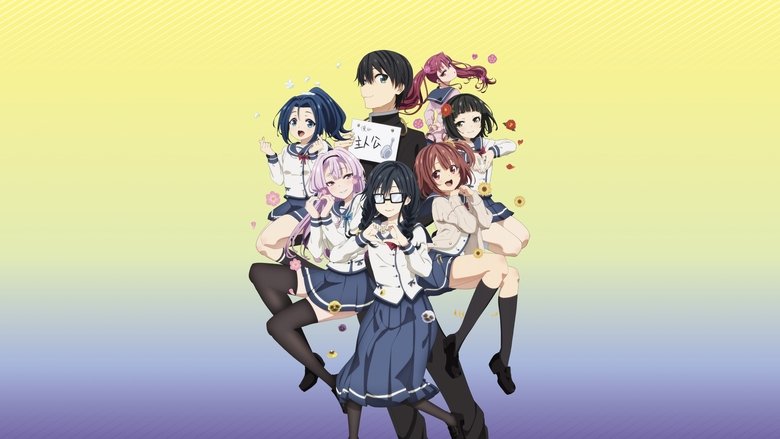
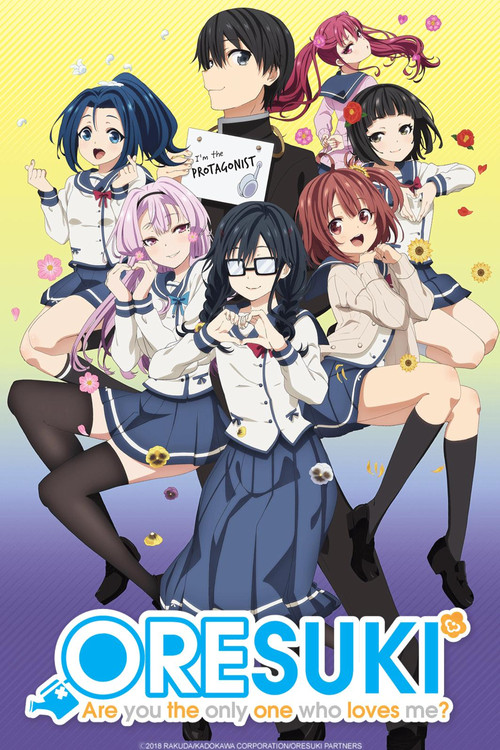
ORESUKI Are you the only one who loves me?
A clever deconstruction of romantic comedy, this series blossoms with biting satire before unfurling into a surprisingly heartfelt examination of facades, friendship, and affection.
ORESUKI Are you the only one who loves me?

俺を好きなのはお前だけかよ

03 October 2019 — 26 December 2019 Japan 1 season 12 episode Ended ⭐ 8.5 (277)
Cast: Daiki Yamashita, Haruka Tomatsu, Haruka Shiraishi, Sachika Misawa, Yuma Uchida
Drama Animation Comedy
Deconstruction of Harem Tropes Appearance vs. Reality Manipulation in Relationships The Nature of Friendship

ORESUKI Are you the only one who loves me? - Ending Explained

⚠️ Spoiler Analysis

The entire premise of "ORESUKI" is built on a series of reveals. The first major twist is that the protagonist, Joro, is not a dense, kind boy but a manipulative schemer, and that the two girls who confess to him, Cosmos and Himawari, are actually in love with his best friend, Sun-chan. The second major twist comes when it's revealed that Sun-chan, the seemingly perfect and friendly best friend, orchestrated a complex plan to make Joro a social pariah out of jealousy for Pansy's affection. He manipulated Cosmos and Himawari by leveraging their feelings for him. Pansy, however, was aware of this plot all along and exposes it, saving Joro.

Later in the series, it is revealed that Pansy's demure appearance is a disguise; she is actually stunningly beautiful, a fact she reveals publicly at the Flower Dance to help Joro. The final arc, covered in the OVA, introduces a rival, Hose, who challenges Joro for Pansy's affection. The climax of this arc contains another twist: Cosmos, Himawari, and another girl, Asunaro, all give their tokens of affection to Hose as part of the bet, but they do so while simultaneously confessing their love for Joro, a move that stuns him and complicates his plans. The ultimate resolution comes in the final scene between Joro and Pansy. After Pansy once again tells him she loves him, Joro responds, "The moon is pretty, isn't it?" This is not a deflection but a famous Japanese literary euphemism for "I love you," attributed to author Soseki Natsume, whose book is Pansy's favorite. It is a subtle, character-driven confession that confirms he reciprocates her feelings, ending the story with them becoming a couple.

Alternative Interpretations

One alternative interpretation focuses on Joro's character not as a scumbag who learns to be good, but as a fundamentally good person who creates a cynical persona as a defense mechanism. This reading suggests that his constant internal scheming is a way to cope with his own perceived mediocrity and insecurity. His acts of kindness are not him developing a new personality, but his true nature leaking through the cracks of his carefully constructed facade. Pansy, in this view, doesn't fall for a "scumbag," but for the genuine, kind-hearted boy she can see hiding underneath the cynical act.

Another interpretation posits that the entire series is a meta-commentary on the anime production process itself. The initial, trope-filled setup represents a pitch for a standard harem show. The subsequent deconstruction is the author's true vision breaking through, while the later arcs, which lean back into some clichés, represent the inevitable pressures of audience expectation and commercial demands on a series. The show's self-aware, fourth-wall-breaking humor lends some credence to this reading, suggesting the characters are fighting against the roles the genre demands of them.