"Delicate, charming and sweet."
Paperman - Symbolism & Philosophy
Symbols & Motifs
Paper Airplanes
The paper airplanes symbolize hope, communication, and the protagonist's persistent efforts to bridge the distance between himself and the woman he's smitten with. Initially, they are simply his tools, but they eventually transform into magical agents of fate, representing the idea that his intentions and desires have taken on a life of their own to bring about the destined connection.
George folds countless sheets from his work stack into airplanes, launching them from his office window towards Meg's across the street. After he gives up in despair, the airplanes magically come to life, swarming around him and propelling him towards Meg, while the lipstick-stained plane guides her to him.
The Red Lipstick Stain
The red lipstick stain is the single splash of color in the otherwise black-and-white film. It symbolizes love, passion, and the profound, colorful impact Meg has on George's monotonous, monochrome life. It is the unique identifier of their connection, the one tangible piece of their chance encounter that he holds onto, motivating his actions throughout the film.
The lipstick mark is imprinted on George's paper when a gust of wind blows it into Meg's face at the train station. He treasures this specific sheet of paper, saving it for his very last, desperate attempt to get her attention. This is the paper that ultimately finds Meg and leads her back to George.
Monochromatic World
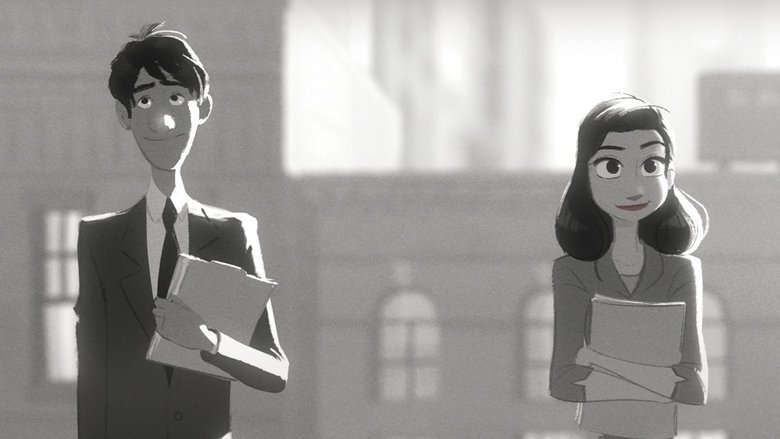
The black-and-white aesthetic represents the dullness, conformity, and emotional isolation of George's life before his world is enlivened by the possibility of love. The cityscape, with its towering skyscrapers, is used as a visual metaphor for George's loneliness, making him seem small and lost in an inhospitable landscape. Meg, and the red lipstick mark she leaves, represent the introduction of color and vibrancy into this world.
The entire film is presented in a stark, minimalist black-and-white style, from the bustling train platform to the oppressive office interiors. This choice emphasizes the visual and emotional contrast when the singular spot of red lipstick appears, highlighting its significance.
Philosophical Questions
Are our lives governed by fate or by our own choices?
The film explores this classic question by presenting a scenario where both forces are seemingly at play. The initial meeting is pure chance, a product of chaotic winds—suggesting fate. However, it is George's conscious decision and relentless effort that keeps the possibility of connection alive. The magical resolution, where the papers act on their own, can be interpreted as destiny taking over when human effort fails. The film doesn't provide a definitive answer but beautifully illustrates the interplay between the two, suggesting that perhaps destiny requires our active participation to be fulfilled.
What is the nature of connection in a modern, isolating world?
"Paperman" raises questions about the possibility of forming genuine connections in an urban environment designed for anonymity and efficiency. Director John Kahrs was directly inspired by the feeling of being lonely while surrounded by millions of people in New York City. The film contrasts the cold, geometric, and monotonous world of work with the chaotic, unpredictable, and magical possibility of a romantic connection. It posits that such connections are not only possible but are worth disrupting the established order of our lives to pursue.
Core Meaning
The core meaning of "Paperman" revolves around the themes of fate, connection, and the magic that can interrupt the mundane routines of life. Director John Kahrs was inspired by the fleeting, random connections one makes with strangers during daily commutes and the question of what it would take for two people who are perfect for each other to find their way back together after a chance encounter.
The film suggests that destiny and a little bit of magic can intervene to bring soulmates together. It's a commentary on breaking free from the soul-crushing conformity of modern work life to pursue a moment of genuine human connection. George's drab, repetitive office job is contrasted with the vibrant, hopeful possibility that Meg represents, a possibility he is willing to risk everything for. Ultimately, the film is a romantic and optimistic assertion that love and fate can triumph over the isolating nature of urban life.