Paperman
A monochrome urban fairytale where fate, propelled by a gentle breeze and a fleet of paper wings, bridges the chasm between two lonely souls amidst the city's stark geometry.
Paperman

Paperman

"Delicate, charming and sweet."

02 November 2012 United States of America 7 min ⭐ 8.0 (1,753)
Director: John Kahrs
Cast: John Kahrs, Kari Wahlgren, Jeff Turley, Jack Goldenberg
Animation Family Romance
Fate vs. Free Will Modern Alienation and Connection The Magic in the Mundane Love as a Rebellious Act

Overview

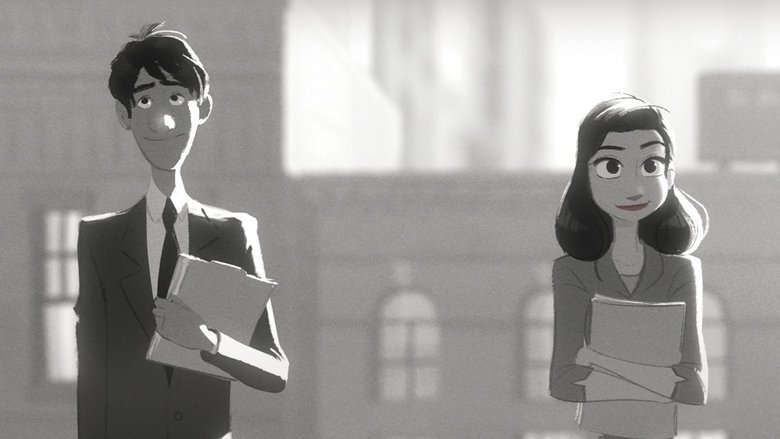
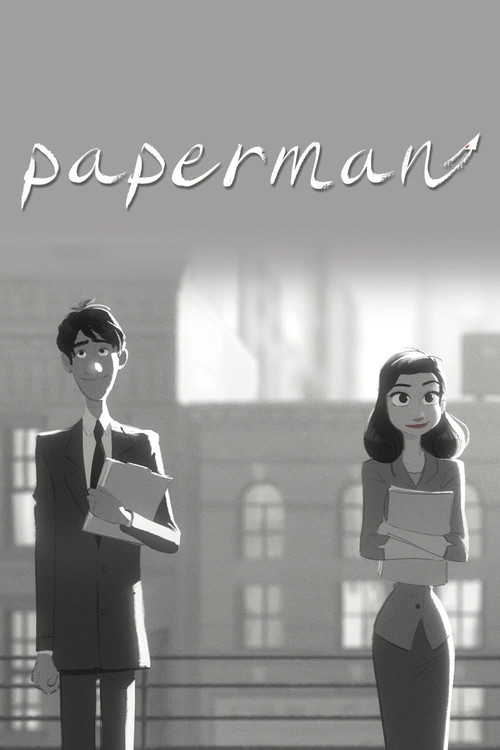
"Paperman" is a black-and-white animated short film set in mid-century New York City. It tells the story of George, a lonely young accountant whose monotonous morning commute takes a magical turn when a gust of wind brings him face-to-face with Meg, a beautiful young woman. A stray paper from his folder is blown into her face, leaving a perfect red lipstick print, but they are quickly separated by their respective trains.

Later, from his drab office window, George is astonished to see Meg in the skyscraper across the street. Fueled by this second chance, he begins a desperate and imaginative attempt to get her attention by crafting and launching a barrage of paper airplanes, each one representing a fragile hope of connection. His efforts are consistently thwarted by the unforgiving city winds and the watchful eye of his stern boss, leading to a charming and heartfelt struggle against the odds.
Core Meaning

The core meaning of "Paperman" revolves around the themes of fate, connection, and the magic that can interrupt the mundane routines of life. Director John Kahrs was inspired by the fleeting, random connections one makes with strangers during daily commutes and the question of what it would take for two people who are perfect for each other to find their way back together after a chance encounter.

The film suggests that destiny and a little bit of magic can intervene to bring soulmates together. It's a commentary on breaking free from the soul-crushing conformity of modern work life to pursue a moment of genuine human connection. George's drab, repetitive office job is contrasted with the vibrant, hopeful possibility that Meg represents, a possibility he is willing to risk everything for. Ultimately, the film is a romantic and optimistic assertion that love and fate can triumph over the isolating nature of urban life.

Thematic DNA

Fate vs. Free Will 35%
Modern Alienation and Connection 30%
The Magic in the Mundane 20%
Love as a Rebellious Act 15%

Fate vs. Free Will

The film masterfully plays with the tension between destiny and individual effort. The initial meeting between George and Meg is a complete accident, a chance encounter orchestrated by the wind, suggesting the hand of fate. However, George's subsequent, frantic efforts to reconnect with her by making and throwing paper airplanes represent his active pursuit—his free will. The magical climax, where the paper airplanes come to life to unite them, suggests a collaboration between the two forces: fate provides the opportunity, but human determination and desire are necessary to see it through.

Modern Alienation and Connection

Set against the backdrop of a bustling, impersonal 1940s New York City, the film highlights the loneliness and isolation that can exist even when surrounded by millions. Director John Kahrs drew from his own experiences of feeling alone in a big city. The characters' drab office environments, filled with identical desks and anonymous workers, symbolize the conformity and monotony of modern life. The quest to connect with Meg is a quest for a meaningful, personal bond that transcends the alienating urban landscape.

The Magic in the Mundane

"Paperman" transforms an ordinary, everyday object—a piece of office paper—into a vessel of magic and romance. The paper airplanes are not just tools; they become extensions of George's hope and, eventually, enchanted agents of destiny. The film suggests that magic isn't something far-removed from our world but can be found in the most mundane objects and moments, waiting for a spark of human emotion to bring it to life.

Love as a Rebellious Act

George's attempts to contact Meg are an act of rebellion against his oppressive work environment. He defies his stern, overbearing boss and neglects his duties, prioritizing a potential human connection over his professional responsibilities. This culminates in him abandoning his job to chase after her, framing the pursuit of love as a courageous and liberating break from the rigid structures of society.

Character Analysis

George

John Kahrs

Archetype: The Everyman Hero
Key Trait: Hopeful

Motivation

His primary motivation is to reconnect with Meg, the woman who brought a fleeting moment of color and joy into his gray existence. He is driven by the memory of their brief encounter and the tangible symbol of that moment: the paper with her lipstick stain. This desire for connection becomes powerful enough to make him defy his boss and abandon his monotonous life.

Character Arc

George begins as a despondent office worker, trapped in the bleak routine of his daily life. His chance encounter with Meg awakens a deep sense of longing and determination. Initially hesitant and clumsy, his resolve grows with each failed paper airplane, pushing him to become more daring. His arc culminates in an act of rebellion and faith, where he abandons his job and gives in to the magical forces (the paper airplanes) that ultimately lead him to happiness and a meaningful connection, transforming him from a passive drone into an active participant in his own destiny.

Meg

Kari Wahlgren

Archetype: The Ideal/The Princess
Key Trait: Charming

Motivation

Initially, her motivations are related to her own work life. However, once the special paper airplane reaches her, her motivation shifts. She is intrigued and charmed by this mysterious and persistent message, compelling her to follow the magical object and discover its source, ultimately leading her back to the man from the train platform.

Character Arc

Meg's arc is less defined as she is primarily seen from George's perspective. She initially appears as a charming, slightly amused woman who shares a brief, serendipitous moment with a stranger. Later, in her office, she seems professional and focused. Her arc begins when the lipstick-stained paper airplane finds her, piquing her curiosity and leading her to reciprocate the search. She transitions from an object of desire to an active participant in the reunion, following the magical paper to find George.

The Boss

Jeff Turley

Archetype: The Antagonist/The Obstacle
Key Trait: Stern

Motivation

His motivation is simple and singular: to ensure his employees are working. He is driven by the demands of productivity and order, viewing George's paper airplane antics as a nonsensical and frustrating distraction from the tasks at hand.

Character Arc

The Boss does not have a developmental arc; he serves as a static obstacle. He represents the oppressive, joyless, and rigid structure of the corporate world that George is trying to escape. His constant, disapproving glares and attempts to force George back to work symbolize society's pressure to conform and prioritize productivity over personal fulfillment.

Symbols & Motifs

Paper Airplanes

Meaning:

The paper airplanes symbolize hope, communication, and the protagonist's persistent efforts to bridge the distance between himself and the woman he's smitten with. Initially, they are simply his tools, but they eventually transform into magical agents of fate, representing the idea that his intentions and desires have taken on a life of their own to bring about the destined connection.

Context:

George folds countless sheets from his work stack into airplanes, launching them from his office window towards Meg's across the street. After he gives up in despair, the airplanes magically come to life, swarming around him and propelling him towards Meg, while the lipstick-stained plane guides her to him.

The Red Lipstick Stain

Meaning:

The red lipstick stain is the single splash of color in the otherwise black-and-white film. It symbolizes love, passion, and the profound, colorful impact Meg has on George's monotonous, monochrome life. It is the unique identifier of their connection, the one tangible piece of their chance encounter that he holds onto, motivating his actions throughout the film.

Context:

The lipstick mark is imprinted on George's paper when a gust of wind blows it into Meg's face at the train station. He treasures this specific sheet of paper, saving it for his very last, desperate attempt to get her attention. This is the paper that ultimately finds Meg and leads her back to George.

Monochromatic World

Meaning:

The black-and-white aesthetic represents the dullness, conformity, and emotional isolation of George's life before his world is enlivened by the possibility of love. The cityscape, with its towering skyscrapers, is used as a visual metaphor for George's loneliness, making him seem small and lost in an inhospitable landscape. Meg, and the red lipstick mark she leaves, represent the introduction of color and vibrancy into this world.

Context:

The entire film is presented in a stark, minimalist black-and-white style, from the bustling train platform to the oppressive office interiors. This choice emphasizes the visual and emotional contrast when the singular spot of red lipstick appears, highlighting its significance.

Philosophical Questions

Are our lives governed by fate or by our own choices?

The film explores this classic question by presenting a scenario where both forces are seemingly at play. The initial meeting is pure chance, a product of chaotic winds—suggesting fate. However, it is George's conscious decision and relentless effort that keeps the possibility of connection alive. The magical resolution, where the papers act on their own, can be interpreted as destiny taking over when human effort fails. The film doesn't provide a definitive answer but beautifully illustrates the interplay between the two, suggesting that perhaps destiny requires our active participation to be fulfilled.

What is the nature of connection in a modern, isolating world?

"Paperman" raises questions about the possibility of forming genuine connections in an urban environment designed for anonymity and efficiency. Director John Kahrs was directly inspired by the feeling of being lonely while surrounded by millions of people in New York City. The film contrasts the cold, geometric, and monotonous world of work with the chaotic, unpredictable, and magical possibility of a romantic connection. It posits that such connections are not only possible but are worth disrupting the established order of our lives to pursue.

Alternative Interpretations

While "Paperman" is largely seen as a straightforward urban fairytale about destiny, some interpretations delve deeper into its subtext. One perspective is to view the entire sequence of the paper airplanes coming to life not as a literal magical event, but as a metaphor for George's internal state. In this reading, the swarm of paper represents his overwhelming surge of passion and desperation, a force so powerful it feels like an external entity compelling him to act, break free from his constraints, and pursue Meg.

Another interpretation focuses on the paper itself as the protagonist. The story can be seen from the perspective of the lipstick-stained paper, whose 'destiny' is to reunite the two people who brought it together. This reading personifies the paper as an agent of fate, using George and Meg as the means to fulfill its own purpose. This perspective shifts the focus from a human love story to a more abstract, magical narrative about connection itself.

Cultural Impact

"Paperman" had a significant impact on the animation industry, largely due to its innovative visual style. At a time when 3D CG animation had become the industry standard, "Paperman" presented a new path forward that honored the legacy of 2D animation. It pioneered a hybrid technique, using software called Meander, that seamlessly blended the dimensionality and stability of CG with the expressive linework of traditional hand-drawn art. This "final line advection" technique was lauded by critics and animators as a breath of fresh air and a potential future for the medium.

The film was released theatrically with Disney's feature "Wreck-It Ralph" in 2012 and was met with widespread critical acclaim. Critics praised its charming, romantic story and its unique aesthetic, with some calling it "perfection itself." Its subsequent win for Best Animated Short at the Academy Awards was a major milestone for Walt Disney Animation Studios, marking their first Oscar in that category in over four decades.

While the exact black-and-white style hasn't been used in a Disney feature, the Meander technology developed for "Paperman" has been integrated into the studio's workflow, influencing later films like "Feast," "Zootopia," and "Moana" by allowing for greater integration of 2D drawing tools into the CG pipeline. The film remains a beloved short, celebrated for its heartfelt storytelling and its successful marriage of classic artistry and modern technology.

Audience Reception

Audience reception for "Paperman" was overwhelmingly positive. Viewers were captivated by its charming and wordless love story, finding it emotionally resonant and heartwarming. Many praised the film's ability to tell a complete and moving story in just under seven minutes, highlighting the power of its visual storytelling. The unique, nostalgic black-and-white animation style, blended with modern techniques, was a major point of praise, with audiences finding it both beautiful and innovative.

There is very little in the way of criticism for the short film. Some viewers noted the storyline's similarity to the 2008 short film "Signs," though this did not detract from the general admiration for "Paperman's" execution and charm. The overall verdict from audiences is that it is a beautifully crafted, emotionally satisfying piece of animation that stands as one of Disney's best short films.

Interesting Facts

  • The film won the Academy Award for Best Animated Short Film at the 85th Academy Awards, the first Disney-produced short to win the award since 1970's "It's Tough to Be a Bird".
  • Director John Kahrs was inspired to create the story based on his own experiences commuting through Grand Central Station in New York City and feeling the tension of making brief, random connections with strangers.
  • The film features a groundbreaking hybrid animation technique that merges 2D hand-drawn animation with 3D computer-generated imagery. This was achieved using a new proprietary Disney software called Meander.
  • The animation team did not have separate cloth or hair departments; details like folds in fabric and hair silhouettes were created through the 2D drawing process to maintain an expressive, hand-drawn feel.
  • The character of George was partly inspired by George Bailey from the classic film "It's a Wonderful Life," who also experiences life's highs and lows and has big dreams.
  • The sound design is crucial in the dialogue-free film, using city sounds, the rustling of paper, and Christophe Beck's score to convey emotion and narrative progression.
  • Longtime Disney animator Glen Keane, known for characters like Ariel and Aladdin, worked on the animation for Meg.

⚠️ Spoiler Analysis

Click to reveal detailed analysis with spoilers

Frequently Asked Questions

Explore More About This Movie

Dive deeper into specific aspects of the movie with our detailed analysis pages

Comments (0)

Leave a comment

No comments yet. Be the first to share your thoughts!