
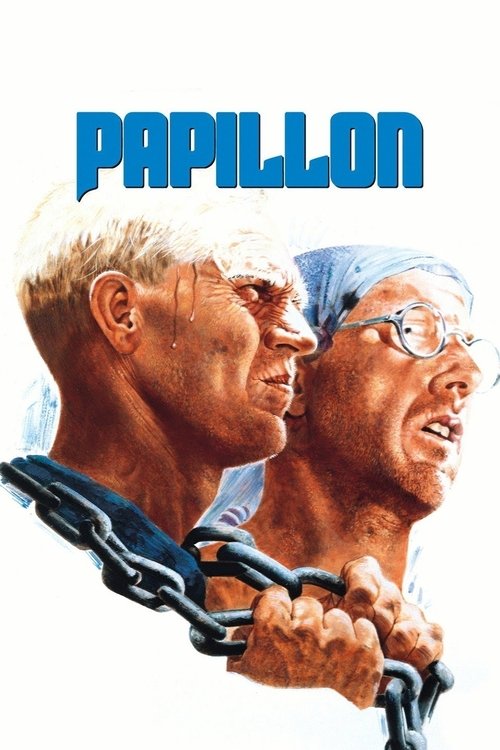
Papillon
A brutal yet poetic prison epic where the unwavering spirit of a man, tattooed with a butterfly, soars against the crushing weight of institutionalized despair.
Papillon
Papillon

"The greatest adventure of escape!"

16 December 1973 United States of America 151 min ⭐ 7.8 (2,026)
Director: Franklin J. Schaffner
Cast: Steve McQueen, Dustin Hoffman, Victor Jory, Don Gordon, Anthony Zerbe
Drama Crime
The Unbreakable Will to Survive and Be Free Friendship and Loyalty in Adversity Dehumanization and Institutional Cruelty The Nature of Justice and Guilt
Budget: $12,000,000
Box Office: $53,267,000

Papillon - Ending Explained

⚠️ Spoiler Analysis

"Papillon" follows Henri Charrière through a series of harrowing escape attempts and brutal punishments. His first escape with Dega and another inmate, Maturette, ends in failure after they are betrayed. Papillon is sentenced to two years in solitary confinement. During this time, he nearly starves and loses his mind but refuses to betray Dega, who had arranged for coconuts to be smuggled to him. Upon release, he immediately plots another escape. This attempt is initially successful; he lives for a time with a native tribe in Honduras and has a relationship with a young woman, Zoraima. However, he is eventually betrayed by a nun at a convent where he seeks refuge and is recaptured.

His punishment for the second escape is five years in solitary. He emerges a much older, gray-haired man, physically diminished but with his will intact. He is then transferred to the inescapable Devil's Island, where he reunites with an aged and resigned Dega. Dega has adapted to life on the island, tending a small garden and having given up all hope of freedom. Papillon, however, studies the ocean currents and devises a final, seemingly suicidal escape plan: to jump from a high cliff into the sea on a makeshift raft of coconuts. Dega, too broken and afraid, refuses to join him. After a heartfelt goodbye, Papillon makes his leap of faith. The powerful waves carry him out to sea. A concluding narration reveals that Henri Charrière made it to freedom and lived the rest of his life as a free man, while the penal system itself was eventually closed. The hidden meaning that becomes clear is that Papillon's relentless obsession was not madness, but the only sane response to an insane system, and his final, desperate act was the ultimate affirmation of life.

Alternative Interpretations

The most significant alternative interpretation of "Papillon" stems from the controversy surrounding the authenticity of its source material. Many historians and researchers believe that Henri Charrière's book is not a factual autobiography but rather a compilation of stories and experiences from various other inmates he met, combined with fictional embellishments. If viewed through this lens, the film is not a docudrama about one man's incredible life, but a fictionalized work that uses the prison colony as a setting for a more archetypal story. The character of Papillon becomes less a historical figure and more a mythical representation of the human spirit's desire for freedom. This reading shifts the focus from "is this true?" to the film's power as a parable about human resilience.

Another interpretation focuses on the ending. While Papillon escapes physically, he is an old, broken man who has lost decades of his life. His victory can be seen as bittersweet and even tragic. He is free, but free to do what? The narrator states he lived the rest of his life a free man, but the film leaves the audience to ponder the immense cost of that freedom. Was the sacrifice of his youth, his health, and his friendships worth the final years of liberty? This interpretation questions whether his obsessive quest for freedom was the ultimate triumph or a pyrrhic victory born of a refusal to accept reality.