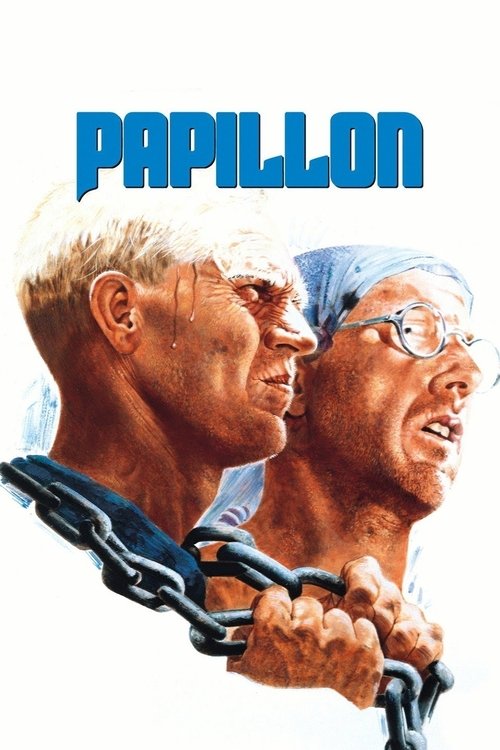
Papillon
"The greatest adventure of escape!"
Overview
"Papillon" (1973), directed by Franklin J. Schaffner, is a gripping historical drama based on the autobiographical novel by Henri Charrière. The film stars Steve McQueen as Charrière, a Parisian safecracker nicknamed "Papillon" because of a butterfly tattoo on his chest. Falsely convicted of murder, he is sentenced to life imprisonment in the brutal French penal colony of Guiana. During his transport, he meets Louis Dega (Dustin Hoffman), a wealthy forger and embezzler. Papillon offers Dega protection in exchange for the funds to finance his escape.
The film chronicles their ensuing friendship and Papillon's relentless and repeated attempts to escape the hellish conditions of the prison. He endures years of solitary confinement and unimaginable hardship, but his will to be free never falters. The narrative spans over a decade, showcasing the extreme lengths one man will go to reclaim his freedom, set against a backdrop of both the stunning and treacherous landscapes of South America. The story is a testament to the endurance of the human spirit in the face of systematic dehumanization.
Core Meaning
The core meaning of "Papillon" revolves around the indomitable nature of the human spirit and the unquenchable thirst for freedom. Director Franklin J. Schaffner crafts a powerful statement on how a person's will can refuse to be broken, even under the most inhumane and soul-crushing conditions. The film posits that true imprisonment is not just physical confinement but the death of hope. Papillon's relentless struggle, even when escape seems impossible, asserts that to be human is to strive for liberty. The narrative critiques penal systems that aim not to rehabilitate but to process and break individuals, ultimately celebrating the profound idea that as long as the will to live freely exists, a person's spirit cannot truly be caged.
Thematic DNA
The Unbreakable Will to Survive and Be Free
This is the central theme of the film. Papillon's entire existence in the penal colony is defined by his singular, obsessive goal: escape. He endures two years of solitary confinement, starvation, and betrayal, yet his spirit of defiance remains intact. His famous line, whispered in the darkness of his cell and shouted at the sea, "Hey you bastards, I'm still here," becomes an anthem for his resilience. The film meticulously documents the physical and psychological toll of his struggle, making his final leap from Devil's Island a profound symbol of the victory of the human will over a dehumanizing system.
Friendship and Loyalty in Adversity
The relationship between Papillon and Louis Dega forms the emotional core of the story. It begins as a pragmatic arrangement for mutual survival but evolves into a deep, genuine friendship. Papillon protects Dega from other inmates, and Dega finances Papillon's escape attempts. A pivotal moment is when Papillon refuses to name Dega as the one who smuggled him coconuts in solitary, an act of loyalty that solidifies their bond. Their final scene on Devil's Island, where Dega chooses to stay while Papillon makes his final escape, is a poignant representation of their different paths, yet their embrace signifies a powerful and enduring connection forged in the worst of circumstances.
Dehumanization and Institutional Cruelty
Schaffner vividly portrays the French penal system as a machine designed to strip men of their identity and humanity. The warden explicitly states, "We're not priests, we're processors... We process dangerous men into harmless ones." The prisoners are subjected to brutal labor, psychological torture, and the constant threat of violence. Dega's eventual resignation to his fate, finding a fragile comfort within the prison walls, illustrates the system's success in breaking some men. Papillon's resistance, therefore, is not just a fight for physical freedom, but a battle to retain his sense of self against a system bent on erasing it.
The Nature of Justice and Guilt
While Papillon is framed for murder, the film explores a deeper sense of guilt. In a surreal dream sequence during solitary confinement, Papillon is tried not for murder, but for "a wasted life." He pleads, "Guilty." This suggests that the ultimate crime is to surrender one's potential and give up on life. This existential guilt fuels his quest for freedom, which becomes a quest for a meaningful existence. The film questions the morality of a "justice" system that is far more cruel and inhumane than the crimes of many of the men it condemns.
Character Analysis
Henri 'Papillon' Charrière
Steve McQueen
Motivation
His primary motivation is an absolute, non-negotiable need for freedom. It's an instinctual drive that cannot be reasoned with or extinguished. He refuses to be "processed" or owned by the system. This is coupled with a desire to clear his name for a crime he didn't commit, but this fades into the background as the elemental need for liberty takes over.
Character Arc
Papillon begins as a confident, self-reliant safecracker. His wrongful conviction and imprisonment transform his focus to one single-minded purpose: escape. Initially, his attempts are based on physical strength and daring. Through repeated failures, years of solitary confinement, and aging, his methods become more about intellect, patience, and an unyielding will. He is physically broken down, emerging from solitary as a graying, weathered man, but his spirit remains defiant. His arc is not one of moral redemption in the traditional sense, but of the purification of his will, shedding everything but the essential drive to be free, which he finally achieves.
Louis Dega
Dustin Hoffman
Motivation
Dega's motivation is survival, but unlike Papillon, his is a more cautious and pragmatic form. He wants to live, but he fears the risks of escape more than the certainty of imprisonment. He hopes his wife and lawyer will secure his release, a hope that eventually fades into resignation. His motivation shifts from escaping the system to surviving within it.
Character Arc
Dega is introduced as a physically weak but intellectually sharp forger, reliant on his hidden wealth and Papillon's protection to survive. He is initially terrified of the prison's brutality. Over time, he adapts, learning to bribe guards and find a level of comfort and resignation within the corrupt system. While he develops immense loyalty and friendship towards Papillon, his spirit is ultimately broken by the system. In the end, he has given up all hope of being released and chooses the perceived safety of Devil's Island over the uncertainty of escape, having been fully "processed" by the penal colony.
Toussaint
Anthony Zerbe
Motivation
His motivation appears to be a mix of compassion and a shared understanding of being an outcast. He helps Papillon because he respects his desire for freedom and perhaps sees a kindred spirit in someone who refuses to be defined by his circumstances. He operates on his own code of honor, separate from the laws of the society that has condemned both him and Papillon.
Character Arc
Toussaint is the chief of a leper colony who provides Papillon with temporary refuge and a boat for one of his escape attempts. His character doesn't have a significant arc but serves as a crucial figure in Papillon's journey. He represents a community that has created its own form of society and freedom outside the conventional world, finding a way to live with their affliction on their own terms.
Symbols & Motifs
The Butterfly (Papillon)
The butterfly tattoo that gives Henri Charrière his nickname is the film's central symbol. It represents freedom, transformation, and the soul's ability to escape physical confinement. Like a butterfly emerging from a chrysalis, Papillon's journey is one of metamorphosis through immense suffering, ultimately leading to his liberation. The symbol is a constant reminder of his identity and his ultimate goal, a piece of him that the prison system can never take away.
The tattoo is prominently displayed on Papillon's chest. The name itself is used throughout the film. The final shot of him being carried away by the ocean waves evokes the image of a butterfly taking flight, leaving the barren rock of Devil's Island behind. Production designer Anthony Masters also reportedly embedded butterfly imagery subliminally into sets and shadows throughout the film to reinforce this theme.
The Ocean
The ocean is a powerful, dual symbol of both the barrier to freedom and the only path toward it. For most of the film, the shark-infested waters surrounding the penal colony represent an impassable obstacle, a constant, menacing reminder of their entrapment. However, for Papillon, it also represents hope and the possibility of escape. He constantly studies the currents, seeing not a cage, but a potential conduit to the outside world.
The sea is a constant visual presence, from the initial voyage to the final, iconic scene. Papillon's final leap from the cliffs of Devil's Island into the waves is the climax of his struggle. He entrusts his life to the very element that held him captive, transforming it from a symbol of imprisonment into one of liberation.
Coconuts
Coconuts symbolize survival, resourcefulness, and friendship. In a place of extreme deprivation, a simple coconut represents life-sustaining nourishment. Dega's act of smuggling coconuts to Papillon in solitary is a profound gesture of loyalty and a literal lifeline. Later, coconuts become the key to freedom itself.
Dega arranges for Papillon to receive coconuts while he is in solitary confinement, an act for which Papillon endures six months of darkness rather than betray his friend. In the film's climax, Papillon engineers his final escape from Devil's Island by creating a raft from sacks of coconuts, using their natural buoyancy to brave the ocean currents. This demonstrates his ingenuity and turns a simple object of survival into a vessel of freedom.
Memorable Quotes
Hey you bastards, I'm still here.
— Henri 'Papillon' Charrière
Context:
He first whispers this line after emerging from two years of brutal solitary confinement, barely able to stand. He repeats it at the very end of the film, shouting it at Devil's Island as the ocean carries him to freedom, signifying his ultimate victory.
Meaning:
This is Papillon's mantra of defiance. It encapsulates his unbreakable spirit and his refusal to be defeated by the dehumanizing prison system. It's a declaration of existence and identity against overwhelming forces trying to erase him.
I accuse you... of a wasted life!
— Judge in Dream
Context:
During his first horrific stint in solitary confinement, Papillon has a surreal nightmare. He is on trial in a vast desert, and the judge levels this accusation at him. His family and Dega are the jury, and they all condemn him.
Meaning:
This quote reframes the concept of guilt. Papillon is innocent of murder, but this dream forces him to confront a deeper, existential failing: the crime of not living fully. It suggests that the greatest tragedy is to surrender one's will and purpose. Papillon's plea of "Guilty" is an acknowledgment of this, which in turn strengthens his resolve to escape and truly live.
Blame is for God and small children.
— Louis Dega
Context:
Dega says this to Papillon at some point during their imprisonment, likely in response to Papillon's protestations of being framed or railing against the injustice of their situation. It highlights the philosophical difference between the two friends.
Meaning:
This line reflects Dega's pragmatic and somewhat cynical worldview. It's his way of saying that in their situation, assigning blame is a useless luxury. What matters is dealing with the reality in front of them and surviving. It speaks to a mature, if resigned, acceptance of one's fate.
Me they can kill... You they own.
— Henri 'Papillon' Charrière
Context:
Papillon says this to Dega, highlighting the fundamental difference in their philosophies. Papillon's constant rebellion may get him killed, but it ensures he is never spiritually broken or "owned" by the prison authorities, unlike Dega, who has chosen to adapt and survive within the rules.
Meaning:
This quote starkly defines the two men's approaches to imprisonment. Papillon sees death as a lesser evil than spiritual submission. He recognizes that by adapting and conforming, Dega is allowing the system to possess his soul, even if it keeps his body alive. It's a powerful statement on the nature of true freedom.
Philosophical Questions
What is the true nature of freedom?
The film explores whether freedom is merely the absence of physical restraint or a state of mind. Papillon's relentless pursuit suggests that physical liberty is paramount. However, his famous line, "Me they can kill... You they own," implies that Dega, by adapting to prison life, has surrendered his inner freedom. The film forces the audience to consider if one can be spiritually free while physically imprisoned, or if the soul's freedom is meaningless without the body's. Papillon's ultimate choice to risk death for a chance at liberty suggests the latter.
What is the greatest crime a person can commit?
Through Papillon's surreal dream sequence, the film proposes that the ultimate transgression is not against society, but against oneself. The judge accuses him not of murder, but of "a wasted life." This raises the philosophical question of what it means to live a worthwhile existence. Is it to follow rules and accept one's lot, or is it to struggle against impossible odds for a higher ideal? The film champions the idea that to give up, to stop striving, is the true failure of the human spirit.
Can the human spirit truly be broken?
"Papillon" presents two contrasting answers to this question through its main characters. Papillon himself is the embodiment of an unbreakable spirit; the more the system tries to crush him, the more resolute he becomes. Dega, on the other hand, represents a spirit that, while not completely extinguished, is bent into submission. He finds a way to endure by giving up the hope of escape. The film suggests that while the spirit can be eroded and worn down to a state of resignation, a determined will, like Papillon's, can endure anything.
Alternative Interpretations
The most significant alternative interpretation of "Papillon" stems from the controversy surrounding the authenticity of its source material. Many historians and researchers believe that Henri Charrière's book is not a factual autobiography but rather a compilation of stories and experiences from various other inmates he met, combined with fictional embellishments. If viewed through this lens, the film is not a docudrama about one man's incredible life, but a fictionalized work that uses the prison colony as a setting for a more archetypal story. The character of Papillon becomes less a historical figure and more a mythical representation of the human spirit's desire for freedom. This reading shifts the focus from "is this true?" to the film's power as a parable about human resilience.
Another interpretation focuses on the ending. While Papillon escapes physically, he is an old, broken man who has lost decades of his life. His victory can be seen as bittersweet and even tragic. He is free, but free to do what? The narrator states he lived the rest of his life a free man, but the film leaves the audience to ponder the immense cost of that freedom. Was the sacrifice of his youth, his health, and his friendships worth the final years of liberty? This interpretation questions whether his obsessive quest for freedom was the ultimate triumph or a pyrrhic victory born of a refusal to accept reality.
Cultural Impact
"Papillon" was released during the New Hollywood era, a time of gritty, character-driven films that challenged traditional cinematic conventions. It stood out as a large-scale epic adventure with a deeply personal and harrowing story. The film was a significant box office success, earning more than double its substantial budget in its first year and proving that audiences had an appetite for long, challenging dramas. It cemented Steve McQueen's status as the "King of Cool" and one of the world's biggest movie stars, providing him with a role that was both physically demanding and emotionally resonant. For Dustin Hoffman, it was another diverse and effective performance that showcased his versatility.
Critically, the film received mixed reviews upon release, with some like Roger Ebert finding it overly long and emotionally distant. Others, however, praised its visual scope and the powerful performances. Over time, "Papillon" has gained the status of a classic, widely regarded as one of the greatest prison escape films ever made. Its unflinching depiction of brutality and its profound meditation on freedom and endurance have influenced countless subsequent films in the genre. The central theme of the individual against a crushing system resonated with the counter-cultural attitudes of the 1970s. Though the historical accuracy of Henri Charrière's book has been questioned, the film's narrative of perseverance remains a powerful and enduring cultural touchstone.
Audience Reception
Audiences largely embraced "Papillon," making it a major commercial success despite its long runtime and harrowing subject matter. Viewers were drawn to the epic scale of the adventure, the powerful dynamic between stars Steve McQueen and Dustin Hoffman, and the inspiring tale of survival against all odds. The film's emotional weight and its raw depiction of prison brutality left a lasting impact on many. The primary point of praise was often directed at the performances, particularly McQueen's, which many consider to be among his career best. Criticisms from some audience members mirrored those of professional critics, focusing on the film's length, which some felt led to a slow pace, particularly in the second half. Roger Ebert famously quipped, "You know something has gone wrong when you want the hero to escape simply so that the movie can be over." Despite this, the overwhelming audience verdict has solidified the film's status as an enduring classic of the prison genre.
Interesting Facts
- Steve McQueen insisted on performing the famous cliff-jumping stunt himself, which took place off the coast of Maui, Hawaii. He later called it "one of the most exhilarating experiences of my life."
- The screenplay was co-written by Dalton Trumbo, a formerly blacklisted writer, who also has a cameo as the Commandant who first addresses the prisoners upon their arrival.
- The role of Louis Dega was significantly expanded from the book to attract Dustin Hoffman to the project. In the novel, Dega is a much more minor character.
- Dustin Hoffman based his character's shy and withdrawn mannerisms on screenwriter Dalton Trumbo, whom he had recently met.
- The prison of St-Laurent-du-Maroni was meticulously recreated in Falmouth, Jamaica, using the original blueprints. The real Henri Charrière served as a consultant on set and praised its authenticity.
- Dustin Hoffman wore special contact lenses so that he could see properly while wearing his character's thick glasses.
- The film was very expensive for its time, with a budget of $12-13.5 million, partly due to filming in remote locations in Spain and Jamaica.
- The film's score was composed by the legendary Jerry Goldsmith and was nominated for an Academy Award.
- Dustin Hoffman lost 18 pounds for his role, reportedly on a diet consisting mainly of coconuts.
- The film's final voice-over narration was reportedly provided by director Franklin J. Schaffner himself.
⚠️ Spoiler Analysis
Click to reveal detailed analysis with spoilers
Frequently Asked Questions
Explore More About This Movie
Dive deeper into specific aspects of the movie with our detailed analysis pages
Comments (0)
No comments yet. Be the first to share your thoughts!