
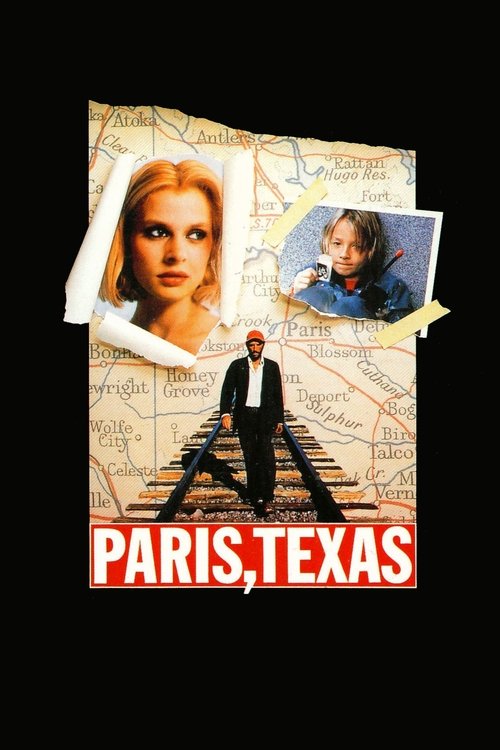
"A place for dreams. A place for heartbreak. A place to pick up the pieces."
Paris, Texas - Symbolism & Philosophy
Symbols & Motifs
The Desert
The desert symbolizes Travis's initial state of emotional barrenness, amnesia, and alienation from society. It's a place devoid of landmarks and memory, reflecting his lost identity. It also represents a space of purification and rebirth, as he emerges from it to begin his journey of self-discovery and redemption.
The film opens with stunning aerial shots of Travis wandering aimlessly through the vast, arid landscapes of the Texas desert. This is where his brother, Walt, finds him, effectively pulling him back into the civilized world.
Paris, Texas
The place, represented only by a photograph of a vacant lot, symbolizes an idealized and perhaps unattainable dream of a perfect family life and a place of belonging. It is the mythical origin of Travis's parents' relationship and his own conception, representing a hope for a fresh start.
Travis carries a photograph of a piece of land he bought in Paris, Texas. He explains to Hunter that he believed he was conceived there and dreamed of building a home for his family on that spot. The fact that the location is never visited in the film reinforces its symbolic, dreamlike quality.
The One-Way Mirror
The one-way mirror in the peep-show booth symbolizes the emotional and communicative barriers between Travis and Jane. He can see her, but she cannot see him, representing his long-held, one-sided perspective of their past. It is only when Jane turns off her light, allowing her to see Travis's silhouette, that a form of mutual recognition and true communication becomes possible, breaking down the barrier.
The climactic and emotionally charged conversations between Travis and Jane take place with them on opposite sides of a one-way mirror in the Houston peep-show club where Jane works.
Roads and Cars
As a road movie, roads and cars are central symbols of transition, escape, and the journey towards self-discovery. The act of driving is a means for Travis to both flee from his past and, eventually, to confront it by seeking out Jane. For Travis and Hunter, the car becomes a space for bonding and reconnecting.
Much of the film's narrative unfolds on the highways of the American Southwest as Travis and Walt, and later Travis and Hunter, travel by car. Travis's insistence on a specific rental car also hints at his attempt to regain control over his life's direction.
Philosophical Questions
Can we ever truly escape our past, or are we destined to be shaped by it forever?
The film explores this question through Travis's journey. His initial amnesia is a literal escape from his past, but he cannot begin to heal until he confronts his memories. His final decision to leave his reunited family suggests that while he can atone for his past, he may never be entirely free from its shadow. The film seems to argue that while the past is always a part of us, we can choose how we respond to it and what actions we take in the present.
What constitutes a family, and can a broken family ever be truly mended?
"Paris, Texas" presents different models of family: the loving but non-biological family of Walt, Anne, and Hunter, and the broken biological family of Travis, Jane, and Hunter. The film questions whether a simple reunion can heal deep wounds. Travis's solution is not to reintegrate himself into the family unit but to facilitate a new beginning for Jane and Hunter. This suggests that a family can be redefined and rebuilt, but not necessarily in its original form.
Is redemption achieved through self-fulfillment or self-sacrifice?
Travis's journey initially seems to be one of self-fulfillment—reclaiming his identity and his family. However, his ultimate act of redemption is one of self-sacrifice. He gives up his own desire to be a husband and father in the traditional sense so that his wife and son can have a chance at happiness. The film presents a complex view of redemption, suggesting it is not about personal gain but about making amends for the harm one has caused, no matter the personal cost.
Core Meaning
The core meaning of "Paris, Texas" revolves around the themes of alienation, memory, and the possibility of redemption. Director Wim Wenders and writer Sam Shepard explore the profound sense of disconnection that can exist between individuals, even within a family, and the isolating nature of unspoken trauma. The film suggests that true healing and reconciliation can only begin after a painful confrontation with the past. Travis's journey is not just a physical one to find his wife, but an internal one to piece together his fractured identity and atone for his past actions. Ultimately, the film carries a message of selfless love and sacrifice; Travis realizes that reuniting his wife and son may mean his own exclusion from their lives, a heartbreaking yet necessary act for their future happiness.