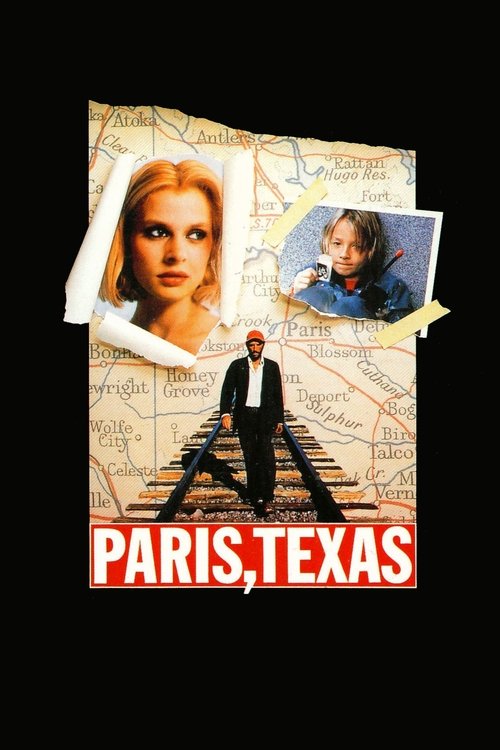
Paris, Texas
"A place for dreams. A place for heartbreak. A place to pick up the pieces."
Overview
"Paris, Texas" begins with Travis Henderson, a man who has been missing for four years, wandering out of the West Texas desert in a silent, trance-like state. His brother, Walt, retrieves him and brings him back to his home in Los Angeles, where Travis is reunited with his seven-year-old son, Hunter. Hunter has been raised by Walt and his wife, Anne, and initially, the boy is wary of this stranger who is his father.
As Travis slowly begins to reconnect with his past and with Hunter, he becomes determined to find his estranged wife, Jane, and reunite their broken family. This desire sets Travis and Hunter on a journey across the American Southwest, a physical and emotional odyssey to locate Jane and confront the painful memories that led to their separation. The film is a patient and poignant exploration of loss, redemption, and the difficulty of communication, set against the stunning and lonely landscapes of America.
Core Meaning
The core meaning of "Paris, Texas" revolves around the themes of alienation, memory, and the possibility of redemption. Director Wim Wenders and writer Sam Shepard explore the profound sense of disconnection that can exist between individuals, even within a family, and the isolating nature of unspoken trauma. The film suggests that true healing and reconciliation can only begin after a painful confrontation with the past. Travis's journey is not just a physical one to find his wife, but an internal one to piece together his fractured identity and atone for his past actions. Ultimately, the film carries a message of selfless love and sacrifice; Travis realizes that reuniting his wife and son may mean his own exclusion from their lives, a heartbreaking yet necessary act for their future happiness.
Thematic DNA
Alienation and Isolation
This theme is central to the film, embodied by Travis's initial state of mute aimlessness in the vast, empty desert. The desolate landscapes mirror his internal emotional state of disconnection from himself and society. This sense of isolation is further explored through the physical and emotional distances between the characters: Travis's four-year absence, the one-way mirror separating him from Jane, and the initial emotional gap between him and his son, Hunter. The film portrays modern America as a place where individuals can be profoundly alone, even when surrounded by others.
The Fallibility of Memory and the Past
"Paris, Texas" delves into how memory, both personal and familial, shapes identity. Travis is a man haunted by a past he can't fully articulate at first. The narrative slowly unravels the events that led to the family's disintegration through Travis's fragmented recollections and his final, painful confession to Jane. The use of Super 8 home movies serves as a tangible, yet idealized, representation of a past that can never be fully reclaimed. The film suggests that the past is not a fixed entity but a subjective experience that continues to influence the present.
The Myth of the American Dream
Wenders, a European director, casts a critical yet affectionate eye on the iconography of the American West and the notion of the American Dream. The road trip, a classic American cinematic motif, becomes a search for a lost ideal of family and home. The very name "Paris, Texas" represents a romanticized, almost mythical place of origin and happiness that may not exist in reality. The film deconstructs the traditional Western hero, presenting Travis not as a triumphant figure, but as a broken man seeking redemption in a landscape of forgotten promises.
Communication and its Failures
The film is profoundly concerned with the difficulties of communication. Travis's initial muteness is the most extreme example, symbolizing his inability to confront his past. Even when characters do speak, they often struggle to convey their true feelings. The climax of the film takes place in a peep-show booth, where Travis and Jane are separated by a one-way mirror, forcing them to communicate without seeing each other directly. It is only in this space of mediated and indirect communication that they can finally be honest with each other, highlighting the barriers people erect and the unconventional ways they must be overcome.
Character Analysis
Travis Henderson
Harry Dean Stanton
Motivation
Travis is driven by a deep-seated need to understand his past and to atone for the pain he caused his family. His primary motivation becomes the desire to reunite his son, Hunter, with his mother, Jane, in an attempt to repair the family he broke.
Character Arc
Travis begins as a tabula rasa, a silent and amnesiac wanderer seemingly stripped of his identity. His journey is one of gradual reawakening, as he reconnects with his memories, his son, and ultimately his capacity for love and responsibility. He transforms from a man running from his past to one who actively confronts it. His final act of reuniting Jane and Hunter, at the cost of his own inclusion in their new life, represents the culmination of his redemptive arc, demonstrating a profound and selfless love.
Jane Henderson
Nastassja Kinski
Motivation
Jane's motivation is complex; she is driven by a desire for self-preservation after a traumatic past, but also by a lingering love for her son, whom she supports financially from a distance. Ultimately, her motivation shifts to a yearning to reconnect with Hunter and heal from her past.
Character Arc
Jane is initially a mysterious figure, a missing piece of the family puzzle. When Travis finds her, she is working in a peep-show booth, emotionally disconnected from her clients and her own past. Through her conversations with Travis, she confronts her own pain and guilt. Her arc is one of re-emerging from a self-imposed exile, culminating in her emotional reunion with Hunter, which offers her a chance to reclaim her role as a mother and begin a new chapter in her life.
Hunter Henderson
Hunter Carson
Motivation
Initially, Hunter's motivation is to maintain the stability of his life with Walt and Anne. As he bonds with Travis, his motivation shifts to a childlike curiosity and a deeper need to know his mother and understand why his family fell apart.
Character Arc
Hunter starts as a child who has no memory of his biological parents and is lovingly cared for by his aunt and uncle. He is initially distant and skeptical of Travis. His arc is one of opening up to the idea of his father and mother, moving from a protected and somewhat detached childhood to embracing the complex reality of his origins. His decision to join Travis on the road trip signifies his trust and his own nascent desire to understand his family's story.
Walt Henderson
Dean Stockwell
Motivation
Walt is motivated by a strong sense of familial duty and love for both his brother and his nephew. He wants to help Travis recover and to ensure Hunter's well-being, even if it means personal heartache.
Character Arc
Walt is the stable, responsible brother who has provided a loving home for Hunter. His arc is one of patience, frustration, and eventual letting go. He acts as a bridge between Travis's lost world and the present reality. He struggles to understand his brother's actions but remains steadfast in his love and support. His journey culminates in the difficult but necessary act of allowing Hunter to leave with Travis, recognizing the boy's need to connect with his biological parents.
Symbols & Motifs
The Desert
The desert symbolizes Travis's initial state of emotional barrenness, amnesia, and alienation from society. It's a place devoid of landmarks and memory, reflecting his lost identity. It also represents a space of purification and rebirth, as he emerges from it to begin his journey of self-discovery and redemption.
The film opens with stunning aerial shots of Travis wandering aimlessly through the vast, arid landscapes of the Texas desert. This is where his brother, Walt, finds him, effectively pulling him back into the civilized world.
Paris, Texas
The place, represented only by a photograph of a vacant lot, symbolizes an idealized and perhaps unattainable dream of a perfect family life and a place of belonging. It is the mythical origin of Travis's parents' relationship and his own conception, representing a hope for a fresh start.
Travis carries a photograph of a piece of land he bought in Paris, Texas. He explains to Hunter that he believed he was conceived there and dreamed of building a home for his family on that spot. The fact that the location is never visited in the film reinforces its symbolic, dreamlike quality.
The One-Way Mirror
The one-way mirror in the peep-show booth symbolizes the emotional and communicative barriers between Travis and Jane. He can see her, but she cannot see him, representing his long-held, one-sided perspective of their past. It is only when Jane turns off her light, allowing her to see Travis's silhouette, that a form of mutual recognition and true communication becomes possible, breaking down the barrier.
The climactic and emotionally charged conversations between Travis and Jane take place with them on opposite sides of a one-way mirror in the Houston peep-show club where Jane works.
Roads and Cars
As a road movie, roads and cars are central symbols of transition, escape, and the journey towards self-discovery. The act of driving is a means for Travis to both flee from his past and, eventually, to confront it by seeking out Jane. For Travis and Hunter, the car becomes a space for bonding and reconnecting.
Much of the film's narrative unfolds on the highways of the American Southwest as Travis and Walt, and later Travis and Hunter, travel by car. Travis's insistence on a specific rental car also hints at his attempt to regain control over his life's direction.
Memorable Quotes
I'm not afraid of heights. I'm afraid of fallin'.
— Travis Henderson
Context:
Travis and Walt are in Los Angeles, and Walt is trying to understand Travis's seemingly irrational fears and behaviors. Travis expresses this sentiment while looking down at the traffic below, a moment that highlights his fragile mental state.
Meaning:
This line, spoken as Travis looks down from a freeway overpass, encapsulates his fear not of a specific situation, but of the loss of control and the potential for another devastating personal collapse. It reflects his deep-seated anxiety about failing himself and his family again.
I used to talk to you all the time, even though I was alone. I walked around for months talking to you. Now I don't know what to say... It was easier when I just imagined you.
— Jane Henderson
Context:
This is from Jane's final, emotional monologue to Travis through the one-way mirror. After he has confessed his story, she opens up about her own experience of their separation and her struggle to move on.
Meaning:
This quote powerfully conveys the pain of separation and the way memory and imagination can sometimes feel more real and manageable than the complexity of an actual relationship. It reveals the depth of Jane's loneliness and her long-held, one-sided conversation with the man who left her.
I knew these people. These two people. They were in love with each other. The girl was very young, about 17 or 18, I guess. And the man was… older. He was kind of raggedy and wild. And she was very beautiful, you know?
— Travis Henderson
Context:
Travis is speaking to Jane through the intercom in the peep-show booth. He tells their story as if it were about two other people, slowly revealing his identity and the truth of their shared history.
Meaning:
This is the beginning of Travis's climactic confession to Jane. By telling their story in the third person, he creates an emotional distance that allows him to finally articulate the painful events of their past. It's a way of confronting the truth without being completely overwhelmed by it.
Philosophical Questions
Can we ever truly escape our past, or are we destined to be shaped by it forever?
The film explores this question through Travis's journey. His initial amnesia is a literal escape from his past, but he cannot begin to heal until he confronts his memories. His final decision to leave his reunited family suggests that while he can atone for his past, he may never be entirely free from its shadow. The film seems to argue that while the past is always a part of us, we can choose how we respond to it and what actions we take in the present.
What constitutes a family, and can a broken family ever be truly mended?
"Paris, Texas" presents different models of family: the loving but non-biological family of Walt, Anne, and Hunter, and the broken biological family of Travis, Jane, and Hunter. The film questions whether a simple reunion can heal deep wounds. Travis's solution is not to reintegrate himself into the family unit but to facilitate a new beginning for Jane and Hunter. This suggests that a family can be redefined and rebuilt, but not necessarily in its original form.
Is redemption achieved through self-fulfillment or self-sacrifice?
Travis's journey initially seems to be one of self-fulfillment—reclaiming his identity and his family. However, his ultimate act of redemption is one of self-sacrifice. He gives up his own desire to be a husband and father in the traditional sense so that his wife and son can have a chance at happiness. The film presents a complex view of redemption, suggesting it is not about personal gain but about making amends for the harm one has caused, no matter the personal cost.
Alternative Interpretations
The ending of "Paris, Texas" is famously bittersweet and open to interpretation. One perspective is that Travis's departure is a tragic but necessary act of sacrifice. He recognizes that his presence could do more harm than good and that the healthiest future for Jane and Hunter is one they build together, free from the ghosts of the past. In this reading, his final act is one of ultimate love and redemption.
Another interpretation is more pessimistic, suggesting that Travis is incapable of change and is doomed to repeat his cycle of wandering and abandonment. He may realize that he is still the same broken man who destroyed his family once and flees out of fear of doing so again. This view emphasizes the cyclical nature of trauma and the difficulty of true healing. Some viewers also question whether reuniting Hunter with a mother he doesn't know, in a hotel room in a strange city, is truly in the child's best interest, adding another layer of ambiguity to Travis's decision.
Cultural Impact
"Paris, Texas" was a significant film of the 1980s and has had a lasting cultural impact. Upon its release, it was a critical success, winning the Palme d'Or at the 1984 Cannes Film Festival, which solidified Wim Wenders's reputation as a leading figure in international cinema. The film's affectionate yet critical portrayal of the United States, as seen through a European lens, resonated with audiences and critics worldwide.
Its influence on cinema can be seen in the work of subsequent filmmakers who have adopted its contemplative pace, stunning cinematography, and focus on landscape as a reflection of characters' inner states. The film's aesthetic, shaped by Robby Müller's cinematography and Ry Cooder's iconic score, has been widely imitated and praised. It has been cited as an inspiration by numerous directors and is considered a cult classic. The film also brought veteran character actor Harry Dean Stanton a rare and much-deserved leading role, which has become his most iconic performance.
Audience Reception
"Paris, Texas" was met with widespread critical acclaim upon its release and has since become a beloved classic among cinephiles. Audiences and critics have praised the film for its stunning cinematography, Harry Dean Stanton's powerful and understated performance, and Ry Cooder's evocative score. The slow, meditative pace and the emotional depth of the story are often highlighted as its greatest strengths. However, some viewers have found the pacing to be too slow or the film to be emotionally distant in its first half. The ending is a frequent point of discussion, with many finding it profoundly moving and heartbreaking, while a minority have criticized Travis's final decision as irresponsible or unsatisfying. Overall, it is regarded as a masterpiece of 1980s cinema, admired for its artistry and its poignant exploration of the human condition.
Interesting Facts
- The screenplay was not finished when filming began. Co-writer Sam Shepard was also acting in another film and would send pages of the script to director Wim Wenders. Shepard dictated the final, climactic monologue over the phone.
- Harry Dean Stanton, who was nearly 60 at the time of filming, considered the role of Travis to be the one he had been waiting for his entire career.
- The film's title, "Paris, Texas," refers to a real town in Texas, but no scenes were actually filmed there.
- Hunter Carson, who plays Hunter, is the son of co-writer L.M. Kit Carson and actress Karen Black.
- Wim Wenders and cinematographer Robby Müller were longtime collaborators, and their shared visual sensibility is a hallmark of the film. They were influenced by the paintings of Edward Hopper.
- The iconic, haunting slide guitar score was composed and performed by Ry Cooder. Wenders considered the music to be a crucial element of the film's success.
- The film won the Palme d'Or, the highest prize at the 1984 Cannes Film Festival.
Easter Eggs
The film shares thematic and structural similarities with John Ford's classic 1956 Western, "The Searchers."
Both films feature a man who emerges from the wilderness after a long absence to reconnect with his family and rescue a female relative. This makes "Paris, Texas" a modern, more introspective take on the classic American Western, with Travis as a contemporary counterpart to John Wayne's Ethan Edwards.
The film's visual style, particularly the use of light and color in lonely, sparse settings, is heavily influenced by the paintings of American realist painter Edward Hopper.
This artistic homage enhances the film's themes of isolation and alienation in American life. Cinematographer Robby Müller's compositions often evoke the feeling of Hopper's work, which is known for its depictions of solitary figures in urban and rural environments.
The film has some resemblances to Wenders's earlier 1974 film, "Alice in the Cities."
Both films are road movies that feature a disillusioned man who forms an unlikely bond with a child and embarks on a journey of self-discovery. This recurring theme in Wenders's work highlights his fascination with American culture and the search for identity.
⚠️ Spoiler Analysis
Click to reveal detailed analysis with spoilers
Frequently Asked Questions
Explore More About This Movie
Dive deeper into specific aspects of the movie with our detailed analysis pages
Comments (0)
No comments yet. Be the first to share your thoughts!