"The first casualty of war is innocence."
Platoon - Symbolism & Philosophy
Symbols & Motifs
Sgt. Elias's Crucifixion
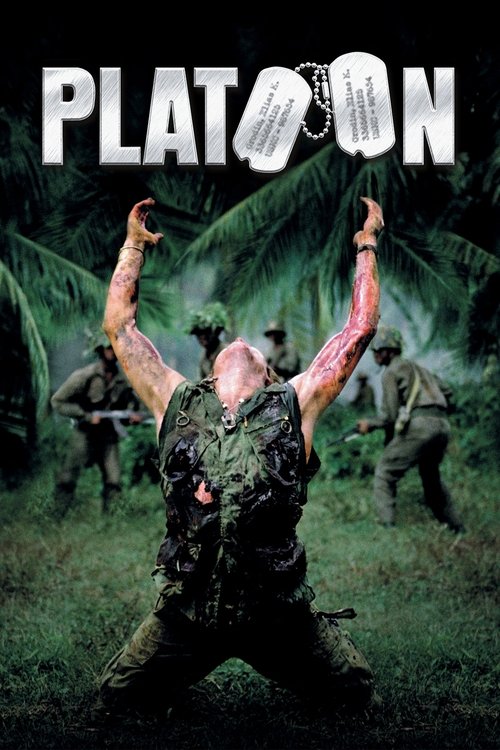
Elias represents a Christ-like figure of sacrifice and grace. His death—arms outstretched towards the sky while being gunned down—is a visual martyrdom, symbolizing the death of morality and hope in the face of unbridled evil.
Betrayed by Barnes and left for dead, Elias emerges from the jungle one last time, running from NVA soldiers before collapsing in a crucifixion pose as the helicopter lifts off, unable to save him.
The Jungle
The jungle is an indifferent, suffocating entity that consumes everything. It serves as a trap, a green hell that hides the enemy and amplifies the soldiers' paranoia, representing the chaotic and primal state of nature where civilization holds no power.
It is the constant backdrop, shot to feel claustrophobic and alive, hiding booby traps and enemies, and "eating" the soldiers alive with insects, heat, and rot.
Barnes's Scars
The extensive scarring on Barnes's face represents his internal corruption and his history of violence. He is the "machine" of war made flesh—broken, stitched back together, and seemingly unkillable (having been shot seven times), embodying the resilience of evil.
Barnes is frequently framed in shadow or close-up to emphasize his disfigured visage, contrasting with Elias's often open, angelic expressions.
Philosophical Questions
Can morality exist in the vacuum of war?
The film asks whether ethical codes are a luxury of civilization. Elias tries to maintain a moral baseline (protecting civilians), while Barnes argues that war suspends all normal rules and that the only 'sin' is losing. The film leaves us questioning if Elias's morality was a weakness that got him killed, or a strength that saved Taylor's soul.
Is evil inherent in human nature?
By stating 'the enemy was in us,' the film suggests that the capacity for atrocity is not unique to the enemy or a specific ideology, but a dormant seed in every human being that war simply fertilizes. It challenges the viewer to accept that under the right pressure, anyone could become Barnes.
Core Meaning
The Enemy Within: Platoon posits that the true war is not fought against an external enemy, but against the darkness inside the human soul. Oliver Stone deconstructs the myth of the heroic soldier, suggesting that war strips away civilization to reveal a primal duality: the capacity for selfless love (Elias) and animalistic violence (Barnes). Ultimately, the film argues that the "first casualty of war is innocence," and that every soldier leaves the battlefield—if they leave at all—carrying the war forever within them.