"An incomparable spectacle."
PlayTime - Symbolism & Philosophy
Symbols & Motifs
Glass and Reflections
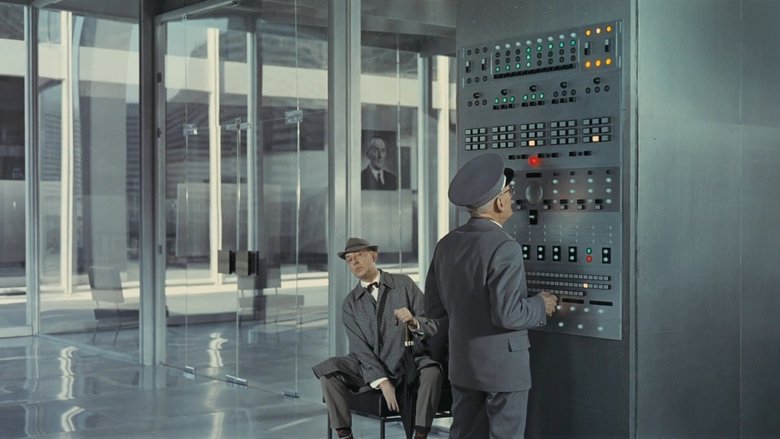
Symbolizes the paradox of modern transparency: we can see everything, yet we are separated from reality. It creates confusion (characters walking into doors) and illusory images (the reflection of the Eiffel Tower).
Used incessantly throughout the office and apartment sequences, most notably when Hulot sees a reflection of Giffard and chases the image instead of the man.
The Traffic Circle
Represents the transformation of mechanical routine into joyful play. It turns the 'rat race' of commuting into a literal merry-go-round.
The final sequence where the cars in the roundabout begin to move like horses on a carousel, accompanied by carnival music.
The Eiffel Tower
Symbolizes the lost 'Old Paris' that has been obscured by modernization. It is a ghost of the past in this new concrete jungle.
The tower is never seen directly; it only appears briefly as a fleeting reflection in a glass door opening and closing.
The Flower Seller
Represents nature and tradition persisting amidst the concrete. A small spot of color in a grey world.
An old woman selling flowers on a street corner, contrasting sharply with the high-tech trade expo nearby.
Philosophical Questions
Can individuality survive in a standardized world?
The film explores this by showing how the rigid environment initially suppresses unique behavior, but eventually, human messiness and distinct personalities break through the uniformity, suggesting that the human spirit is indomitable.
Is chaos necessary for authentic human connection?
The restaurant sequence suggests that disaster is a prerequisite for joy. Only when the meticulously planned opening night falls apart do the patrons actually start talking, laughing, and connecting with one another.
How does architecture shape our behavior?
Tati visualizes how modern lines dictate movement (walking in right angles), contrasting this with the natural 'curve' of human interaction, questioning whether we shape our cities or our cities shape us.
Core Meaning
Jacques Tati's magnum opus is a profound observation on the conflict between cold modernity and warm humanity. Tati does not merely condemn the sterile, standardized future of glass towers and gadgets; rather, he suggests that the human spirit—chaotic, curved, and unpredictable—will inevitably reassert itself over the rigid straight lines of urban planning.
The film invites the viewer to play along with the director, actively scanning the wide, detail-rich frame to find humor and life in the corners of a homogenized world. Ultimately, it is a message of optimism: no matter how uniform the world becomes, people will always turn it into a carnival.