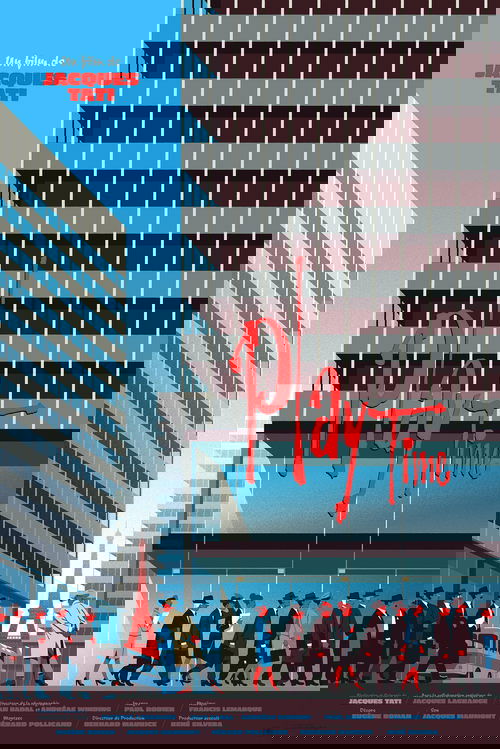
PlayTime
A modernist satire blending sterile architectural comedy with a silent symphony of chaotic humanity. Amidst a maze of glass and steel, a befuddled wanderer discovers that life's organic curve ultimately breaks through the rigid straight line.
PlayTime

PlayTime

"An incomparable spectacle."

13 December 1967 France 115 min ⭐ 7.7 (634)
Director: Jacques Tati
Cast: Jacques Tati, Barbara Dennek, Rita Maiden, France Rumilly, France Delahalle
Comedy
Modernity vs. Humanity Alienation and Connection Consumerism and Americanization The Democracy of the Eye

Overview

In a futuristic, hyper-modernized Paris dominated by steel, glass, and endless gray skyscrapers, the iconic Monsieur Hulot attempts to attend an important business meeting. However, he quickly becomes lost in a labyrinth of high-tech offices, trade exhibitions, and confusing corridors, drifting aimlessly through a city that has lost its romantic charm to efficiency and consumerism.

Parallel to his journey, a group of American tourists, including a young woman named Barbara, arrives to tour the city but finds only identical modern buildings and international trade fairs. The paths of Hulot, Barbara, and various eccentric Parisians repeatedly cross in a series of loosely connected vignettes, culminating in a chaotic, disastrous, yet joyous opening night at the Royal Garden restaurant, where the pristine modern façade crumbles to reveal the messy warmth of human connection.
Core Meaning

Jacques Tati's magnum opus is a profound observation on the conflict between cold modernity and warm humanity. Tati does not merely condemn the sterile, standardized future of glass towers and gadgets; rather, he suggests that the human spirit—chaotic, curved, and unpredictable—will inevitably reassert itself over the rigid straight lines of urban planning.

The film invites the viewer to play along with the director, actively scanning the wide, detail-rich frame to find humor and life in the corners of a homogenized world. Ultimately, it is a message of optimism: no matter how uniform the world becomes, people will always turn it into a carnival.

Thematic DNA

Modernity vs. Humanity 30%
Alienation and Connection 25%
Consumerism and Americanization 25%
The Democracy of the Eye 20%

Modernity vs. Humanity

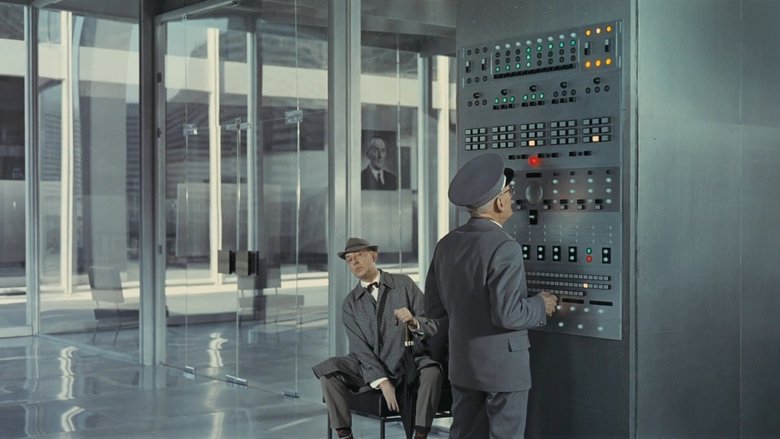
The film visually pits the straight line against the curve. The architecture is rigid, orthogonal, and grey, forcing people to move in sharp angles. However, as the film progresses—especially in the restaurant sequence—the organic, curved movements of people break down the environment, turning a sterile space into a lively, messy party.

Alienation and Connection

Glass walls and windows are constant barriers, separating characters even when they are inches apart. Hulot often sees people but cannot reach them, or hears them but cannot see them. Yet, these transparent barriers also create new, accidental forms of connection, suggesting that shared isolation is a modern human condition.

Consumerism and Americanization

The Paris of PlayTime is indistinguishable from any other modern capital, filled with international products and American tourists. The trade exhibition sequence satirizes the obsession with useless gadgets (like a door that slams in 'Golden Silence'), highlighting the superficiality of consumer culture.

The Democracy of the Eye

Tati refuses to use close-ups or guide the audience's attention to a specific joke. Instead, he uses wide shots packed with details, forcing the viewer to actively choose where to look. This structural theme democratizes the viewing experience, making the audience an active participant in observing the world.

Character Analysis

Monsieur Hulot

Jacques Tati

Archetype: The Befuddled Observer
Key Trait: Well-meaning clumsiness

Motivation

To attend a meeting with Monsieur Giffard (a goal that is constantly thwarted and eventually abandoned).

Character Arc

Hulot is not a traditional protagonist but a catalyst for chaos. He starts as an outsider trying to fit into the business world but eventually becomes the accidental life of the party at the Royal Garden, helping to deconstruct the rigid social order.

Barbara

Barbara Dennek

Archetype: The Seeker
Key Trait: Curiosity

Motivation

To see the romantic Paris she has imagined, rather than the modern duplicate she is shown.

Character Arc

A young American tourist who feels disconnected from the sterile tour group. She constantly looks for the 'real' Paris and finds a kindred spirit in Hulot. She represents the bridge between the tourist gaze and genuine human connection.

Monsieur Giffard

Georges Montant

Archetype: The Modern Bureaucrat
Key Trait: Stress

Motivation

To maintain efficiency and professional appearances.

Character Arc

Initially a busy, elusive figure representing the fast-paced corporate world. After suffering a minor injury (running into a glass door), he joins the chaotic revelry at the restaurant, loosening his tie and his rigid demeanor.

Symbols & Motifs

Glass and Reflections

Meaning:

Symbolizes the paradox of modern transparency: we can see everything, yet we are separated from reality. It creates confusion (characters walking into doors) and illusory images (the reflection of the Eiffel Tower).

Context:

Used incessantly throughout the office and apartment sequences, most notably when Hulot sees a reflection of Giffard and chases the image instead of the man.

The Traffic Circle

Meaning:

Represents the transformation of mechanical routine into joyful play. It turns the 'rat race' of commuting into a literal merry-go-round.

Context:

The final sequence where the cars in the roundabout begin to move like horses on a carousel, accompanied by carnival music.

The Eiffel Tower

Meaning:

Symbolizes the lost 'Old Paris' that has been obscured by modernization. It is a ghost of the past in this new concrete jungle.

Context:

The tower is never seen directly; it only appears briefly as a fleeting reflection in a glass door opening and closing.

The Flower Seller

Meaning:

Represents nature and tradition persisting amidst the concrete. A small spot of color in a grey world.

Context:

An old woman selling flowers on a street corner, contrasting sharply with the high-tech trade expo nearby.

Memorable Quotes

Slam... [Silence]

— Trade Show Salesman

Context:

At the trade exhibition, while demonstrating a new door design to potential buyers.

Meaning:

A visual/sound gag rather than a spoken quote. The salesman demonstrates a door that slams in 'Golden Silence,' satirizing the modern obsession with neutralizing reality and sound.

Wait 'til you see how modern it is!

— American Tourist

Context:

Spoken by a tourist to her group upon arriving at the ultra-modern airport.

Meaning:

Highlights the irony of the tourists traveling across the world only to seek out the same modern comforts they have at home, ignoring the unique culture of Paris.

It's so hot in here. Please, feel at home.

— Apartment Resident

Context:

Inviting a guest into the goldfish-bowl apartment that is visible to everyone on the street.

Meaning:

Spoken while the character is in a glass-walled apartment fully exposed to the street. It emphasizes the complete loss of privacy and the performative nature of domestic life in the modern city.

Philosophical Questions

Can individuality survive in a standardized world?

The film explores this by showing how the rigid environment initially suppresses unique behavior, but eventually, human messiness and distinct personalities break through the uniformity, suggesting that the human spirit is indomitable.

Is chaos necessary for authentic human connection?

The restaurant sequence suggests that disaster is a prerequisite for joy. Only when the meticulously planned opening night falls apart do the patrons actually start talking, laughing, and connecting with one another.

How does architecture shape our behavior?

Tati visualizes how modern lines dictate movement (walking in right angles), contrasting this with the natural 'curve' of human interaction, questioning whether we shape our cities or our cities shape us.

Alternative Interpretations

While typically viewed as a satire of dehumanizing modernism, some critics argue that the film is not purely negative. The ending, where the sterile city is transformed into a carnival, suggests an acceptance of the new world. Tati might be saying that humanity can adapt to any environment, finding joy and 'play' even in the most sterile of concrete jungles. The film can thus be read not as a rejection of the future, but as a guide on how to live in it: by maintaining a sense of humor and community.

Cultural Impact

PlayTime is a tragic masterpiece of cinema history. Upon its release in 1967, it was a critical perplexity and a commercial catastrophe that destroyed Jacques Tati's career and financial stability. Audiences, expecting the slapstick of Mr. Hulot's Holiday, were baffled by the plotless, austere, and complex nature of the film.

However, in the decades since, its reputation has been completely rehabilitated. It is now widely considered one of the greatest films ever made, praised for its visionary set design, intricate soundscapes, and prescient critique of globalization and architecture. Directors like David Lynch and Wes Anderson have cited its visual precision as a major influence. It stands today as a monument to uncompromising artistic vision and the beauty of 70mm filmmaking.

Audience Reception

Contemporary audiences in 1967 were largely disappointed, finding the film too long, the plot non-existent, and the humor too subtle compared to Tati's previous hits. The lack of focus on Monsieur Hulot was a major point of contention.

Modern audiences and critics, however, revere the film. It holds a near-perfect score on review aggregators, with praise directed at its choreography, sound design, and visual comedy. It is frequently cited in 'Best Films of All Time' lists, though some casual viewers still find its pacing slow and its lack of dialogue challenging.

Interesting Facts

  • Jacques Tati built an entire massive set called 'Tativille' on the outskirts of Paris, featuring working escalators, paved roads, and two power plants.
  • The film was a colossal financial failure upon release, bankrupting Tati and forcing him to sell his family home and the rights to his previous films.
  • Tati insisted on shooting in 70mm film to capture the vast scale of the architecture and to allow the audience to scan the frame without directorial guidance.
  • The production took nearly nine years to complete, with three years dedicated solely to filming.
  • To save money on extras, Tati used life-sized photographic cutouts of people in the background of some wide shots.
  • The film originally ran for 155 minutes, but Tati was forced to cut it down significantly after the disastrous premiere.
  • There are almost no close-ups in the entire film; Tati wanted to respect the viewer's freedom to look where they pleased.

Easter Eggs

False Hulots

Throughout the film, several characters appear in the background wearing Hulot's signature raincoat, hat, and pipe. This reinforces the theme of loss of individuality and suggests that Hulot is just one of many confused souls in the modern city.

The Waiter from Trafic

The older waiter who laughs at everything in the Royal Garden scene reappears in Tati's later film Trafic, creating a subtle continuity in Tati's cinematic universe.

Eiffel Tower Reflection

The Eiffel Tower, the icon of Paris, is never shown directly. It appears only once as a fleeting reflection in a glass door, a commentary on how the real city has become a ghost in the face of modernization.

Mon Oncle References

The construction workers and the music-loving teenagers move with a 'curved' naturalism that recalls the characters from Tati's previous film Mon Oncle, representing the lingering spirit of the old world.

⚠️ Spoiler Analysis

Click to reveal detailed analysis with spoilers

Frequently Asked Questions

Explore More About This Movie

Dive deeper into specific aspects of the movie with our detailed analysis pages

Comments (0)

Leave a comment

No comments yet. Be the first to share your thoughts!