
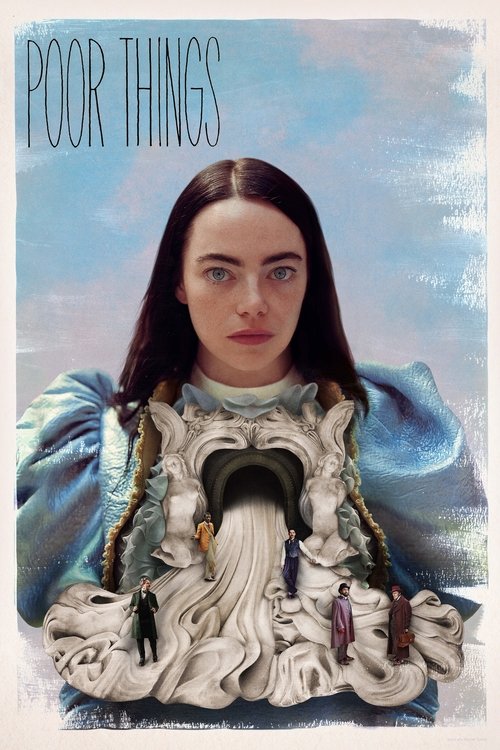
"She’s nothing like you’ve ever seen."
Poor Things - Symbolism & Philosophy
Symbols & Motifs
The Fisheye Lens
The extreme ultra-wide and fisheye lenses symbolize Bella's infantile, distorted, and hyper-focused perspective of the world during her early development.
Used prominently during her confinement in London and moments of overwhelming discovery, it creates a porthole effect that visually isolates her while magnifying her intense emotional and sensory experiences.
Color vs. Black and White
The transition from monochrome to hyper-saturated color represents Bella's intellectual and sexual awakening, as well as her expanding worldview.
The film begins in stark black and white while Bella is trapped in Godwin's house. The moment she leaves with Duncan to travel the world, the screen erupts into vibrant, surreal, and painterly colors.
Godwin Baxter's Scars
Godwin's heavily disfigured face and biomechanical digestive system symbolize the trauma of generational abuse in the name of progress, and the physical toll of scientific obsession.
Godwin explains to Bella and Max that his own father mutilated him for medical research. Unlike his father, Godwin ultimately chooses compassion over pure clinical detachment when raising Bella.
The Cruise Ship
The luxurious ocean liner acts as a gilded cage and a microcosm of upper-class detachment.
Duncan traps Bella on the ship to monopolize her attention, but it is here she meets philosophers who introduce her to reading. The ship physically separates the wealthy from the suffering of the lower classes, which Bella discovers when she looks over the railing in Alexandria.
Philosophical Questions
If a human were raised entirely free of societal shame and conditioning, how would they behave?
The film uses Bella as a tabula rasa (blank slate) to explore the artificiality of societal norms. Without inherited guilt regarding sex, propriety, or class, Bella approaches the world with pure empiricism [1.2]. The film suggests that shame is entirely constructed, and that a truly free mind naturally gravitates toward pleasure, curiosity, and eventually, profound empathy.
What is the relationship between suffering, empathy, and personal growth?
During her time in Alexandria, Bella is devastated by the sight of extreme poverty and death. This moment of horrific realization catalyzes her evolution from a hedonistic child into a deeply moral adult. The film posits that one cannot become a fully formed, enlightened individual without confronting and internalizing the suffering of others.
Does the pursuit of science and creation justify the violation of nature?
Godwin Baxter commits a grotesque violation of nature by transplanting a baby's brain into its mother's corpse. Yet, this ungodly act results in Bella—a vibrant, brilliant force for good. The film asks the audience to weigh the ethical horror of Godwin's methods against the miraculous beauty of his creation, ultimately leaving the morality of such hubris ambiguous.
Core Meaning
At its core, Poor Things is a triumphant exploration of female agency, bodily autonomy, and the dismantling of patriarchal control. Director Yorgos Lanthimos uses the Frankenstein mythos not as a cautionary tale of scientific hubris, but as a framework for a woman discovering herself entirely free from societal conditioning and shame. The film posits that true liberation comes from embracing the entirety of the human experience—both its "sugar and violence."
Furthermore, it serves as a biting satire of polite society. By filtering the world through Bella's uncorrupted, empirical lens, the movie exposes the absurdity of social constructs, the fragility of the male ego, and the oppressive nature of 'civilized' norms. The overarching message is deeply optimistic: a mind unburdened by inherited guilt and allowed to forge its own path will inevitably gravitate towards empathy, intellectual curiosity, and self-determination.