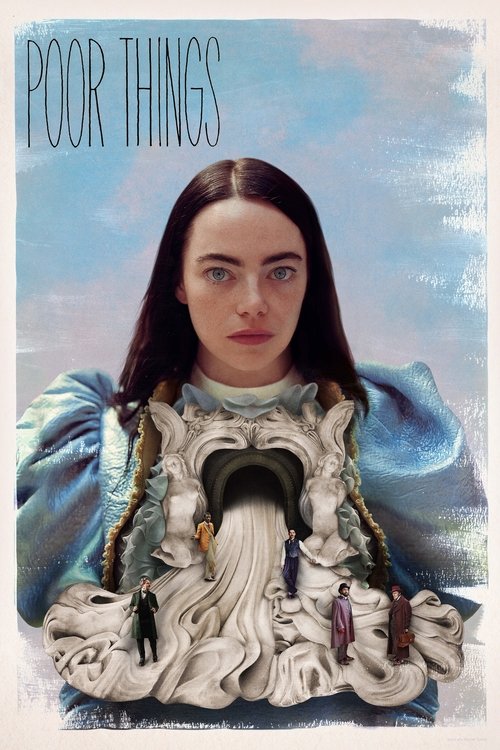
Poor Things
"She’s nothing like you’ve ever seen."
Overview
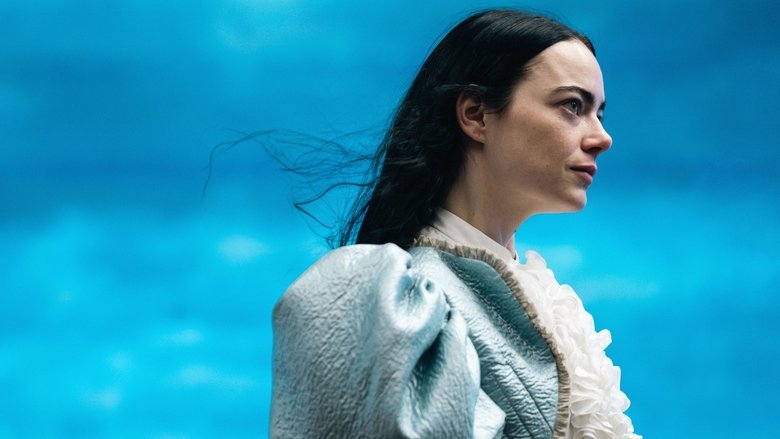
In a surreal, reimagined Victorian London, Poor Things follows the fantastical evolution of Bella Baxter, a young woman brought back to life by the brilliant and unorthodox scientist Dr. Godwin Baxter. Initially confined to Godwin's estate with a rapidly developing mind but the uncoordinated body of an adult, Bella's insatiable curiosity soon outgrows her sheltered existence. Eager to understand the world, she embarks on a whirlwind global adventure with Duncan Wedderburn, a slick and debauched lawyer.
As Bella travels across continents, her journey becomes a profound coming-of-age story. Free from the prejudices and shame of her era, she encounters the vast spectrum of human experience—from sensory pleasures and intellectual philosophy to extreme poverty and societal cruelty. Her rapid maturation forces those around her to confront their own limitations and desires, as Bella steadily transforms into a fiercely independent woman committed to equality and liberation.

Core Meaning
At its core, Poor Things is a triumphant exploration of female agency, bodily autonomy, and the dismantling of patriarchal control. Director Yorgos Lanthimos uses the Frankenstein mythos not as a cautionary tale of scientific hubris, but as a framework for a woman discovering herself entirely free from societal conditioning and shame. The film posits that true liberation comes from embracing the entirety of the human experience—both its "sugar and violence."
Furthermore, it serves as a biting satire of polite society. By filtering the world through Bella's uncorrupted, empirical lens, the movie exposes the absurdity of social constructs, the fragility of the male ego, and the oppressive nature of 'civilized' norms. The overarching message is deeply optimistic: a mind unburdened by inherited guilt and allowed to forge its own path will inevitably gravitate towards empathy, intellectual curiosity, and self-determination.
Thematic DNA
Female Agency and Liberation
Bella's central arc is the reclamation of her own body and destiny. Initially treated as an experiment by Godwin and a possession by Duncan, she consistently sheds the patriarchal boundaries placed upon her. Through sexual exploration, intellectual awakening, and eventual financial independence, she becomes the sole author of her life.
The Construct of Shame and Society
Because Bella is essentially a blank slate, she does not possess the inherent shame that Victorian society expects of women. Her blunt honesty and unapologetic desires act as a mirror, exposing the hypocrisy, fragility, and irrationality of 'polite society' and the men who try to dictate its rules.
Empiricism vs. Sheltered Ignorance
The film champions experiencing the world firsthand. Godwin attempts to keep Bella safe through isolation, but she can only grow by adventuring and encountering life's extremes. Her philosophical awakening in Alexandria, where she witnesses devastating poverty, cements her understanding that knowledge requires witnessing both beauty and suffering.
Creation and the Creator
A twist on the Frankenstein narrative, the film examines the bond between maker and creation. Godwin Baxter views himself as a godlike figure of science, but eventually learns he must relinquish control to let his creation flourish. In turn, Bella forgives him, ultimately taking up his scientific mantle to become a creator and healer herself.
Character Analysis
Bella Baxter
Emma Stone
Motivation
Driven by an insatiable hunger for empirical experience, she wants to consume everything the world has to offer—sex, food, philosophy, and travel—and eventually seeks to use her knowledge to heal and improve society.
Character Arc
Starting as a reanimated corpse with the brain of an infant, Bella rapidly evolves through stages of toddlerhood, rebellious adolescence, and philosophical adulthood. She transitions from an uncoordinated, captive experiment to a highly educated, self-actualized doctor who fully controls her own fate.
Dr. Godwin Baxter
Willem Dafoe
Motivation
To push the boundaries of science and anatomy, carrying on the legacy of his cruel father but struggling to do so with the compassion his father lacked.
Character Arc
Initially a cold, detached scientist who views Bella merely as a fascinating experiment to monitor, Godwin slowly realizes he harbors deep paternal love for her. He learns to let go of his desire to control her, eventually facing his own mortality with grace as she returns to him.
Duncan Wedderburn
Mark Ruffalo
Motivation
Hedonism, sexual conquest, and the narcissistic need to possess and control the women he engages with.
Character Arc
Introduced as a slick, hyper-confident, and debauched lawyer who believes he can manipulate Bella for hedonistic pleasure, Duncan slowly unravels. As Bella's intellect and independence surpass his control, he devolves into a desperate, hysterical, and broken man consumed by jealousy.
Max McCandles
Ramy Youssef
Motivation
To assist Godwin in his scientific endeavors and to support Bella with genuine, unconditional devotion.
Character Arc
Starting as an eager, somewhat naive medical student hired to track Bella's data, Max falls in love with her. Unlike Duncan, Max's arc is defined by his willingness to overcome his Victorian male pride, ultimately accepting Bella's autonomy and past without judgment.
Alfie Blessington
Christopher Abbott
Motivation
Absolute domination, ownership over his wife, and the enforcement of patriarchal authority at any cost.
Character Arc
Alfie is the cruel, aristocratic husband of Victoria (Bella's original body). He attempts to forcefully reintegrate Bella into his oppressive, violent household, intending to physically mutilate her to ensure compliance, but is ultimately defeated and subjected to Bella's own brand of surgical justice.
Symbols & Motifs
The Fisheye Lens
The extreme ultra-wide and fisheye lenses symbolize Bella's infantile, distorted, and hyper-focused perspective of the world during her early development.
Used prominently during her confinement in London and moments of overwhelming discovery, it creates a porthole effect that visually isolates her while magnifying her intense emotional and sensory experiences.
Color vs. Black and White
The transition from monochrome to hyper-saturated color represents Bella's intellectual and sexual awakening, as well as her expanding worldview.
The film begins in stark black and white while Bella is trapped in Godwin's house. The moment she leaves with Duncan to travel the world, the screen erupts into vibrant, surreal, and painterly colors.
Godwin Baxter's Scars
Godwin's heavily disfigured face and biomechanical digestive system symbolize the trauma of generational abuse in the name of progress, and the physical toll of scientific obsession.
Godwin explains to Bella and Max that his own father mutilated him for medical research. Unlike his father, Godwin ultimately chooses compassion over pure clinical detachment when raising Bella.
The Cruise Ship
The luxurious ocean liner acts as a gilded cage and a microcosm of upper-class detachment.
Duncan traps Bella on the ship to monopolize her attention, but it is here she meets philosophers who introduce her to reading. The ship physically separates the wealthy from the suffering of the lower classes, which Bella discovers when she looks over the railing in Alexandria.
Memorable Quotes
I have adventured it and found nothing but sugar and violence.
— Bella Baxter
Context:
Spoken by Bella as she reflects on her travels and the harsh realities she has witnessed outside the safety of Godwin's home.
Meaning:
This beautifully distills Bella's philosophical realization about the human condition. She recognizes that the world is a dichotomy of extreme pleasure and agonizing cruelty, and to live fully, one must acknowledge both.
My father once told me, 'Always carve with compassion.' He was a fucking idiot, but it's not bad advice.
— Dr. Godwin Baxter
Context:
Godwin says this while discussing surgical and scientific philosophy, revealing the dark humor and underlying trauma that defines his character.
Meaning:
This quote highlights Godwin's complex relationship with his abusive father and his own approach to science. It underscores the film's theme of balancing clinical detachment with humanity.
I am a flawed, experimenting person, and I will need a husband with a more forgiving disposition.
— Bella Baxter
Context:
Spoken to Duncan Wedderburn as she rejects his possessive and jealous nature, realizing they are entirely incompatible.
Meaning:
Bella refuses to conform to the Victorian expectation of a pure, submissive wife. She demands a partner who accepts her continuous evolution and autonomy.
I am finding being alive fascinating.
— Bella Baxter
Context:
Bella says this as she ravenously experiences the novelties of the world, from food to music to intimacy.
Meaning:
A pure expression of Bella's joie de vivre. It encapsulates her boundless curiosity and appreciation for existence, untouched by societal cynicism.
Do not care for polite society. It's f***ing boring. Destroys one's soul.
— Duncan Wedderburn
Context:
Duncan uses this line to convince Bella to run away with him, appealing to her innate desire to break free from Godwin's rules.
Meaning:
While Duncan says this to seduce Bella and appear rebellious, it ironically foreshadows how polite society's rules eventually crush him when Bella takes his advice far more literally and fearlessly than he ever could.
Philosophical Questions
If a human were raised entirely free of societal shame and conditioning, how would they behave?
The film uses Bella as a tabula rasa (blank slate) to explore the artificiality of societal norms. Without inherited guilt regarding sex, propriety, or class, Bella approaches the world with pure empiricism [1.2]. The film suggests that shame is entirely constructed, and that a truly free mind naturally gravitates toward pleasure, curiosity, and eventually, profound empathy.
What is the relationship between suffering, empathy, and personal growth?
During her time in Alexandria, Bella is devastated by the sight of extreme poverty and death. This moment of horrific realization catalyzes her evolution from a hedonistic child into a deeply moral adult. The film posits that one cannot become a fully formed, enlightened individual without confronting and internalizing the suffering of others.
Does the pursuit of science and creation justify the violation of nature?
Godwin Baxter commits a grotesque violation of nature by transplanting a baby's brain into its mother's corpse. Yet, this ungodly act results in Bella—a vibrant, brilliant force for good. The film asks the audience to weigh the ethical horror of Godwin's methods against the miraculous beauty of his creation, ultimately leaving the morality of such hubris ambiguous.
Alternative Interpretations
While widely celebrated as a triumphant feminist narrative, Poor Things has sparked varied interpretations. Some critics argue about the implications of male authorship—questioning whether a film directed and written by men can truly encapsulate a female empowerment fantasy, or if its frequent sexual depictions occasionally blur the line into exploitation, despite Bella's agency. Alternatively, some viewers interpret Bella's journey not as total liberation, but as a navigation of different male-controlled domains: moving from Godwin's patriarchal science to Duncan's sexual possession, and finally settling into the male-dominated medical establishment.
The film's ending also invites debate. Bella's decision to implant a goat's brain into Alfie's head can be read as a glorious, poetic reclamation of power over her abuser. Conversely, a darker interpretation suggests that Bella has simply inherited Godwin's scientific hubris. By mutilating Alfie without consent, she crosses a moral boundary, indicating that to survive and conquer a cruel world, she had to adopt the very methods of the 'mad scientists' who created her.
Cultural Impact
Upon its release, Poor Things made a seismic impact on contemporary cinema, dominating the 2024 awards season by winning the Golden Lion at the Venice Film Festival and securing four Academy Awards, including Best Actress for Emma Stone. Culturally, the film ignited widespread discourse regarding female autonomy, the depiction of sex on screen, and the male gaze. By presenting a heroine entirely devoid of societal shame, Lanthimos challenged traditional coming-of-age narratives and offered a radical feminist fairy tale.
Aesthetically, the film pushed the boundaries of the 'New Weird' movement. The stunning production design—featuring anachronistic, steampunk-adjacent Victorian fashion and surreal, painted skies—inspired trends in fashion and art, with costume designer Holly Waddington's work heavily praised. The film's philosophical depth, combined with its unabashed humor, solidified Yorgos Lanthimos as one of the most audacious auteurs of modern cinema, proving that high-concept surrealism can achieve massive critical and commercial success.
Audience Reception
Poor Things received overwhelmingly positive reactions from audiences and critics alike, earning a reputation as a modern masterpiece of surrealist cinema. Viewers universally praised Emma Stone's fearless, physical performance, citing it as the best of her career. The film's production design, cinematography, and wildly inventive script were lauded for creating a wholly unique, immersive universe. Mark Ruffalo's hilarious turn as the pathetic Duncan Wedderburn was also a major highlight for fans.
However, the film was not without controversy. The explicit and frequent sexual content was a point of division; while many viewers found it essential to Bella's arc of bodily autonomy, others found it excessive or jarring. Despite these debates, the general consensus celebrated the film's audacity. Audiences embraced its bizarre premise and dark humor, rewarding its willingness to take massive artistic risks with strong box office returns and passionate online discourse.
Interesting Facts
- Emma Stone worked extensively with a movement coach to map out Bella's physical evolution, progressing from the uncoordinated, puppet-like walk of a toddler to the fluid, confident stride of an adult.
- To prepare for their roles as Victorian surgeons, Willem Dafoe and Ramy Youssef attended actual mortician school to learn how to properly handle instruments and bodies.
- The film's surreal visual style heavily utilized an incredibly rare 4mm OpTex Super Cine fisheye lens, originally designed for 16mm cameras, placed on a 35mm sensor to create the heavy, porthole-like vignette effect.
- Poor Things is the first major feature production to shoot on 35mm Ektachrome and develop it as reversal via the E-6 process since Kodak reintroduced the film stock.
- The intricate, larger-than-life sets for cities like Lisbon and Alexandria were built entirely on soundstages in Budapest, honoring the feel of 1930s Hollywood studio epics rather than using modern green screens.
Easter Eggs
Dr. Godwin Baxter's name
The name 'Godwin' is a direct nod to William Godwin, the real-life father of Mary Shelley, who authored Frankenstein. It cements the film's thematic roots as a modernized, feminist retelling of the Frankenstein mythos.
Cameo by composer Jerskin Fendrix
The film's composer, Jerskin Fendrix, makes a brief on-screen appearance as the musician playing the strange, hybridized instrument during the chaotic and iconic dance scene in the Lisbon restaurant.
Hitchcockian aspect ratios and VistaVision
Director Yorgos Lanthimos used VistaVision (a widescreen format from the 1950s) for the reanimation sequence, and shot much of the film in a 1.66:1 aspect ratio, serving as a cinematic homage to classic Hollywood portraiture and directors like Alfred Hitchcock.
⚠️ Spoiler Analysis
Click to reveal detailed analysis with spoilers
Frequently Asked Questions
Explore More About This Movie
Dive deeper into specific aspects of the movie with our detailed analysis pages
Comments (0)
No comments yet. Be the first to share your thoughts!