
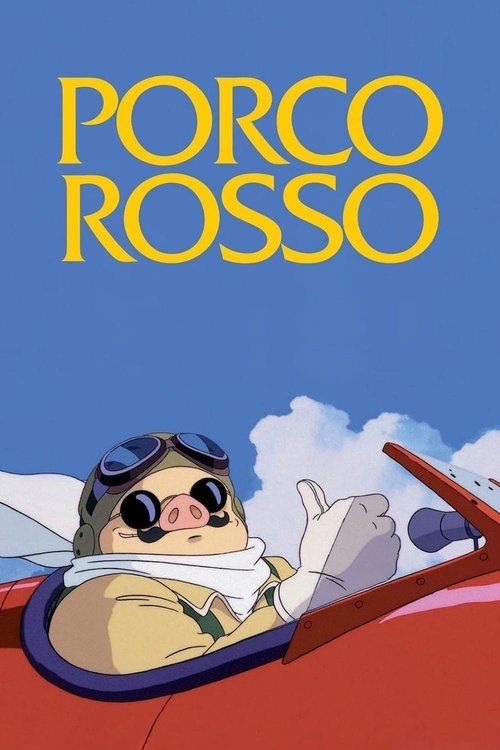
Porco Rosso
A sun-drenched aerial adventure where melancholy and honor collide, embodied by a crimson seaplane cutting through the Adriatic blue as a man's porcine mask hides the scars of a lost era.
Porco Rosso
Porco Rosso

紅の豚

"Can a pig really fly?"

18 July 1992 Japan 93 min ⭐ 7.8 (3,559)
Director: Hayao Miyazaki
Cast: Shūichirō Moriyama, Tokiko Kato, Bunshi Katsura VI, Tsunehiko Kamijô, Akemi Okamura
Animation War Family Fantasy Comedy Adventure
Anti-Fascism and Political Integrity Survivor's Guilt and Trauma The Romanticism of Flight Female Empowerment and Agency Midlife Disillusionment
Budget: $9,200,000
Box Office: $44,600,000

Porco Rosso - Ending Explained

⚠️ Spoiler Analysis

The film concludes with a chaotic fistfight between Porco and Curtis, which ends in a draw as both fall into the water. This physical confrontation strips away the 'heroic pilot' personas, leaving them as vulnerable men. When Gina arrives to warn them of the approaching Italian Air Force, Fio kisses Porco. In the immediate aftermath, Curtis reacts with shock to Porco's face, implying that the curse was momentarily broken.

The epilogue, narrated by an older Fio, leaves the final outcome ambiguous but provides subtle clues. A tiny red seaplane is visible parked near Gina's private garden during the final flyover, strongly suggesting that Marco finally visited her during the day, won the bet, and they spent their lives together. The curse is revealed not as a spell to be 'broken' by a kiss, but as a state of mind that Marco finally allows himself to move past by accepting love and forgiveness.

Alternative Interpretations

One popular interpretation is that the curse is purely psychological. From this perspective, Marco hasn't literally turned into a pig, but his survivor's guilt and self-hatred are so profound that he — and by extension, the world — can only perceive him as a beast. Supporting this is the fact that in moments of vulnerability or nobility, characters like Fio and Curtis briefly see him as a human.

Another reading suggests the film is an allegory for the loss of leftist ideals. Set in the interwar period, Porco (the 'Red Pig') represents the aging revolutionaries or communists (often called 'pigs' by fascists) who have gone into hiding or become cynical after their dreams of a better world were crushed by the reality of war and the rise of the far-right.