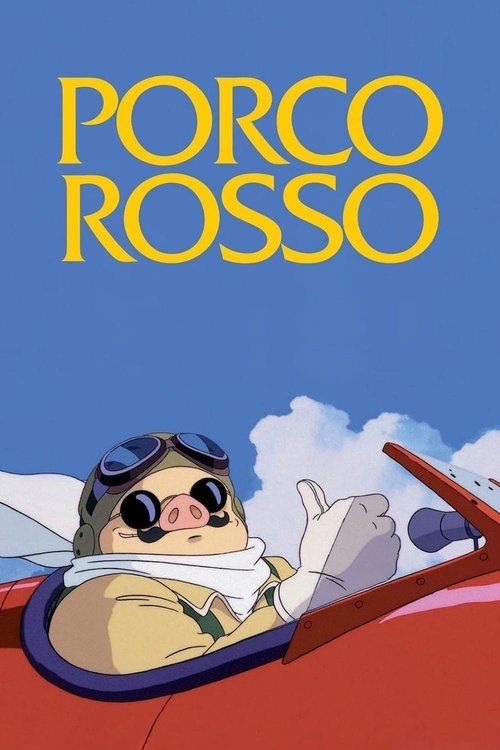
Porco Rosso
紅の豚
"Can a pig really fly?"
Overview
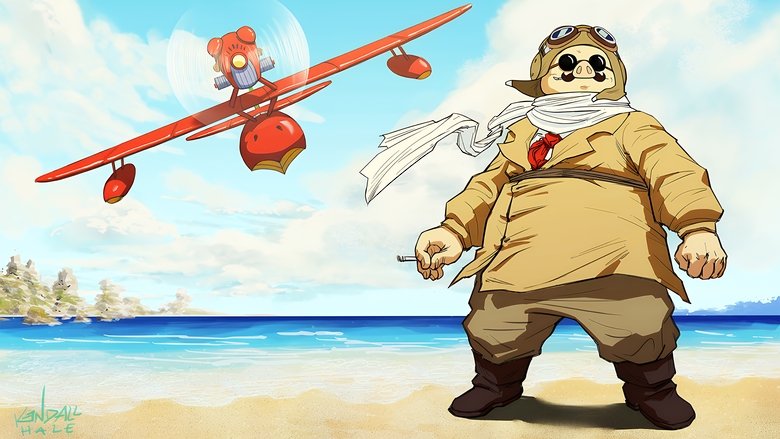
Set in the late 1920s against the breathtaking backdrop of the Adriatic Sea, Porco Rosso follows the exploits of Marco Pagot, a legendary World War I fighter ace. Following a mysterious incident that claimed his comrades, Marco has been transformed into an anthropomorphic pig and now lives as a freelance bounty hunter known as Porco Rosso. Operating from a secluded island hideout, he spends his days thwarting bumbling sky pirates and visiting the elegant Madame Gina at her Hotel Adriano.
The narrative shifts when a group of disgruntled pirates hires Donald Curtis, a brash American pilot, to eliminate Porco. After a disastrous initial skirmish that leaves his beloved red seaplane in ruins, Porco travels to Milan to seek repairs from his old friend Piccolo. There, he meets Fio, Piccolo's spirited and talented seventeen-year-old granddaughter, who insists on redesigning his plane and joining him on his journey home. As the fascist Italian government tightens its grip on the region, Porco must confront his past and navigate a final showdown with Curtis to regain his honor and protect those he loves.
Core Meaning
At its heart, Porco Rosso is a profound meditation on humanity and disillusionment. Director Hayao Miyazaki uses the protagonist's transformation as a metaphor for a man who has lost faith in the human race after witnessing the horrors of war and the rise of totalitarianism. By choosing to live as a 'pig' rather than a 'fascist,' Marco rejects the cruelty and greed he associates with human society.
The film explores the possibility of redemption through connection. While Porco attempts to 'fly solo' to avoid further pain, it is the unwavering hope of Fio and the enduring love of Gina that challenge his cynicism. The core message suggests that while we cannot escape the scars of our past or the ugliness of the world, we can find our humanity again through individual acts of courage, friendship, and the refusal to succumb to hate.
Thematic DNA
Anti-Fascism and Political Integrity
The film is explicitly set during the rise of Mussolini's Italy. Porco's refusal to rejoin the air force despite being a war hero serves as a stark rejection of nationalism. His famous line, "I'd rather be a pig than a fascist," encapsulates the theme of maintaining moral integrity in a corrupt political landscape.
Survivor's Guilt and Trauma
Marco's transformation is heavily implied to be a self-imposed curse resulting from the trauma of surviving a dogfight where all his friends died. The "belt of planes" sequence reveals his deep-seated belief that "the good ones are all dead," leading him to view himself as unworthy of human form.
The Romanticism of Flight
Miyazaki’s lifelong obsession with aviation is central here. Flight is depicted as a pure, liberating act that transcends earthly politics. The sky is a sanctuary where skill and honor matter more than the flags pilots fly under.
Female Empowerment and Agency
Through Fio and the all-female workforce at the Piccolo workshop, the film subverts traditional gender roles of the era. Fio’s technical brilliance and bravery are the catalysts for Porco’s personal growth, while Gina represents emotional strength and independent resilience.
Midlife Disillusionment
The film is often described as Miyazaki’s most autobiographical and "adult" work. It deals with the melancholy of aging, the loss of youthful ideals, and the complex, unrequited love of middle-aged characters who have lived through too much.
Character Analysis
Porco Rosso (Marco Pagot)
Shūichirō Moriyama
Motivation
To live life on his own terms, flying for his own pride rather than for a state or cause he despises.
Character Arc
Begins as a cynical, self-isolated bounty hunter who has 'given up' on being human. Through his friendship with Fio and his rivalry with Curtis, he slowly reconciles with his past and regains a flicker of faith in humanity.
Madame Gina
Tokiko Kato
Motivation
To see Marco return to his human self and find peace in their shared history.
Character Arc
A woman who has lost three husbands to aviation. She remains a pillar of elegance and strength, waiting for Marco to stop hiding behind his curse and notice her love.
Fio Piccolo
Akemi Okamura
Motivation
To prove her worth as an aircraft designer and to save Porco from his own cynicism.
Character Arc
A bright-eyed, talented engineer who breaks stereotypes. She doesn't have a traditional 'growth' arc so much as she serves as the moral compass that forces Porco to grow.
Master Piccolo
Bunshi Katsura VI
Motivation
To keep his business afloat and support his family, even if it means employing only women during the economic downturn.
Character Arc
An old friend of Porco who provides the technical means for his return to the sky. He represents the older generation's adaptability and loyalty.
The Boss of Mamma Aiuto
Tsunehiko Kamijô
Motivation
To make a living through piracy while maintaining a sense of community and code among the sky pirates.
Character Arc
Starts as a rival pirate but is revealed to be a sentimental and honorable man who deeply respects the 'rules' of the sky and the innocence of children.
Symbols & Motifs
The Porcine Curse
Symbolizes disillusionment and self-loathing. Marco sees humanity as 'ugly' due to war and fascism; by becoming a pig, he externalizes his rejection of human society and his own survivor's guilt.
Marco is the only character physically transformed, though the film hints that 'all middle-aged men are pigs' in a metaphorical sense.
The Belt of Planes
Represents a celestial afterlife or purgatory for pilots. It symbolizes the tragic, collective loss of life in war and the eternal, peaceful flight beyond earthly conflict.
Shown during a flashback to World War I where Porco watches his friends' planes ascend into a milky white stream of light in the high atmosphere.
The Crimson Seaplane (Savoia S.21)
A symbol of individual freedom and passion. The bright red color signifies both his nickname 'Rosso' and his defiance of the grey, standardized military forces.
The plane is Porco's home and livelihood; its destruction and rebirth mirror his own character arc.
Gina's Secret Garden
Symbolizes waiting, sanctuary, and unrequited love. It is a space untouched by the chaos of the outside world where hope still lives.
Gina makes a bet that if Porco visits her in the garden during the day, she will finally marry him.
Memorable Quotes
Fashisuto ni naru yori buta no hō ga mashi sa.
— Porco Rosso
Context:
Said to his former friend Ferrarin in a cinema when encouraged to rejoin the Italian Air Force.
Meaning:
This is the thematic backbone of the film, expressing a preference for being a social outcast (a 'pig') over a moral monster (a fascist).
Tobanai buta wa tada no buta da.
— Porco Rosso
Context:
Responding to Gina's concern for his safety and her plea for him to stop flying.
Meaning:
Implies that purpose and passion define existence; for Porco, if he stops flying, he loses the last thing that makes him more than just an animal.
Koko de wa ai wa totemo chigau no yo.
— Madame Gina
Context:
Said to Donald Curtis after he unsuccessfully tries to woo her with promises of Hollywood fame.
Meaning:
Reflects the unique, slow-burning, and often tragic nature of romance in a world constantly interrupted by flight and war.
Ii yatsu wa minna shin'da yo.
— Porco Rosso
Context:
Told to Fio during the quiet night scene as he recounts his experience in the war.
Meaning:
A direct expression of his survivor's guilt, indicating his belief that his survival was an accident or a mistake because he doesn't consider himself 'good.'
Philosophical Questions
Does our physical appearance dictate our humanity?
The film repeatedly contrasts Porco’s 'ugly' pig face with his noble, selfless actions. It asks if a man who looks like a beast but acts with honor is more 'human' than a man who looks human but acts like a monster (the fascists).
Can an individual remain neutral in a time of political polarization?
Porco tries to remain a bounty hunter 'for hire,' but the film suggests that in the face of fascism, true neutrality is impossible. His flight itself becomes an act of political resistance.
Alternative Interpretations
One popular interpretation is that the curse is purely psychological. From this perspective, Marco hasn't literally turned into a pig, but his survivor's guilt and self-hatred are so profound that he — and by extension, the world — can only perceive him as a beast. Supporting this is the fact that in moments of vulnerability or nobility, characters like Fio and Curtis briefly see him as a human.
Another reading suggests the film is an allegory for the loss of leftist ideals. Set in the interwar period, Porco (the 'Red Pig') represents the aging revolutionaries or communists (often called 'pigs' by fascists) who have gone into hiding or become cynical after their dreams of a better world were crushed by the reality of war and the rise of the far-right.
Cultural Impact
Porco Rosso holds a unique place in Studio Ghibli's filmography as it marks a departure from the studio's usual child-centric fantasies toward a more mature, European-influenced narrative. It was a massive commercial success in Japan, becoming the highest-grossing film of 1992, even outperforming Beauty and the Beast.
Internationally, the film solidified Miyazaki's reputation for detailed mechanical animation and historical world-building. Its political stance against fascism has made it a recurring cultural touchstone; for instance, Porco's 'better a pig than a fascist' quote was used in Spanish political circles as recently as 2023. The film also significantly influenced the portrayal of aviation in anime, leading to later works like The Wind Rises.
Audience Reception
Initially, some audiences were puzzled by a Ghibli film featuring an adult protagonist and complex political themes. However, it quickly grew into a beloved classic. Critics praise its sensory richness — the sound of the waves, the lighting of the cockpit — and its ability to balance slapstick humor with deep melancholy.
Audience reviews frequently highlight the ending's ambiguity as its most compelling feature. While some viewers find the lack of a clear 'happily ever after' frustrating, most appreciate the mature handling of unrequited love and the suggestion that Gina’s bet was eventually won.
Interesting Facts
- The film was originally commissioned by Japan Airlines (JAL) as a 45-minute in-flight short film to entertain passengers.
- The name 'Ghibli' is visible on the engine of Porco's new plane, a nod to the studio and the Italian aircraft Caproni Ca.309 Ghibli.
- Hayao Miyazaki has often drawn himself as a pig in self-portraits, making this film his most personal and autobiographical work.
- The Savoia S.21 is actually a fictitious aircraft, though Savoia-Marchetti was a real Italian aircraft manufacturer.
- The song Gina sings, 'Le Temps des cerises,' is a real French song associated with the Paris Commune, fitting the film's leftist undertones.
- The closing credits feature various drawings of pig-pilots, suggesting that the 'curse' of middle-aged men becoming pigs is a widespread phenomenon.
Easter Eggs
The 'Ghibli' Engine
When Porco's plane is being repaired, the word 'Ghibli' is clearly cast into the metal of the engine. While it refers to the studio, it's also historically accurate as Ghibli was a nickname for the Caproni aircraft and means 'desert wind' in Italian.
Sherlock Hound Reference
The name 'Marco Pagot' is a tribute to the Italian animator Marco Pagot, whose family collaborated with Miyazaki on the 1980s series Sherlock Hound.
⚠️ Spoiler Analysis
Click to reveal detailed analysis with spoilers
Frequently Asked Questions
Explore More About This Movie
Dive deeper into specific aspects of the movie with our detailed analysis pages
Comments (0)
No comments yet. Be the first to share your thoughts!