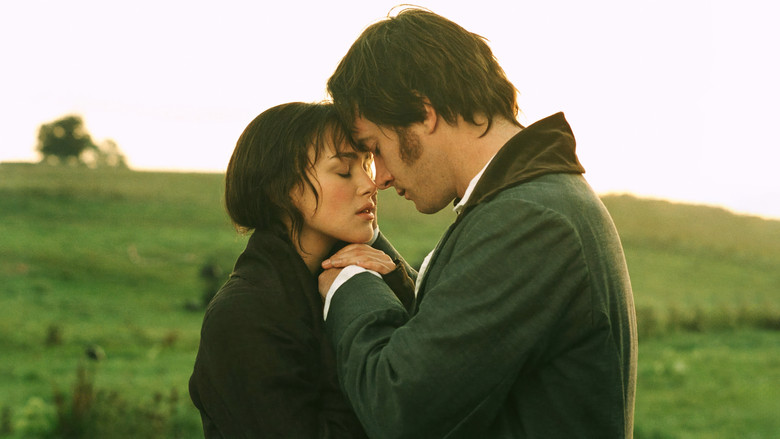

"Sometimes the last person on earth you want to be with is the one person you can't be without."
Pride & Prejudice - Symbolism & Philosophy
Symbols & Motifs
Hands
Hands symbolize connection, repressed desire, and the bridging of social divides. They are a recurring visual motif representing the unspoken emotions between Elizabeth and Darcy.
The most famous instance is Darcy's unscripted hand flex after helping Elizabeth into her carriage—a moment that conveys the profound impact of their brief physical contact. The camera also focuses on their hands when they dance, and later at Pemberley, emphasizing the tension and growing connection between them. This focus on hands offers a glimpse into their inner turmoil and burgeoning feelings in a society where open displays of emotion were constrained.
Nature and Landscapes
The natural landscapes of the English countryside reflect the characters' emotional states and the freedom from societal constraints. Nature represents a space for authenticity and introspection.
Elizabeth is frequently shown walking or standing in vast, beautiful landscapes, like the cliff edge. These scenes visually represent her independent spirit and contemplative nature. The raw, untamed scenery often contrasts with the formal, confined interiors of the stately homes, highlighting the difference between natural feeling and social artifice. The final proposal scene, set in the misty dawn fields, uses nature to create a backdrop of pure, unadorned romance.
Statues at Pemberley
The classical statues in Darcy's gallery at Pemberley symbolize his true character, stripped of his pride and the public's perception. They represent a timeless, idealized beauty and nobility that Elizabeth begins to see in him.
As Elizabeth tours Pemberley, she wanders through a hall of marble statues. The camera lingers on her as she observes the art, and then on a bust of Darcy himself. In this moment, surrounded by classical beauty and seeing him through the eyes of his housekeeper's fond testimony, her prejudice begins to dissolve. The statues represent a more permanent, essential truth about Darcy that lies beneath his difficult exterior.
The Swing
The swing Elizabeth uses at the Bennet home symbolizes both her youthful freedom and the contemplative, circular journey of her feelings and perspectives throughout the story.
Elizabeth is seen on the swing at different emotional points in the film. It represents a small, private space for thought and escape. The circular motion of the swing can be seen as a metaphor for her changing opinions of Darcy, moving from dislike to love as she revisits her initial judgments and gains new understanding.
Philosophical Questions
To what extent do first impressions and societal prejudices shape our understanding of others, and can we ever truly overcome them?
The film's central conflict revolves around this question. Elizabeth's and Darcy's initial meeting is a disaster of mutual misunderstanding. The narrative meticulously explores how their prejudices—Elizabeth's against Darcy's arrogance and Darcy's against her family's social standing—are constructed and then deconstructed. It suggests that overcoming these biases is an arduous process requiring self-reflection, humility, and a willingness to accept new information that contradicts one's initial beliefs. The film ultimately offers a hopeful answer: that through reason, empathy, and love, we can correct our flawed initial judgments to see the true nature of a person.
Is it possible to reconcile personal desire with social duty and expectation?
This question is explored through multiple characters. Elizabeth is a champion of personal desire, refusing to marry for any reason other than deep love, directly defying the social expectation for a woman in her position. Darcy, in contrast, is initially a figure of social duty, who is taught by his love for Elizabeth to prioritize his personal feelings. Charlotte Lucas provides the counter-argument, choosing social duty and security over personal desire entirely. The film seems to conclude that while reconciling the two is difficult and rare, the most fulfilling life is one where personal desire and authenticity are honored, even if it means challenging the status quo.
What is the true basis of a successful marriage: love, economic security, or social compatibility?
The film presents a spectrum of marriages. Lydia and Wickham's is based on fleeting passion and scandal. Charlotte and Mr. Collins's is a pragmatic business arrangement for security. Jane and Bingley's is a union of sweet, genuine affection and social suitability. The central relationship of Elizabeth and Darcy, however, suggests the ideal marriage is a deeper union. It is founded not just on passionate love, but on mutual respect, intellectual equality, and the growth that comes from challenging and improving one another. The film champions love as the foundation, but shows that the strongest love is one that has been tested and is built on a profound understanding of each other's character.
Core Meaning
Joe Wright's "Pride & Prejudice" is a passionate exploration of love's ability to transcend the rigid barriers of social class, preconceived notions, and personal pride. The film's core message is that true understanding and connection require looking beyond superficial first impressions and societal expectations to see the genuine character of a person. It suggests that love is not a simple, straightforward emotion but a transformative journey of self-discovery, humility, and the courage to challenge one's own biases. The director's focus on the emotional reality of its young characters, portraying them as people experiencing profound feelings for the first time, underscores the universal and timeless nature of love and the struggle for individual happiness in a world bound by convention.