Full spoilers follow.
The structure. The film is told in deliberately scrambled order, and the single most important thing to understand is that its final scene is not its chronological ending. In story order, the diner robbery and Jules's decision to leave the criminal life fall in the middle of events. Tarantino moves that scene to the end so that redemption becomes the film's last word, rather than an incident swallowed by everything that follows.
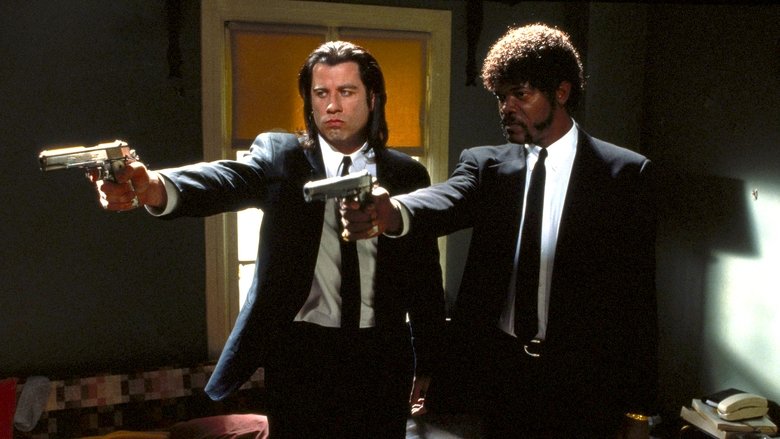
The opening apartment. Jules and Vincent retrieve Marsellus's briefcase and execute the young men who stole it. Jules performs his Ezekiel 25:17 speech first — scripture as an execution ritual he has never actually thought about. A hidden fourth man then empties a handgun at them at close range and misses with every shot. Jules reads this as divine intervention; Vincent insists it was a freak occurrence. This is the film's fork in the road, and everything else follows from which man is right.
The aftermath. Vincent accidentally shoots their passenger Marvin in the head in the car, forcing the pair to hide at Jimmie's house and summon Winston Wolfe to clean up. Stripped of their black suits and dressed in T-shirts and shorts, they go to the diner — where the film will eventually end.
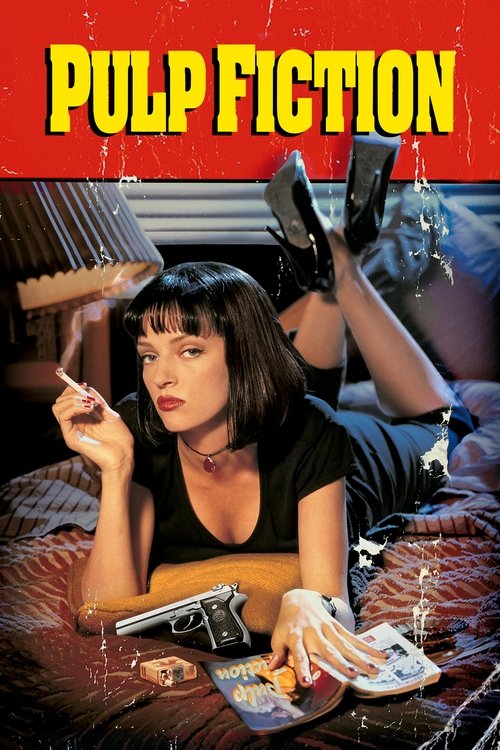
Mia Wallace. Vincent escorts his boss's wife to Jack Rabbit Slim's, where they win a twist contest. Back at the house, Mia finds Vincent's heroin in his coat pocket, mistakes it for cocaine, snorts it and overdoses. Vincent drives her to his dealer Lance's house and revives her with an adrenaline needle to the heart. They agree to keep the night secret from Marsellus. The rumour circulating earlier in the film — that Marsellus had a man thrown out of a window for giving Mia a foot massage — establishes exactly how lethal this evening was.
Butch. Paid by Marsellus to lose a fight, Butch bets on himself, kills his opponent in the ring and runs. He returns to his apartment for his father's gold watch — an heirloom carried through a prisoner-of-war camp and passed to him via his father's comrade Captain Koons — and finds Vincent, sent to kill him, emerging from the bathroom. Butch shoots Vincent dead with Vincent's own gun, left on the kitchen counter. This is why the film's chronology matters: Vincent is already dead when we later see him alive in the diner. The man who dismissed the miracle does not survive the day.
The pawnshop. Butch runs into Marsellus by chance in the street, hits him with his car, and the two crash into a pawnshop where shopkeeper Maynard knocks them out and delivers them to his associate Zed. Marsellus is raped in the basement. Butch frees himself, reaches the door — and turns back, arming himself with a katana to save the man who wants him dead. Marsellus kills Maynard's accomplice, declares he is "gonna get medieval" on Zed, and releases Butch on two conditions: he tells no one, and he leaves Los Angeles forever. Butch rides away on Zed's chopper, "Grace", with Fabienne — the film's one clean escape, purchased by an act of mercy nobody required of him.
The diner finale. We return to Jules and Vincent at breakfast, before Vincent's death. Pumpkin and Honey Bunny — the couple seen in the film's very first scene — hold up the restaurant and demand the briefcase. Jules disarms Pumpkin, then re-reads his own Ezekiel speech aloud, admitting he never considered what it meant. He decides he is trying to be the shepherd: he gives Pumpkin the money from his own wallet, lets both robbers walk out alive, and announces he is quitting the business. He and Vincent leave the diner with the briefcase.
The briefcase. Its contents are never shown — only a golden light on the faces of those who open it, and a combination of 666 in some readings. It is a textbook MacGuffin: an object whose only function is to move the plot. Tarantino has said it contains whatever the viewer wants it to contain, which is precisely the point — the film is about what men will do for a thing they cannot name.
What only becomes clear afterwards. On rewatch, the film reveals itself as a moral experiment with a control group. Two men receive identical evidence of something inexplicable. One reinterprets his life and walks out of the story alive; the other shrugs, keeps working, and is shot dead coming out of a bathroom by a man he was sent to kill. Tarantino never states the conclusion — but he arranges the timeline so that the last thing you carry out of the theatre is a killer choosing, for no profitable reason, not to kill.