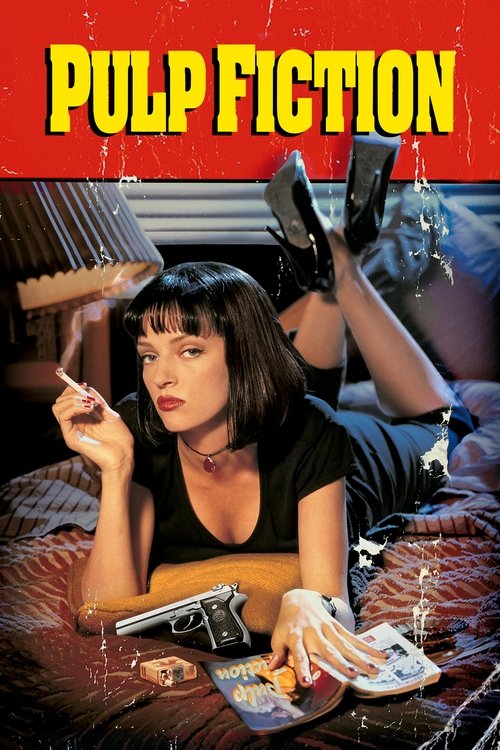
Pulp Fiction
"From the creator of 'True Romance' & 'Reservoir Dogs'"
Overview
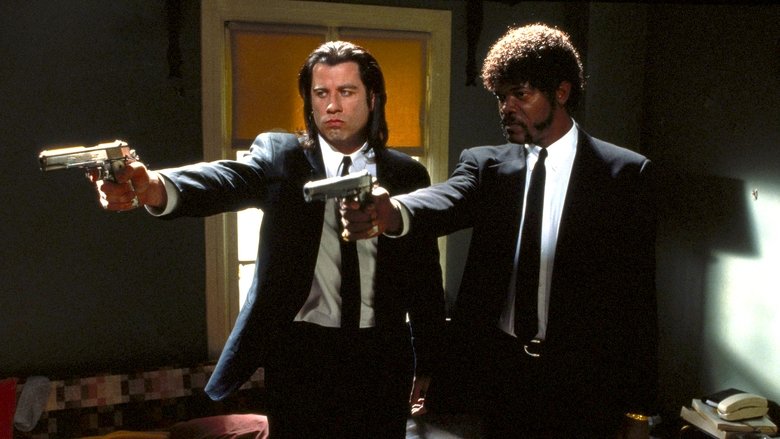
"Pulp Fiction" weaves together three main, interrelated stories of crime and redemption in Los Angeles, presented in a non-chronological order that challenges conventional narrative structure. The film follows Vincent Vega and Jules Winnfield, two hitmen for gangster Marsellus Wallace, as they navigate philosophical discussions, retrieve a mysterious briefcase, and handle a series of unexpected crises.
Another storyline centers on an aging boxer, Butch Coolidge, who is paid by Marsellus to throw a fight but decides to double-cross him, leading to a desperate escape. The third major thread involves Vincent escorting Marsellus's wife, Mia Wallace, for a night out that takes a perilous turn after an accidental drug overdose. These narratives intersect in unexpected ways, bookended by a robbery at a diner that brings key characters full circle, creating a unique and influential cinematic experience.
Core Meaning
The core meaning of "Pulp Fiction" revolves around the themes of chance, morality, and redemption in a world saturated with violence and pop culture. Director Quentin Tarantino explores the lives of criminals who are forced to confront profound moral questions in the midst of chaotic and often absurd situations. Jules's spiritual awakening after a 'miraculous' survival suggests that moments of grace and opportunities for redemption can appear in the most unlikely of circumstances. Ultimately, the film suggests that while life may be a series of random, violent events, the choices individuals make in those moments—to show mercy, to change their path, or to honor a code—define their character and offer a slim chance at salvation.
Thematic DNA
Redemption and Transformation
This theme is most prominently embodied by the character Jules Winnfield. After miraculously surviving a hail of bullets, he interprets the event as "divine intervention" and decides to renounce his life as a hitman. His transformation is highlighted in the final diner scene, where he de-escalates a robbery and reinterprets his signature 'Ezekiel 25:17' speech, not as a threat, but as a reflection on his desire to become a better man, or a "shepherd." This arc contrasts with his partner Vincent, who dismisses the event as a "freak occurrence" and ultimately meets a grim fate, suggesting that the failure to recognize or seize a chance for redemption has fatal consequences.
Chance vs. Divine Intervention
The film constantly plays with the idea of whether events are mere coincidence or part of a larger, perhaps divine, plan. The central debate between Jules and Vincent after the shootout encapsulates this theme. Jules believes God saved them for a reason, while Vincent sees it as pure luck. This theme extends to other storylines: Butch Coolidge coincidentally runs into his boss Marsellus Wallace while retrieving his father's watch, a chance encounter that leads to a violent, shared ordeal and an unexpected truce. The non-linear structure emphasizes how seemingly random moments can dramatically alter a character's destiny.
Morality in a Criminal World
"Pulp Fiction" presents a world of professional criminals who, despite their violent occupations, operate by their own distinct codes of honor and morality. Vincent and Jules are cold-blooded killers but engage in casual, philosophical debates about foot massages and divine justice. Marsellus Wallace, a ruthless crime boss, shows a form of honor by letting Butch go after Butch saves his life. The film blurs the lines between good and evil, showcasing characters who are complex and multi-faceted rather than simple villains.
Pop Culture and Postmodernism
The film is saturated with references to movies, television, and music, reflecting a postmodern sensibility where media and reality are intertwined. Characters discuss TV pilots, 1950s diners, and cultural differences about fast food. This self-reflexivity and homage to genre films (like film noir and hardboiled crime stories) became a hallmark of Tarantino's style. The title itself refers to pulp magazines known for their graphic violence and punchy dialogue, a style the film masterfully emulates and elevates.
Character Analysis
Jules Winnfield
Samuel L. Jackson
Motivation
Initially, Jules is motivated by his loyalty to his boss, Marsellus, and a professional pride in his work. After his epiphany, his motivation shifts entirely to achieving spiritual redemption and leaving his violent past behind.
Character Arc
Jules begins as a charismatic but ruthless hitman who enjoys the power of his position. His defining moment comes when he and Vincent survive a barrage of bullets unscathed. He interprets this as a miracle and a sign from God to change his ways. His arc is one of spiritual awakening; he transforms from a self-proclaimed "tyranny of evil men" to someone who wants to be "the shepherd," seeking a life of peace and purpose. He ends the film walking away from his life of crime.
Vincent Vega
John Travolta
Motivation
Vincent is primarily motivated by his job, his loyalty to Marsellus, and the pursuit of pleasure. He follows orders, whether it's retrieving a briefcase, taking the boss's wife to dinner, or dealing with problems as they arise. His motivation remains consistent and self-serving throughout his storyline.
Character Arc
Vincent Vega is a cool, detached, and pragmatic hitman who enjoys the hedonistic side of his criminal lifestyle, including his heroin use. Unlike his partner Jules, Vincent has no significant character arc. He dismisses the 'miracle' shootout as a fluke and continues his life unchanged. His story is a cautionary tale; his complacency and lack of introspection lead directly to his unceremonious death at the hands of Butch Coolidge, highlighting the consequences of remaining static in a chaotic world.
Mia Wallace
Uma Thurman
Motivation
Mia seems motivated by a desire to escape the boredom and isolation of her life. She seeks excitement and connection, which she finds briefly during her night out with Vincent. Her actions, such as snorting what she believes to be cocaine, are impulsive and driven by a search for a thrill.
Character Arc
Mia is introduced as the enigmatic and dangerous wife of a powerful gangster. While she fits the femme fatale archetype visually, the film subverts it by revealing her vulnerability and loneliness. Her arc within her segment, "Vincent Vega and Marsellus Wallace's Wife," is one of near-death and survival. After her overdose and subsequent revival via an adrenaline shot, she and Vincent share a moment of quiet understanding and agree to never speak of the incident, forming an unspoken bond forged in shared trauma.
Butch Coolidge
Bruce Willis
Motivation
Butch's primary motivation is to secure a future for himself and his girlfriend, Fabienne. This is deeply tied to honoring the memory of his father, symbolized by the gold watch he risks everything to retrieve. His actions are driven by a personal code of honor that ultimately outweighs his initial selfish plan.
Character Arc
Butch starts as a washed-up boxer seemingly motivated by greed, accepting a bribe to throw a fight. However, he shows his defiance and integrity by double-crossing Marsellus and winning the bout. His arc solidifies when he risks his life to save Marsellus from a horrific assault in the pawn shop basement. This act of honor and mercy earns him his freedom. His journey is about reclaiming his masculinity and honor, culminating in him riding off into the sunset with his girlfriend.
Symbols & Motifs
The Mysterious Briefcase
The briefcase is a classic MacGuffin—a plot device that motivates characters but whose contents are unimportant to the story itself. Its mysterious golden glow invites endless speculation. Popular theories suggest it contains Marsellus Wallace's soul (due to the "666" combination lock and the bandage on his head) or the diamonds from Reservoir Dogs. Co-writer Roger Avary stated it was originally written to contain diamonds, but Tarantino decided leaving it ambiguous was more interesting, allowing each viewer to imagine its contents.
Jules and Vincent are tasked with retrieving the briefcase for their boss, Marsellus Wallace, at the beginning of the film. Its contents are never revealed to the audience, but whoever looks inside is left in a state of awe. The glow was achieved on set by a simple orange light bulb inside the case. It serves as the catalyst for much of the film's initial action.
The Gold Watch
Butch's gold watch symbolizes his heritage, honor, and connection to his father. It represents a promise and a legacy passed down through generations of his family, who endured great hardship to protect it. It is his motivation for risking his life by returning to his apartment, driving his entire story arc forward.
In a flashback, a young Butch is given the watch by Captain Koons, a Vietnam War veteran who served with Butch's deceased father. Koons details the uncomfortable lengths to which both he and Butch's father went to hide and preserve the watch. As an adult, Butch's girlfriend Fabienne forgets to pack it when they are fleeing Marsellus, forcing him to confront his past and his enemies to retrieve it.
The Bathroom
The bathroom frequently serves as a space of vulnerability, consequence, and fateful encounters. It's a recurring motif where characters retreat, only to emerge into a dramatically changed, and often dangerous, situation. It highlights how mundane moments can intersect with life-altering violence.
Vincent Vega's trips to the bathroom have disastrous timing. When he is in the bathroom at Mia Wallace's house, she overdoses on his heroin. When he emerges from the bathroom during the diner robbery, the situation has escalated completely. Most significantly, when he is in the bathroom at Butch's apartment, he emerges to find Butch, who then kills him with his own gun.
Memorable Quotes
The path of the righteous man is beset on all sides by the inequities of the selfish and the tyranny of evil men...
— Jules Winnfield
Context:
Jules recites this passage twice in the film. First, in Brett's apartment before he and Vincent kill him. Second, in the diner during the robbery, where he explains its new, personal significance to the robber, Pumpkin.
Meaning:
This quote, a heavily altered version of a biblical passage, serves as Jules's intimidating calling card before an execution. Initially, he admits he says it because it sounds "cold-blooded." However, after his epiphany, he re-examines its meaning, contemplating his own role as either the "tyranny of evil men" or the "shepherd." It becomes the philosophical centerpiece of his character's transformation.
They call it a 'Royale with Cheese.'
— Vincent Vega
Context:
In the film's opening sequence for their storyline, Vincent and Jules are driving to an apartment to execute some men who have wronged their boss. On the way, Vincent tells Jules about his time in Amsterdam and the subtle cultural differences he observed in Europe, such as what McDonald's calls a Quarter Pounder in France.
Meaning:
This line exemplifies the film's signature dialogue: mundane, pop-culture-filled conversations set against a backdrop of criminal activity. It establishes Vincent's character as someone who has been abroad and highlights the film's focus on the small, observational details of its characters' lives. The juxtaposition of this trivial chat with their impending violent job is a key element of the movie's dark humor and cool detachment.
Zed's dead, baby. Zed's dead.
— Butch Coolidge
Context:
After escaping the pawn shop, Butch returns to the motel to pick up Fabienne. She asks him about the owner of the chopper motorcycle he has acquired. He delivers this line, informing her (and the audience) of the fate of one of the men who captured and assaulted him and Marsellus.
Meaning:
This quote is a darkly comedic and laconic confirmation that the immediate threat to Butch and his girlfriend has been neutralized. It signifies the end of Butch's harrowing ordeal and his victory over his tormentors. The casual delivery encapsulates the film's tone of understated coolness in the face of extreme violence and trauma.
That's when you know you've found somebody special. When you can just shut the fuck up for a minute and comfortably enjoy the silence.
— Mia Wallace
Context:
Mia says this to Vincent at Jack Rabbit Slim's diner. It's part of her attempt to break through Vincent's professional reserve and connect with him on a more personal level during their "date."
Meaning:
This line reveals a deeper, more introspective side to Mia's character, moving beyond her cool, party-girl exterior. It speaks to a desire for genuine connection and intimacy, a theme that subtly runs through the film's disparate storylines. It's a moment of surprising sincerity in a film celebrated for its sharp, witty dialogue.
Philosophical Questions
Do moments of grace or 'miracles' have the power to genuinely transform an individual's life?
The film explores this question through the divergent paths of Jules and Vincent. After they both survive what should have been a fatal shooting, Jules accepts it as a moment of divine intervention and a clear sign that he must change his life, leading him toward redemption. Vincent dismisses the same event as a "freak occurrence," a random bit of luck. He remains unchanged and his nihilistic path leads to his death. The film seems to suggest that the significance of such an event lies not in its objective reality as a miracle, but in one's willingness to perceive it as meaningful and act upon that perception.
What is the nature of honor and morality in a world devoid of conventional ethics?
"Pulp Fiction" presents a criminal underworld where traditional morality is absent, yet characters still adhere to personal codes of conduct. Jules and Vincent are killers but discuss the morality of giving a foot massage. Marsellus is a ruthless gangster, but when Butch saves his life from sadistic rapists, he reciprocates by forgiving Butch's debt and betrayal, demonstrating a code of honor. The film challenges the audience to find morality in these flawed characters, suggesting that virtues like loyalty, respect, and even mercy can exist outside the confines of the law.
Is human existence governed by random chance or a predetermined fate?
This is a central philosophical debate within the film. The non-linear narrative structure highlights the chaotic and unpredictable nature of life, where a series of coincidences can lead to profound consequences. Butch's accidental meeting with Marsellus, Vincent's ill-timed bathroom breaks, and the diner robbery all seem to be products of random chance. However, Jules's spiritual interpretation of his survival suggests a higher power at play. The film doesn't provide a definitive answer, leaving the audience to ponder whether the characters' lives are a meaningless series of events or guided by an unseen hand.
Alternative Interpretations
The most debated element of "Pulp Fiction" is the contents of the mysterious briefcase. While officially a MacGuffin, several popular fan theories offer alternative interpretations. One of the most famous theories posits that the briefcase contains Marsellus Wallace's soul. Proponents point to the briefcase's combination lock code of "666," the bandage on the back of Marsellus's head (where a soul might be extracted), and the ethereal golden glow that mesmerizes anyone who looks inside.
Another theory connects the film to Tarantino's other works, suggesting the briefcase holds the diamonds from the heist in Reservoir Dogs. This idea was considered by the writers but ultimately dismissed as "too boring and predictable." A similar crossover theory proposes it contains Elvis's gold suit from True Romance (which Tarantino wrote).
A more meta-interpretation suggests the briefcase is a symbol of cinema itself or contains an Oscar, representing Tarantino's own ambition. Ultimately, Tarantino and co-writer Roger Avary have maintained that the contents are deliberately ambiguous, meant to be whatever the viewer imagines.
Cultural Impact
"Pulp Fiction" was a cultural watershed that redefined independent cinema in the 1990s. Produced on a modest budget of around $8.5 million, its worldwide gross of over $213 million proved that unconventional, director-driven films could be massive commercial successes. This success revitalized Miramax Films and inspired a wave of indie filmmakers to pursue bold, non-linear storytelling with stylized dialogue and violence.
Roger Ebert called it "the most influential film of the decade," spawning numerous imitators that tried to capture its blend of neo-noir, black comedy, and pop-culture pastiche. The film's non-chronological structure, which was disorienting to some critics, was hailed by others as revolutionary and has been widely adopted in film and television since. It almost single-handedly revived the career of John Travolta, earning him an Oscar nomination, and propelled Samuel L. Jackson and Uma Thurman to A-list stardom.
Its impact on pop culture is immense and enduring. The film's dialogue, from "Royale with Cheese" to the Ezekiel 25:17 monologue, became instantly iconic and integrated into the cultural lexicon. The soundtrack, featuring surf rock and soul classics, revived interest in retro music. The film's aesthetic—from Mia Wallace's bob haircut to the characters' simple black suits—became a staple of 90s cool. Decades later, posters, parodies, and references to "Pulp Fiction" remain ubiquitous, cementing its status as a landmark of modern cinema.
Audience Reception
Upon its release, "Pulp Fiction" was met with widespread critical acclaim and became a cultural phenomenon. Audiences were captivated by its clever, endlessly quotable dialogue, unconventional non-linear narrative, and ironic blend of humor and strong violence. The performances were universally praised, particularly the career-revitalizing turn from John Travolta and the star-making roles for Samuel L. Jackson and Uma Thurman, all of whom received Oscar nominations.
Points of praise frequently centered on the film's originality and energy, with many viewers finding it a refreshing and electrifying departure from mainstream Hollywood filmmaking. The eclectic soundtrack was also a massive success, becoming inseparable from the film's identity. Criticism, though less common, was typically aimed at the film's graphic violence and extensive profanity. Some critics found its pop-culture-obsessed style to be self-indulgent or emotionally hollow. Overall, however, the audience verdict was overwhelmingly positive, solidifying the film's status as a modern classic and a fan favorite that continues to be celebrated for its coolness and rewatchability.
Interesting Facts
- The role of Vincent Vega was originally written for Michael Madsen, who played Vic Vega (Vincent's brother) in "Reservoir Dogs," but he turned it down.
- The iconic dance scene at Jack Rabbit Slim's was largely improvised, with John Travolta incorporating dance moves like The Batman and The Swim beyond the simple Twist that Tarantino had envisioned.
- The adrenaline shot scene was filmed in reverse; John Travolta pulled the needle out of Uma Thurman's chest, and the footage was reversed in post-production to create the effect of him plunging it in.
- The red 1964 Chevrolet Chevelle Malibu convertible driven by Vincent belonged to Quentin Tarantino in real life and was stolen shortly after the film's release.
- The expensive Jack Rabbit Slim's set was the single biggest cost of the production, built from scratch for about $150,000.
- The wallet belonging to Jules that reads "Bad Mother Fucker" is a reference to the 1971 film "Shaft."
- The role of Jules was written specifically for Samuel L. Jackson, but he almost lost it after a producer was impressed by another actor. Jackson's final, angry audition secured him the part.
- The Ezekiel 25:17 passage recited by Jules is not an exact biblical quote but was largely borrowed and modified from a 1976 Japanese martial arts film, "The Bodyguard."
Easter Eggs
The Big Kahuna Burger
This fictional Hawaiian-themed fast-food chain is a recurring brand in Quentin Tarantino's films. After its memorable appearance in "Pulp Fiction," it is also mentioned or seen in "Reservoir Dogs," "From Dusk Till Dawn," and "Once Upon a Time in Hollywood," helping to create a shared "Tarantino Universe."
The Vega Brothers Connection
Vincent Vega (John Travolta) from "Pulp Fiction" is the brother of Vic Vega, a.k.a. Mr. Blonde (Michael Madsen), from Tarantino's debut film, "Reservoir Dogs." Tarantino once planned a prequel film centered on the two brothers, but it never came to fruition.
Robert Rodriguez Directs Tarantino's Scene
Fellow filmmaker and close friend Robert Rodriguez directed the scene in which Tarantino's character, Jimmie, appears. This was a friendly collaboration between the two directors, who have often worked on each other's projects.
Mia Wallace's TV Pilot Description
Mia describes the failed TV pilot she starred in, "Fox Force Five," about a team of female secret agents. The description of the team members bears a striking resemblance to the members of the Deadly Viper Assassination Squad in Tarantino's later film, "Kill Bill," which also stars Uma Thurman.
⚠️ Spoiler Analysis
Click to reveal detailed analysis with spoilers
Frequently Asked Questions
Explore More About This Movie
Dive deeper into specific aspects of the movie with our detailed analysis pages
Comments (0)
No comments yet. Be the first to share your thoughts!