"I don’t go down for nobody."
Raging Bull - Symbolism & Philosophy
Symbols & Motifs
The Boxing Ring
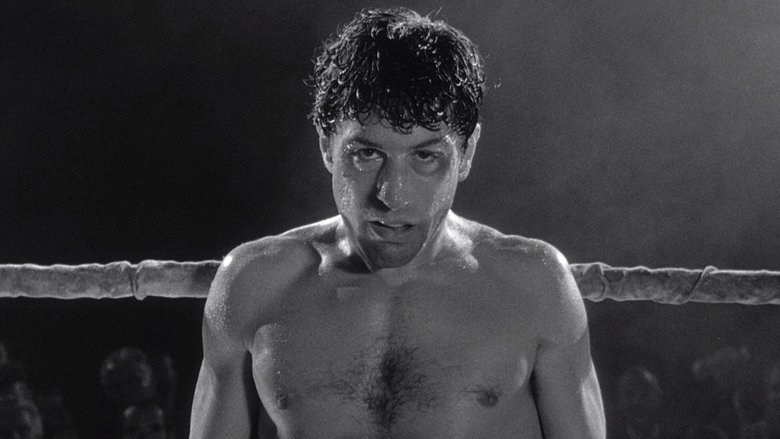
The ring is an allegory for Jake's life and internal state. It is the only place where his rage and self-destructive tendencies are celebrated and given purpose. It functions as a stage for his violent psychodrama, a place of both confession and punishment. Scorsese alters the ring's size throughout the film; it appears larger and more isolating when Jake feels helpless, and smaller or claustrophobic during moments of intense, personal conflict.
The ring is the setting for all of the film's boxing sequences. In his final, brutal fight against Sugar Ray Robinson, Jake willingly absorbs a horrific beating, leaning on the ropes in a pose reminiscent of a crucifixion, finding a perverse sense of absolution in the punishment.
Mirrors
Mirrors symbolize self-reflection and Jake's fractured self-perception. Throughout the film, Jake confronts his own image during moments of contemplation or crisis. Lacking the vocabulary to express his inner turmoil, gazing into a mirror is his primary method of self-examination.
The film is bookended by scenes of an older Jake LaMotta looking at himself in a dressing room mirror. The final, powerful scene has him reciting Marlon Brando's "I coulda been a contender" speech from "On the Waterfront" to his own reflection, suggesting a final, painful reckoning with the man he has become.
Water and Ice
Water serves as a motif with dual meanings. Early in the film, the sun-drenched swimming pool where he meets Vickie represents desire and a brief period of domestic hope. Conversely, cold water and ice symbolize suppression, detachment, and punishment.
After becoming aroused by Vickie before a fight, Jake pours a bucket of ice water on his lap to suppress his sexual desire, an act of self-denial that foreshadows his later destructive behavior. He also plunges his swollen hands into buckets of ice after fights, connecting the cold with the pain and consequence of his violent profession.
Animal Imagery
The motif of animals underscores Jake's primal, instinctual nature. His nickname is "The Bronx Bull," and his behavior is often described as animalistic. This symbolism culminates in his breakdown in jail where he screams, "I'm not an animal!", a desperate assertion of the humanity he fears he has lost.
Jake wears a leopard-print robe for his fights. After a domestic dispute, a neighbor yells, "He's an animal!" The sound design of the fight scenes reportedly includes distorted animal roars and screeches, blending the human and the beastial.
Philosophical Questions
Can a person find redemption without being forgivable?
The film forces the audience to grapple with the nature of redemption for a character who is, by most measures, irredeemable. Jake LaMotta is abusive, violent, and cruel. He never truly apologizes or atones in a conventional way. The film questions whether redemption is an external act of forgiveness from others or an internal state of self-awareness. Jake's final moments suggest a quiet reconciliation with himself, a recognition of his own failings. Does this personal, lonely acknowledgment count as redemption, even if he remains unforgiven by those he hurt and the world at large?
What is the relationship between violence, masculinity, and identity?
"Raging Bull" explores how identity, particularly a certain form of masculinity, can be pathologically intertwined with violence. For Jake, violence is not just an act; it is his primary mode of communication, self-expression, and self-worth. The film asks whether such a man can exist outside the context that rewards his violence (the boxing ring). When his ability to fight is gone, his identity collapses, leading to his pathetic downfall. It poses the uncomfortable question of how society shapes and rewards aggressive masculinity, only to condemn the man who cannot turn it off.
Is there a distinction between humanity and animalism?
The film constantly blurs the line between man and beast through its central "Raging Bull" metaphor. Jake's neighbors call him an animal, and his actions are often primal and instinct-driven. The film culminates in Jake's desperate cry, "I'm not an animal!" from his jail cell. This moment forces the question: what separates us from animals? Is it self-awareness? The capacity for guilt? The film suggests that this line is dangerously thin, and that denying one's own brutality and capacity for destruction is a path toward losing one's humanity entirely.
Core Meaning
The core meaning of "Raging Bull" is an exploration of self-destruction rooted in masculine insecurity and rage. Martin Scorsese uses the boxing ring not as a stage for athletic triumph, but as a brutal allegory for Jake LaMotta's internal life. The ring is the one place where his rage is rewarded, serving as a form of confession and penance for his sins outside it. The film posits that LaMotta's greatest opponent was never in the ring, but was always himself—his crippling jealousy, inability to express his emotions except through violence, and deep-seated self-loathing. Ultimately, it's a tragic examination of how a man's violent nature, fueled by fear and sexual inadequacy, can lead to complete alienation and the loss of everything he holds dear, questioning the very nature of redemption for such a deeply flawed individual.