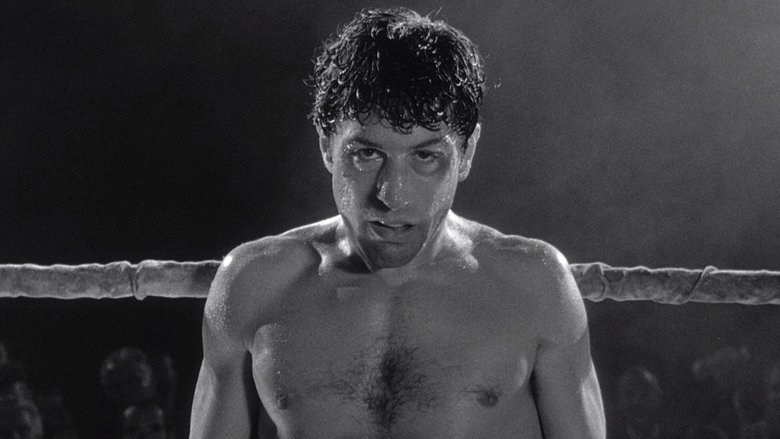
"I don’t go down for nobody."
Director: Martin Scorsese
Cast: Robert De Niro, Cathy Moriarty, Joe Pesci, Frank Vincent, Nicholas Colasanto
Raging Bull — Movie Quotes
Memorable Quotes
You never got me down, Ray.
Context
After the final, bloody bout against his rival Sugar Ray Robinson, a battered and defeated Jake stumbles over to Robinson's corner and speaks this line directly to him, just before the officials pull him away.
Meaning
This line, spoken to Sugar Ray Robinson after a brutal beating that costs him his title, encapsulates Jake's core identity. It's a defiant cry of masochistic pride. Even in a devastating loss, his refusal to be knocked down is his only victory. It highlights his philosophy that absorbing punishment is a form of strength and control.
I'm the boss. I'm the boss. I'm the boss. I'm the boss. I'm the boss.
Context
In their home, after an argument where Jake has been physically aggressive and accusatory towards Vickie, he stands over her, repeating this line in a desperate attempt to reassert his dominance.
Meaning
This frantic, repetitive chant reveals Jake's profound insecurity and his desperate need for control within his marriage. He repeats the phrase after a violent confrontation with Vickie, trying to convince both her and himself of an authority he feels slipping away due to his own paranoia and jealousy.
Did you f**k my wife?
Context
Jake confronts his brother Joey at home, asking him this question point-blank. When Joey's sarcastic and dismissive answers fail to satisfy him, Jake explodes, leading to a savage beating in front of Joey's wife and children.
Meaning
This question is the raw, brutal embodiment of Jake's all-consuming and unfounded jealousy. It is the catalyst for the film's most tragic moment of violence, the point of no return where Jake's paranoia leads him to destroy his most important relationship—the one with his brother.
I coulda been a contender. I could've been somebody, instead of a bum, which is what I am, let's face it.
Context
In the final scene of the film, an older, overweight Jake practices his nightclub act alone in a dressing room. He shadowboxes lightly before looking into the mirror and reciting this monologue to his own reflection.
Meaning
By reciting this iconic line from "On the Waterfront," Jake is not just mimicking Marlon Brando; he is adopting the words of another broken man to articulate his own profound sense of failure and regret. It is a moment of painful self-awareness where he confronts his wasted potential and the life his own actions have ruined. It's not a direct imitation of Brando, but rather Jake LaMotta's interpretation of another character's pain, making it a powerful and layered conclusion.
Explore More About This Movie
Dive deeper into specific aspects of the movie with our detailed analysis pages