
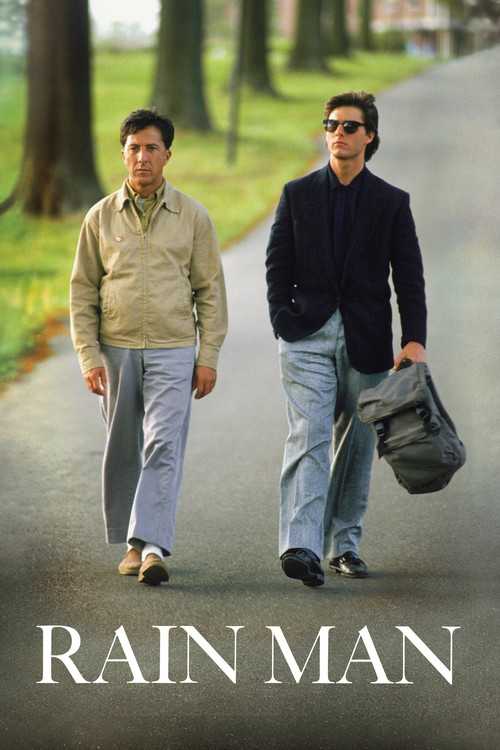
"A journey through understanding and fellowship."
Rain Man - Symbolism & Philosophy
Symbols & Motifs
The 1949 Buick Roadmaster
Symbolizes the father's legacy and the bridge between the brothers. Initially a source of conflict (Charlie was disowned for taking it), it becomes the vessel for their bonding and a literal vehicle for Charlie's emotional journey.
The car is present throughout the entire road trip; Charlie drives Raymond in the very car he was forbidden to touch as a teenager, reclaiming his heritage through his brother.
The "Rain Man" Name
Represents the distortion of childhood memory and the hidden protection of a brother. It is the phonetic corruption of "Raymond" by a toddler Charlie.
Charlie realizes that his imaginary childhood friend "Rain Man," who sang to him when he was scared, was actually his brother Raymond, unlocking the emotional core of the film.
The Camera and Photos
Raymond's way of documenting and ordering his world. It represents his objective, detached observation of reality, capturing moments he cannot emotionally process in real-time.
Raymond constantly takes photos during the trip. In the end credits, these photos are shown, allowing the audience to see the journey through Raymond's eyes.
Hot Water
Symbolizes danger and the trauma of separation. It explains the father's protective, albeit harsh, decision to institutionalize Raymond.
When Charlie turns on the hot water in a motel tub, Raymond panics, shouting "Hot water burn baby!" revealing that he nearly accidentally scalded Charlie as an infant, leading to his removal from the home.
Wallbrook Institution
Represents safety, routine, and isolation from the chaotic "real world." It is the womb-like environment Raymond needs but Charlie initially tries to rip him from.
The film begins and ends with Wallbrook, framing the journey as a temporary venture into the unknown before returning to safety.
Philosophical Questions
Does utility determine the value of a life?
Charlie initially values Raymond only for his inheritance and then his card-counting ability. The film challenges the viewer to find value in Raymond's existence simply for who he is, independent of his "usefulness" or social conformity.
Autonomy vs. Paternalism
The film raises the ethical dilemma of who gets to decide for Raymond. Does Charlie have the right to give him freedom if it endangers him? Does the state have the right to imprison him for his own safety? The ending suggests a compromise where safety wins, but the question of Raymond's desires remains ambiguous.
Core Meaning
At its heart, Rain Man is a story about the transformation of a man who sees people as objects into a man who learns to accept another human being on their own terms. It challenges the conventional movie trope of a "cure"; Raymond does not change or recover from his autism. Instead, the film argues that true connection requires the neurotypical individual (Charlie) to bridge the gap, promoting a message of acceptance over alteration. It posits that love is not about reciprocity, but about presence and understanding.