Rain Man
"A journey through understanding and fellowship."
Overview
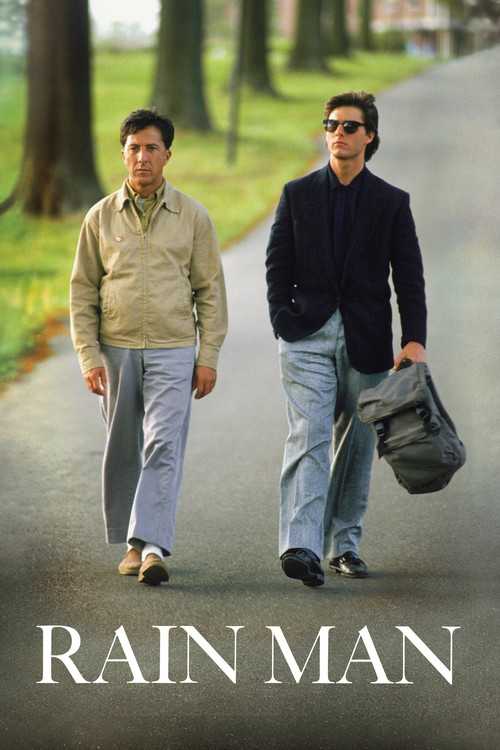
Charlie Babbitt (Tom Cruise) is a self-centered, debt-ridden Los Angeles car dealer who learns that his estranged father has died. Expecting a massive inheritance to save his business, he is shocked to discover that the $3 million estate has been bequeathed to an unnamed beneficiary at a mental institution in Cincinnati. There, Charlie meets his older brother, Raymond (Dustin Hoffman), an autistic savant whose existence was kept secret from him. Motivated by greed, Charlie "kidnaps" Raymond, intending to ransom him for half the inheritance.
Refusing to fly due to Raymond's intense fear of aviation disasters, the mismatched pair embarks on a cross-country road trip in their father's 1949 Buick Roadmaster. As they traverse the American landscape, Charlie is forced to adapt to Raymond's rigid routines and unique perception of the world. Through frustration, card-counting in Las Vegas, and resurfacing childhood memories, Charlie's mercenary goals slowly dissolve into a genuine, albeit complex, brotherly bond.
Core Meaning
At its heart, Rain Man is a story about the transformation of a man who sees people as objects into a man who learns to accept another human being on their own terms. It challenges the conventional movie trope of a "cure"; Raymond does not change or recover from his autism. Instead, the film argues that true connection requires the neurotypical individual (Charlie) to bridge the gap, promoting a message of acceptance over alteration. It posits that love is not about reciprocity, but about presence and understanding.
Thematic DNA
The Nature of Brotherhood
The film deconstructs the idea of family obligation versus genuine connection. Charlie starts by viewing Raymond as a financial asset (a "portable bank teller"), but the journey forces him to assume the role of a protector. The bond is solidified not through grand gestures, but through the shared ritual of the road and the recovery of the "Rain Man" memory, revealing that Raymond was the comforting figure of Charlie's lonely childhood.
Neurodiversity and Perception
Through Raymond, the film explores a different way of experiencing reality—one defined by patterns, statistics, and sensory overload. While criticized in modern contexts for establishing the "savant" stereotype, the film thematically emphasizes that Raymond's perspective is valid and consistent, contrasting his rigid honesty with Charlie's manipulative social duplicity.
Transformation and Redemption
Charlie's character arc is the film's emotional engine. He begins as a hyper-capitalist symbol of the 80s—impatient, shallow, and emotionally unavailable. His interactions with Raymond force him to slow down (literally and metaphorically) and develop patience, empathy, and selflessness, culminating in his decision to put Raymond's well-being above his own financial gain.
The Past vs. The Present
Charlie is running from his past (his father), while Raymond lives in a perpetual present defined by routine, yet has a perfect memory of the past. The road trip serves as a mechanism to reconcile Charlie with his history, specifically the painful memory of his mother's death and his father's perceived coldness, which is recontextualized by the revelation of why Raymond was sent away.
Character Analysis
Raymond Babbitt
Dustin Hoffman
Motivation
To maintain his routine and safety (watching "The People's Court," eating pancakes with maple syrup first) and to avoid sensory overload.
Character Arc
Raymond remains static in his condition; he does not "overcome" his autism. However, he experiences the world outside his institution, drives a car, dances, and makes a connection with Charlie, referencing him as "Main Man" by the end.
Charlie Babbitt
Tom Cruise
Motivation
Initially: To get his half of the $3 million inheritance. Finally: To protect and be with his brother.
Character Arc
Starts as an abrasive, materialistic narcissist. Through the trials of the road trip, he learns patience and selfless love, eventually realizing he wants his brother in his life more than the money.
Susanna
Valeria Golino
Motivation
To bring out the humanity in Charlie and treat Raymond with dignity.
Character Arc
She acts as the voice of reason and empathy, leaving Charlie when his cruelty peaks and returning when she sees his genuine care for Raymond. She facilitates the human connection Raymond needs.
Symbols & Motifs
The 1949 Buick Roadmaster
Symbolizes the father's legacy and the bridge between the brothers. Initially a source of conflict (Charlie was disowned for taking it), it becomes the vessel for their bonding and a literal vehicle for Charlie's emotional journey.
The car is present throughout the entire road trip; Charlie drives Raymond in the very car he was forbidden to touch as a teenager, reclaiming his heritage through his brother.
The "Rain Man" Name
Represents the distortion of childhood memory and the hidden protection of a brother. It is the phonetic corruption of "Raymond" by a toddler Charlie.
Charlie realizes that his imaginary childhood friend "Rain Man," who sang to him when he was scared, was actually his brother Raymond, unlocking the emotional core of the film.
The Camera and Photos
Raymond's way of documenting and ordering his world. It represents his objective, detached observation of reality, capturing moments he cannot emotionally process in real-time.
Raymond constantly takes photos during the trip. In the end credits, these photos are shown, allowing the audience to see the journey through Raymond's eyes.
Hot Water
Symbolizes danger and the trauma of separation. It explains the father's protective, albeit harsh, decision to institutionalize Raymond.
When Charlie turns on the hot water in a motel tub, Raymond panics, shouting "Hot water burn baby!" revealing that he nearly accidentally scalded Charlie as an infant, leading to his removal from the home.
Wallbrook Institution
Represents safety, routine, and isolation from the chaotic "real world." It is the womb-like environment Raymond needs but Charlie initially tries to rip him from.
The film begins and ends with Wallbrook, framing the journey as a temporary venture into the unknown before returning to safety.
Memorable Quotes
I'm an excellent driver.
— Raymond Babbitt
Context:
Said repeatedly, most notably when Charlie lets him drive the Buick slowly in a parking lot.
Meaning:
A mantra Raymond uses to self-soothe and assert competence. It becomes an iconic line representing his unique, innocent perspective.
K-Mart sucks.
— Raymond Babbitt
Context:
Charlie tells Raymond this "secret" when Raymond insists on buying his boxer shorts at K-Mart.
Meaning:
Demonstrates Raymond's blunt honesty and reliance on consumer habits/brands as anchors for his reality. Also serves as a humorous bonding moment.
C-H-A-R-L-I-E, my main man.
— Raymond Babbitt
Context:
Said by Raymond towards the end of the film (and at the train station) as they say goodbye.
Meaning:
The ultimate sign of affection and recognition from Raymond. It signifies that Charlie has become a permanent, trusted part of his world.
One for bad. Two for good.
— Raymond Babbitt
Context:
Used throughout the film to make decisions; Charlie repeats "Bet two for good" at the end.
Meaning:
Raymond's binary system for navigating the world, which Charlie adopts to communicate with him.
Ten minutes to Wapner.
— Raymond Babbitt
Context:
Raymond panics whenever they are in danger of missing the show, forcing Charlie to stop at random farmhouses to find a TV.
Meaning:
Highlights Raymond's absolute need for routine and his obsession with "The People's Court," which dictates the schedule of their entire trip.
Philosophical Questions
Does utility determine the value of a life?
Charlie initially values Raymond only for his inheritance and then his card-counting ability. The film challenges the viewer to find value in Raymond's existence simply for who he is, independent of his "usefulness" or social conformity.
Autonomy vs. Paternalism
The film raises the ethical dilemma of who gets to decide for Raymond. Does Charlie have the right to give him freedom if it endangers him? Does the state have the right to imprison him for his own safety? The ending suggests a compromise where safety wins, but the question of Raymond's desires remains ambiguous.
Alternative Interpretations
The Cynical/Tragic Reading: Some critics argue that the film is not about Raymond at all, but entirely about Charlie. In this view, Raymond is merely a narrative device or "prop" used to redeem the yuppie protagonist, possessing no true agency of his own. The ending, where he returns to the institution, can be seen as society's inability to integrate neurodivergent individuals.
The "Love Story" Reading: Director Barry Levinson has described it as a love story between two brothers who can never truly touch. The tragedy is that just as they find a way to communicate, they must separate for Raymond's safety, making it a story about the sacrifices required by genuine love.
Cultural Impact
Rain Man was a cultural phenomenon that single-handedly brought the concept of autism to the general public's awareness. Before 1988, autism was largely misunderstood or unknown to the masses; the film sparked a global conversation and increased funding and research.
However, its legacy is complex. While it humanized neurodivergence, it also established the "Autistic Savant" stereotype—the misconception that all autistic people have "superpowers" like card counting or eidetic memory. This trope has persisted in media for decades (e.g., The Good Doctor). Commercially, it was the highest-grossing film of 1988 and won four Academy Awards, including Best Picture and Best Actor for Hoffman, solidifying Tom Cruise's status as a dramatic actor capable of holding his own against screen legends.
Audience Reception
Upon release, Rain Man was universally embraced by audiences and critics alike, praised for its unsentimental yet touching direction and the chemistry between the leads. Hoffman's performance was lauded as a masterclass, though some modern reviews criticize it as "cripface" or overly mannered. The film holds a high approval rating, with audiences appreciating the emotional payoff of the brotherly bond. Criticism generally focuses on the dated portrayal of autism and the "magical negro" style trope applied to disability, where the disabled character exists to enlighten the privileged protagonist.
Interesting Facts
- Dustin Hoffman originally wanted to play the role of Charlie Babbitt, but was moved to tears by the savant character and switched roles.
- The scene where Raymond farts in the phone booth was improvised; Hoffman actually passed gas, and the dialogue that followed was a genuine reaction between him and Cruise.
- The film was shot sequentially (in the order of the story) to help the actors develop their characters' relationship organically.
- Dustin Hoffman based his character largely on Kim Peek, a real-life savant with an eidetic memory, as well as Peter Guthrie for the distinctive shuffling walk.
- Director Barry Levinson has a cameo as the psychiatrist at the end of the film who evaluates Raymond.
- Qantas Airlines is famously mentioned as the only airline that has 'never crashed' (at least no jet fatalities at the time), which was a specific detail Levinson included, leading Qantas to show the film on flights while other airlines cut the scene.
- Jack Nicholson and Robert De Niro both turned down the role of Raymond before it went to Hoffman.
Easter Eggs
Cruise's Birthday on the Windshield
The numbers on the windshield of the red sports car at the beginning of the film are '3762'. Tom Cruise's birthday is July 3, 1962 (3/7/62).
Vernon Manor Hotel Address
Raymond repeatedly mentions buying his underwear at K-Mart at '400 Oak Street.' This is the actual address of the Vernon Manor Hotel in Cincinnati, where the cast and crew stayed during filming.
97X Bam! Sticker
Raymond repeats the radio tagline '97X, Bam! The future of Rock and Roll.' This is a real radio station (WOXY) in Oxford, Ohio, and the tagline is a genuine local reference.
⚠️ Spoiler Analysis
Click to reveal detailed analysis with spoilers
Frequently Asked Questions
Explore More About This Movie
Dive deeper into specific aspects of the movie with our detailed analysis pages
Comments (0)
No comments yet. Be the first to share your thoughts!