
乱
"In a mad world, only the mad are sane."
Ran - Symbolism & Philosophy
Symbols & Motifs
The Three Arrows
The three arrows initially symbolize Hidetora's plea for unity among his sons. He demonstrates that a single arrow is easily broken, but a bundle of three is strong, representing his hope that his sons will remain united.
In an early scene, Hidetora uses the arrows as a lesson. However, Saburo shatters the symbolism by breaking the bundle over his knee, correctly predicting that the brothers' inherent treachery makes unity impossible. This act foreshadows the complete fracturing of the Ichimonji clan.
The Burning Castle
The destruction of the Third Castle by fire is a powerful symbol of the collapse of Hidetora's legacy, power, and sanity. It represents the complete annihilation of the Ichimonji clan's dominion and the physical manifestation of the "chaos" engulfing the kingdom.
During the siege by Taro and Jiro's armies, Hidetora is trapped inside the burning keep. His emergence from the inferno, stunned and ghost-like, marks his final descent into madness. The iconic, silent sequence of him walking down the steps of the blazing castle is a visual centerpiece of the film.
The Fox
The fox motif is associated with Lady Kaede and symbolizes her cunning, vengeful, and destructive nature. In Japanese folklore, foxes (kitsune) are often depicted as intelligent, trickster spirits with the power to deceive and manipulate humans.
Hidetora's fool, Kyoami, refers to the ruins of a fox's den on the castle grounds, a place where a vixen spirit is said to have lived. This is a direct reference to Lady Kaede, whose family Hidetora destroyed to claim the castle. Her subsequent actions—manipulating both Taro and Jiro—embody the vengeful spirit of the kitsune, bringing ruin upon the Ichimonji clan from within.
Clouds and Sky
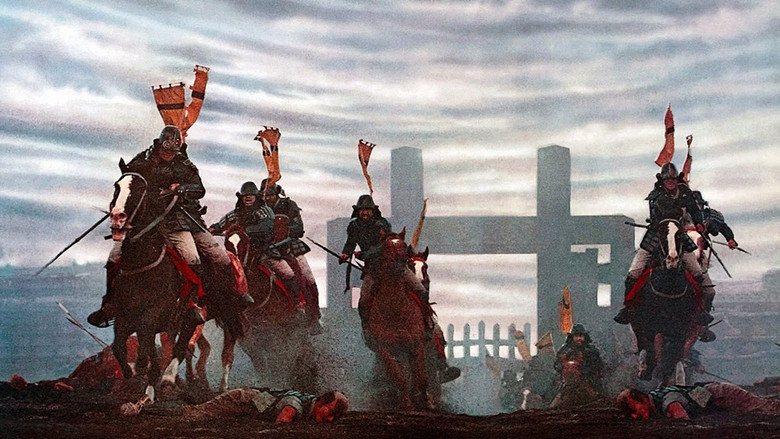
The recurring shots of the sky and clouds serve as a motif representing a vast, indifferent cosmos or the heavens, which look down upon human folly without intervention. They create a sense of scale, dwarfing the characters' struggles and emphasizing the ultimate insignificance of their violent conflicts in the face of nature and eternity.
Kurosawa frequently cuts from scenes of intense human drama and brutal warfare to serene, painterly shots of the sky. This juxtaposition highlights the contrast between the chaos of the human world and the impassive, enduring power of the natural world, reinforcing the film's nihilistic themes.
Blindness
Blindness in "Ran" symbolizes a lack of foresight, moral clarity, and spiritual guidance. Hidetora is metaphorically blind to his sons' true nature, while the literally blind Tsurumaru represents the innocent victims of Hidetora's past cruelty and the state of humanity in a chaotic world.
Hidetora's initial blindness to his folly leads to his downfall. He later encounters Tsurumaru, a young man he blinded years ago after slaughtering his family. The film's final shot is of the blind Tsurumaru, alone at the edge of a cliff, having dropped his scroll of the Buddha, a powerful image suggesting that humanity is lost and abandoned, unable to see the path forward.
Philosophical Questions
Is humanity doomed to a perpetual cycle of violence?
The film relentlessly explores this question, largely answering in the affirmative. Hidetora built his kingdom through violence, and his sons continue this legacy, turning it upon him and each other. The narrative structure is cyclical, with past atrocities directly causing present conflicts (like Lady Kaede's revenge). The final dialogue between Tango and Kyoami, where they conclude the gods can only weep at humanity's endless self-destruction, suggests this cycle is an inherent part of the human condition, unbreakable and eternal.
In a world without divine justice, what is the meaning of suffering?
"Ran" portrays a universe where there are no gods to intervene or dispense justice. The virtuous, like Lady Sué and Saburo, suffer and die just as the wicked do. Hidetora's suffering leads to a moment of tragic self-awareness, but it does not bring redemption or restore order. The film seems to conclude that suffering in this world is meaningless and arbitrary. It is simply the consequence of human cruelty and ambition, a state of being in a chaotic, indifferent cosmos, as expressed in Kyoami's final, desperate cries to a silent heaven.
Does power inevitably corrupt?
The film serves as a powerful illustration of the adage that "power corrupts." Hidetora's long reign made him arrogant and blind to the truth. The moment his sons, Taro and Jiro, inherit power, it immediately warps their judgment and fuels their greed, leading them to betray their father and each other. Even the desire for power is enough to start the destructive chain of events. The film presents power not as a tool for governance but as a poison that erodes morality, loyalty, and family.
Core Meaning
The core meaning of "Ran" is a profound and nihilistic exploration of the destructive nature of power, ambition, and the ensuing chaos that follows the breakdown of order and loyalty. Director Akira Kurosawa uses the framework of Shakespeare's "King Lear" to paint a bleak picture of humanity, suggesting that the cycles of violence and betrayal are inescapable. Hidetora, a man who built his kingdom through ruthless violence, finds that the same brutality is turned upon him by his own sons, illustrating that the legacy of violence is self-perpetuating.
The film critiques the very notion of authority and power, portraying it as a corrupting force that inevitably leads to suffering and destruction. There is a sense of cosmic indifference to human suffering; as characters cry out to the gods, they are met with silence, suggesting a world where humanity is left to its own self-destructive devices. The final, haunting image of the blind Tsurumaru teetering on the edge of a cliff encapsulates the film's message: in a world consumed by chaos, humanity is blind, abandoned, and on the brink of its own annihilation, with no salvation in sight.