Ran
乱
"In a mad world, only the mad are sane."
Overview
"Ran," which translates to "chaos," is a 1985 epic historical drama directed by the legendary Akira Kurosawa. The film is a reimagining of William Shakespeare's "King Lear," set in the tumultuous Sengoku period of feudal Japan. It tells the story of Hidetora Ichimonji, an aging and powerful warlord who, after a lifetime of brutal conquest, decides to abdicate his throne and divide his kingdom among his three sons: Taro, Jiro, and Saburo.
Hidetora expects this act to bring him a peaceful retirement, with his sons honoring and protecting him. However, his youngest and most honest son, Saburo, bluntly tells him that his plan is naive and will lead to ruin, for which he is promptly banished. True to Saburo's prediction, Hidetora's two elder sons, spurred on by their own ambition and the manipulations of their wives, quickly turn against their father, stripping him of his power, his retinue, and his dignity.
Cast out and descending into madness, Hidetora wanders the desolate landscapes he once conquered, accompanied only by his loyal fool, Kyoami. The brothers, meanwhile, wage a devastating war against each other for ultimate control, plunging the kingdom into the very chaos their father had sought to avoid. The film is a visually stunning and deeply pessimistic meditation on the cyclical nature of violence, the corrupting influence of power, and the fragility of family bonds in a world devoid of divine grace.
Core Meaning
The core meaning of "Ran" is a profound and nihilistic exploration of the destructive nature of power, ambition, and the ensuing chaos that follows the breakdown of order and loyalty. Director Akira Kurosawa uses the framework of Shakespeare's "King Lear" to paint a bleak picture of humanity, suggesting that the cycles of violence and betrayal are inescapable. Hidetora, a man who built his kingdom through ruthless violence, finds that the same brutality is turned upon him by his own sons, illustrating that the legacy of violence is self-perpetuating.
The film critiques the very notion of authority and power, portraying it as a corrupting force that inevitably leads to suffering and destruction. There is a sense of cosmic indifference to human suffering; as characters cry out to the gods, they are met with silence, suggesting a world where humanity is left to its own self-destructive devices. The final, haunting image of the blind Tsurumaru teetering on the edge of a cliff encapsulates the film's message: in a world consumed by chaos, humanity is blind, abandoned, and on the brink of its own annihilation, with no salvation in sight.
Thematic DNA
The Cycle of Violence and Retribution
"Ran" powerfully illustrates the theme that violence begets more violence. Lord Hidetora built his empire through brutal conquest, slaughtering other lords and their families. In his old age, he becomes a victim of the very same cruelty at the hands of his own children and the vengeful Lady Kaede, whose family he destroyed. The film posits that the seeds of future conflict are sown in past atrocities, creating an inescapable cycle of retribution that consumes everyone involved, leaving only devastation in its wake.
The Futility and Chaos of War
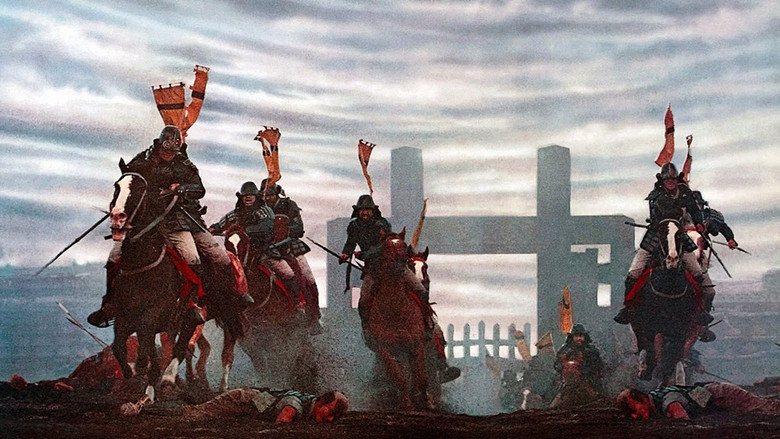
The film's title, "Ran," translates to "chaos," a theme that permeates every frame. Kurosawa presents war not as a glorious or heroic endeavor, but as a senseless and destructive force that obliterates honor, loyalty, and life without distinction. The epic battle scenes are depicted with a stark, brutal beauty, often accompanied by a mournful score that replaces the sounds of combat, transforming the slaughter into a tragic, silent ballet of death. This stylistic choice emphasizes the ultimate futility and horror of conflict.
Betrayal and the Disintegration of Family
At its heart, "Ran" is a story of familial collapse. Hidetora's decision to divide his kingdom, born of a foolish trust in his sons' loyalty, directly leads to their betrayal. The bonds of blood prove meaningless in the face of greed and ambition, as Taro and Jiro turn on their father and then each other. Saburo's genuine loyalty is tragically punished. This theme explores the fragility of human relationships when tested by the corrupting influence of power, showing how family can be the most vicious battlefield.
Nihilism and the Absence of Divine Justice
"Ran" offers a deeply pessimistic, nihilistic worldview. Characters frequently question the existence of gods or Buddha, and the suffering they endure goes unanswered. Kyoami the fool screams at the heavens, accusing the gods of being cruel and mischievous, while Tango suggests the gods can only weep for humanity's self-destructive nature. The film suggests a universe devoid of moral order or divine intervention, where humans are left to their own cruel devices, endlessly repeating the same mistakes.
Character Analysis
Lord Hidetora Ichimonji
Tatsuya Nakadai
Motivation
Initially, his motivation is to secure a peaceful retirement while retaining the title and respect of a Great Lord. He naively believes he can control his legacy and enforce unity among his ambitious sons. Ultimately, his motivation becomes simple survival and a desperate, maddened search for meaning in the chaos he has unleashed.
Character Arc
Hidetora begins as a powerful, arrogant, and ruthless warlord who has built his kingdom through a lifetime of violence. Believing he can orchestrate a peaceful end to his life, he foolishly divides his power, an act of pride that triggers his downfall. He is betrayed by his sons, stripped of all authority, and cast out into the wilderness, where he descends into madness. Through immense suffering, he is humbled and comes to recognize his past sins and the folly of his actions, but this realization comes too late, leading to his death from grief upon the loss of his one loyal son.
Lady Kaede
Mieko Harada
Motivation
Her sole motivation is revenge. Every action she takes is a calculated step toward the complete annihilation of the Ichimonji clan to avenge the murder of her family and the theft of her ancestral home.
Character Arc
Lady Kaede is introduced as the wife of the eldest son, Taro. It is revealed that her family was slaughtered by Hidetora so he could seize their castle. Her entire existence is a carefully constructed performance, hiding a burning desire for vengeance. After Taro's death, she seduces his brother Jiro, manipulating him to secure her position and continue her plot to destroy the Ichimonji clan from within. She remains a cold, calculating, and ruthless figure until the very end, finding a grim vindication in the family's ruin before she is killed.
Jiro Ichimonji
Jinpachi Nezu
Motivation
Jiro is driven by an insatiable lust for power. He wants to usurp his older brother and rule the entire kingdom, believing himself more worthy and capable than Taro. His ambition is easily manipulated by others, particularly Lady Kaede.
Character Arc
Jiro, the middle son, is ambitious and ruthless. Initially overshadowed by his older brother Taro, he quickly sees an opportunity in the family conflict. He betrays his father and conspires to have Taro killed so he can seize power for himself. Manipulated by Lady Kaede, he becomes the new Great Lord but is consumed by paranoia and the endless warfare required to hold his position. His ambition leads to the death of his virtuous wife, Lady Sué, and ultimately leaves him as the sole, cursed survivor of the Ichimonji clan, ruling over a wasteland.
Saburo Ichimonji
Daisuke Ryū
Motivation
Saburo is motivated by a genuine, albeit harsh, love and loyalty for his father. He wants to protect Hidetora from his own foolishness and from the inevitable betrayal of his brothers. His final act is one of forgiveness and rescue.
Character Arc
Saburo, the youngest son, is defined by his blunt honesty and genuine loyalty. He is the only one who sees the folly in his father's plan and speaks the truth, which leads to his banishment. He proves his loyalty by returning with an army not to conquer, but to save his father from Jiro. He succeeds in reconciling with the repentant Hidetora, but in a tragic twist of fate, he is killed by a sniper's bullet moments after their reunion. His death represents the destruction of hope, loyalty, and goodness in a world consumed by chaos.
Kyoami
Peter (Shinnosuke Ikehata)
Motivation
Kyoami is motivated by loyalty to his master. Despite the abuse he sometimes suffers, he stays with Hidetora through his madness and downfall, offering what little comfort and harsh truth he can.
Character Arc
Kyoami is Hidetora's court jester. Like the Fool in "King Lear," he uses wit and sarcasm to speak truth to power, often mocking Hidetora's foolishness while remaining fiercely loyal. He follows Hidetora into exile and madness, acting as his sole companion and a cynical commentator on the unfolding tragedy. Kyoami's journey is from a comic relief figure to a voice of despair, culminating in him screaming at the heavens, questioning the cruelty of the gods after the deaths of Hidetora and Saburo.
Symbols & Motifs
The Three Arrows
The three arrows initially symbolize Hidetora's plea for unity among his sons. He demonstrates that a single arrow is easily broken, but a bundle of three is strong, representing his hope that his sons will remain united.
In an early scene, Hidetora uses the arrows as a lesson. However, Saburo shatters the symbolism by breaking the bundle over his knee, correctly predicting that the brothers' inherent treachery makes unity impossible. This act foreshadows the complete fracturing of the Ichimonji clan.
The Burning Castle
The destruction of the Third Castle by fire is a powerful symbol of the collapse of Hidetora's legacy, power, and sanity. It represents the complete annihilation of the Ichimonji clan's dominion and the physical manifestation of the "chaos" engulfing the kingdom.
During the siege by Taro and Jiro's armies, Hidetora is trapped inside the burning keep. His emergence from the inferno, stunned and ghost-like, marks his final descent into madness. The iconic, silent sequence of him walking down the steps of the blazing castle is a visual centerpiece of the film.
The Fox
The fox motif is associated with Lady Kaede and symbolizes her cunning, vengeful, and destructive nature. In Japanese folklore, foxes (kitsune) are often depicted as intelligent, trickster spirits with the power to deceive and manipulate humans.
Hidetora's fool, Kyoami, refers to the ruins of a fox's den on the castle grounds, a place where a vixen spirit is said to have lived. This is a direct reference to Lady Kaede, whose family Hidetora destroyed to claim the castle. Her subsequent actions—manipulating both Taro and Jiro—embody the vengeful spirit of the kitsune, bringing ruin upon the Ichimonji clan from within.
Clouds and Sky
The recurring shots of the sky and clouds serve as a motif representing a vast, indifferent cosmos or the heavens, which look down upon human folly without intervention. They create a sense of scale, dwarfing the characters' struggles and emphasizing the ultimate insignificance of their violent conflicts in the face of nature and eternity.
Kurosawa frequently cuts from scenes of intense human drama and brutal warfare to serene, painterly shots of the sky. This juxtaposition highlights the contrast between the chaos of the human world and the impassive, enduring power of the natural world, reinforcing the film's nihilistic themes.
Blindness
Blindness in "Ran" symbolizes a lack of foresight, moral clarity, and spiritual guidance. Hidetora is metaphorically blind to his sons' true nature, while the literally blind Tsurumaru represents the innocent victims of Hidetora's past cruelty and the state of humanity in a chaotic world.
Hidetora's initial blindness to his folly leads to his downfall. He later encounters Tsurumaru, a young man he blinded years ago after slaughtering his family. The film's final shot is of the blind Tsurumaru, alone at the edge of a cliff, having dropped his scroll of the Buddha, a powerful image suggesting that humanity is lost and abandoned, unable to see the path forward.
Memorable Quotes
In a mad world, only the mad are sane.
— Kyoami
Context:
Kyoami says this to Tango, Hidetora's loyal retainer, as they watch over the increasingly unhinged Lord. Hidetora has lost his kingdom, his family, and his mind, and is wandering the desolate plains. The quote reflects the idea that his madness is a form of escape or perhaps the only logical reaction to an insane world.
Meaning:
This iconic line encapsulates a central theme of the film. It suggests that when the world itself has descended into chaos and irrational violence, the conventional standards of sanity no longer apply. Hidetora's madness becomes a strangely appropriate response to the treachery and horror surrounding him.
Are there no gods... no Buddha? If you exist, hear me. You are mischievous and cruel! Are you so bored up there you must crush us like ants? Is it such fun to see men weep?
— Kyoami
Context:
Kyoami screams this line towards the sky in utter despair after witnessing the tragic deaths of both Saburo and Hidetora. His loyal master and the one good son are dead, and Kyoami's grief turns to rage against a silent, seemingly indifferent universe.
Meaning:
This quote is a powerful expression of the film's nihilism. It is a direct challenge to the heavens, accusing any divine beings of being malicious spectators to human suffering, rather than benevolent guardians. It questions the existence of divine justice in a world filled with senseless tragedy.
It is the gods who weep. They see us killing each other over and over since time began. They can't save us from ourselves.
— Tango
Context:
After Kyoami accuses the gods of being cruel, Tango rebukes him for his blasphemy. Tango suggests that the divine realm is one of sorrow, not malice, forced to watch the tragic, repeating cycle of human conflict without being able to intervene.
Meaning:
This is a direct response to Kyoami's angry outburst. It offers an alternative, though equally bleak, theological perspective. The gods are not cruel, but powerless and sorrowful observers of humanity's unending, self-inflicted violence. It reinforces the theme that humanity is responsible for its own damnation.
We are your sons, but you count on our fidelity. In my eyes, that makes you a fool. A senile old fool.
— Saburo Ichimonji
Context:
Saburo says this to Hidetora during the initial scene where the lord divides his kingdom. While his brothers offer false flattery, Saburo confronts his father with the brutal reality of their nature, which he sees as a direct inheritance of Hidetora's own bloody legacy. This honest assessment gets him banished.
Meaning:
This blunt statement establishes Saburo's character as the sole truth-teller and foreshadows the entire tragedy. He understands that he and his brothers are products of a violent and merciless world created by their father, and that to expect loyalty from them is the height of foolishness.
Man is born crying. When he has cried enough, he dies.
— Kyoami
Context:
Kyoami says this to Hidetora as the old lord is lost in his madness. It is a moment of bleak philosophical reflection amidst the chaos, reflecting the fool's role as a commentator on the tragic nature of human existence.
Meaning:
This quote is a simple yet profound summation of the film's deeply pessimistic view of the human condition. It reduces life to a brief journey of suffering, beginning and ending in sorrow, with little room for joy or peace.
Philosophical Questions
Is humanity doomed to a perpetual cycle of violence?
The film relentlessly explores this question, largely answering in the affirmative. Hidetora built his kingdom through violence, and his sons continue this legacy, turning it upon him and each other. The narrative structure is cyclical, with past atrocities directly causing present conflicts (like Lady Kaede's revenge). The final dialogue between Tango and Kyoami, where they conclude the gods can only weep at humanity's endless self-destruction, suggests this cycle is an inherent part of the human condition, unbreakable and eternal.
In a world without divine justice, what is the meaning of suffering?
"Ran" portrays a universe where there are no gods to intervene or dispense justice. The virtuous, like Lady Sué and Saburo, suffer and die just as the wicked do. Hidetora's suffering leads to a moment of tragic self-awareness, but it does not bring redemption or restore order. The film seems to conclude that suffering in this world is meaningless and arbitrary. It is simply the consequence of human cruelty and ambition, a state of being in a chaotic, indifferent cosmos, as expressed in Kyoami's final, desperate cries to a silent heaven.
Does power inevitably corrupt?
The film serves as a powerful illustration of the adage that "power corrupts." Hidetora's long reign made him arrogant and blind to the truth. The moment his sons, Taro and Jiro, inherit power, it immediately warps their judgment and fuels their greed, leading them to betray their father and each other. Even the desire for power is enough to start the destructive chain of events. The film presents power not as a tool for governance but as a poison that erodes morality, loyalty, and family.
Alternative Interpretations
While "Ran" is primarily seen as a direct adaptation of "King Lear" set in feudal Japan, several alternative and complementary interpretations enrich its meaning.
An Allegory for the Nuclear Age: Kurosawa himself suggested in an interview that a secret subject of the film is the threat of nuclear apocalypse. Hidetora can be seen as a figure who has unleashed a destructive power (akin to nuclear weapons) that he can no longer control, leading to mutual annihilation. The film's overwhelming sense of doom, the scorched landscapes, and the futility of conflict can be read as a reflection of post-Hiroshima anxieties and the fear of a world on the brink of self-destruction.
A Personal Testament of Kurosawa: Many critics and Kurosawa himself have hinted that the character of Hidetora is a reflection of the director. By the 1980s, Kurosawa was an aging titan of cinema who felt out of fashion and betrayed by the Japanese film industry that he had helped build. Hidetora's story—an old master who loses control of his 'kingdom' and is cast out—can be seen as an autobiographical metaphor for Kurosawa's own professional struggles, his feelings of obsolescence, and his determined effort to create one last, great work against all odds.
Critique of Japanese History and Authority: Beyond the universal themes, the film can be interpreted as a pointed critique of Japanese history, particularly the cycles of civil war during the Sengoku period and, by extension, the destructive nature of absolute authority that led Japan into World War II. By portraying the samurai class not as heroic figures but as pawns in brutal and meaningless power struggles, Kurosawa deconstructs nationalist myths and warns against repeating the mistakes of the past.
Cultural Impact
"Ran" is widely regarded as Akira Kurosawa's final epic masterpiece and a towering achievement in world cinema. Released in 1985, the film came after a difficult period for the director, who had struggled with depression and finding funding for his projects. Its creation was a testament to his perseverance, and its critical success cemented his legacy as one of the greatest filmmakers of all time.
Its influence on cinema is profound, particularly in its depiction of large-scale battles. Kurosawa's masterful staging, use of color-coded armies for clarity, and painterly compositions have been cited as inspirations by numerous directors. The iconic battle scene, stripped of diegetic sound and set to Tôru Takemitsu's haunting score, is a landmark in cinematic language, transforming brutal violence into a tragic opera. Filmmakers like Steven Spielberg have acknowledged being influenced by its powerful imagery.
Culturally, "Ran" is a significant cross-cultural work, brilliantly transposing a cornerstone of English literature, Shakespeare's "King Lear," into the world of feudal Japan. This fusion demonstrated the universality of Shakespeare's themes of power, betrayal, and madness. However, Kurosawa imbued the story with a distinctly Japanese aesthetic, drawing from Noh theater traditions in performance and makeup, and a Buddhist-influenced nihilism. Some analysts also interpret the film as a post-Hiroshima allegory, with Hidetora's self-destructive kingdom reflecting Kurosawa's anxieties about the nuclear age and the potential for global apocalypse.
Upon its release, "Ran" was hailed by critics worldwide for its stunning visuals, powerful performances, and thematic depth, receiving Oscar nominations for directing, cinematography, art direction, and winning for costume design. It stands as a monumental work of art, a bleak but beautiful meditation on the human condition that continues to be studied and revered for its artistic and philosophical power.
Audience Reception
Audiences have overwhelmingly praised "Ran" as a cinematic masterpiece, frequently citing its epic scale and breathtaking visual beauty as standout qualities. The film's cinematography, with its sweeping landscapes and vibrant, symbolic use of color, is consistently lauded as among the greatest of all time. The battle sequences, particularly the silent siege of the third castle, are often highlighted as masterful pieces of filmmaking, demonstrating Kurosawa's unparalleled ability to stage complex action with artistic depth.
The performances are also a major point of praise, especially Tatsuya Nakadai's powerful portrayal of Lord Hidetora's descent into madness and Mieko Harada's chilling performance as the vengeful Lady Kaede. The film's profound, albeit bleak, themes resonate strongly with viewers, who appreciate its deep philosophical exploration of power, chaos, and the human condition.
Points of criticism are rare but occasionally surface. Some viewers find the film's pacing to be slow, given its nearly three-hour runtime. The theatrical, Noh-inspired acting style can also feel overly stylized or cold to some Western audiences, creating an emotional distance from the characters. The film's unrelenting nihilism and bleak ending, while thematically powerful, can be emotionally taxing and leave some viewers with a sense of hopelessness. However, the vast majority of audience reception acknowledges "Ran" as a profound and visually spectacular epic, one of the crowning achievements of Akira Kurosawa's celebrated career.
Interesting Facts
- "Ran" was the most expensive Japanese film ever made at the time of its release, with a budget of approximately $11-12 million.
- Director Akira Kurosawa was 75 years old when he directed "Ran" and his eyesight was failing, so he relied on detailed, painted storyboards for every shot in the film.
- Kurosawa's wife of 39 years, Yōko Yaguchi, passed away during the production. He halted filming for only one day to mourn before returning to work.
- The elaborate and colorful costumes, designed by Emi Wada, took over two years to create and won an Academy Award. More than 1,400 costumes were handmade by traditional artisans.
- The film utilized 1,400 extras and 200 horses for its massive battle sequences.
- The castle that is burned down in the film's iconic siege scene was a real structure built on the slopes of Mount Fuji and actually set on fire, with no miniatures used.
- Kurosawa originally conceived the story based on a legend of the Sengoku-period warlord Mōri Motonari and his three loyal sons, only later blending it with Shakespeare's "King Lear."
- Kurosawa often used three cameras filming simultaneously to capture scenes from different angles, a technique he had perfected on earlier films like "Seven Samurai."
- Despite its international acclaim and Oscar nominations for Kurosawa's direction, the Japanese film industry did not select "Ran" as its official entry for the Best Foreign Film Oscar.
- Tatsuya Nakadai's ghost-like makeup in the latter half of the film was heavily inspired by traditional Japanese Noh theater masks.
⚠️ Spoiler Analysis
Click to reveal detailed analysis with spoilers
Frequently Asked Questions
Explore More About This Movie
Dive deeper into specific aspects of the movie with our detailed analysis pages
Comments (0)
No comments yet. Be the first to share your thoughts!