"It only takes one witness to spoil the perfect crime."
Rear Window - Symbolism & Philosophy
Symbols & Motifs
The Rear Window
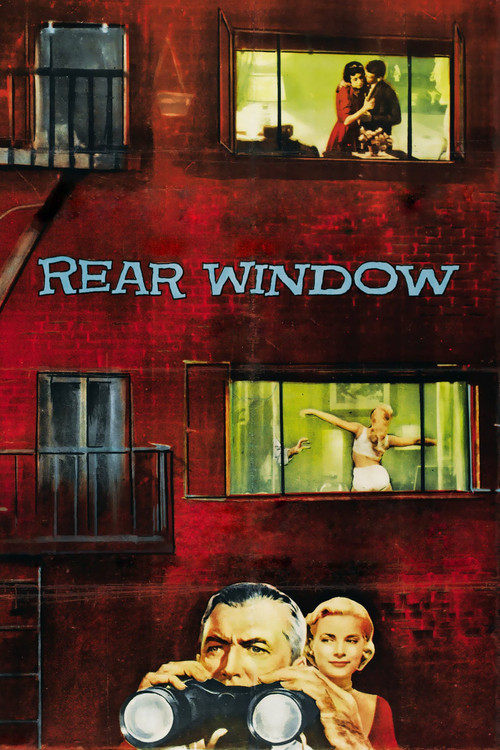
The window is the central and most powerful symbol in the film. It represents the barrier between Jeff's confinement and the outside world, but it also functions as a movie screen through which he (and the audience) watches the lives of others unfold. It symbolizes both physical limitation and a portal to vicarious experience, highlighting the voyeuristic nature of cinema itself.
The entire film is framed by what is visible through Jeff's rear window. The raising of the bamboo blinds at the beginning signals the start of the 'show,' and their lowering at the end concludes our period of observation.
Jeff's Camera and Telephoto Lens
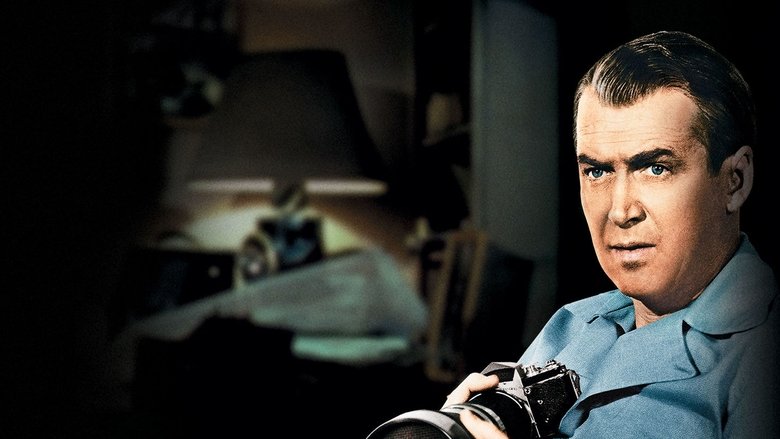
Jeff's camera equipment, particularly his telephoto lens, symbolizes his emotional detachment and his professional inclination to observe life from a distance. It acts as a physical and psychological barrier, allowing him to intrude upon his neighbors' privacy while remaining safely removed from any real involvement. It can also be interpreted as a phallic symbol, representing a form of power and penetration in his state of physical impotence.
Jeff uses his camera and binoculars throughout the film to get closer, more intimate views of his neighbors. He uses the camera's flashbulbs as a weapon to blind and disorient Thorwald during their final confrontation, turning his tool of passive observation into an instrument of self-defense.
The Broken Leg and Plaster Cast
Jeff's broken leg and full-leg cast are symbols of his physical confinement, powerlessness, and emasculation. His immobility is the catalyst for his voyeurism. The cast can also be interpreted as a symbol of his emotional and sexual impotence, particularly in his reluctance to commit to his relationship with Lisa. At the end, his second broken leg suggests he will be confined for even longer, perhaps forcing him to finally settle down.
Jeff is confined to a wheelchair for the entire film. His cast is a constant visual reminder of his vulnerability and frustration. In the final scene, he has a cast on both legs, ironically achieving a state of complete immobility just as his relationship with Lisa seems to have stabilized.
Mrs. Thorwald's Wedding Ring
The wedding ring symbolizes the institution of marriage and commitment, a central concern for Jeff and Lisa. For Mrs. Thorwald, it is a possession she would never willingly leave behind, making its absence a key piece of evidence. For Lisa, finding and wearing the ring is a symbolic act of proving her worth to Jeff and stepping into the role of a wife, albeit in a dangerous and unconventional way.
Lisa astutely observes that a woman would not go on a trip without her wedding ring. This becomes the crucial clue they seek. Lisa risks her life to sneak into Thorwald's apartment to find it, and when she's caught, she defiantly flashes the ring on her finger towards Jeff, signaling her success while also symbolically trying on the role of a married woman.
Philosophical Questions
Is it morally justifiable to invade someone's privacy for the greater good?
The film relentlessly explores this ethical dilemma. Jeff's spying begins as an immoral and intrusive hobby. His nurse, Stella, initially condemns his actions, quoting the law against Peeping Toms. However, when his voyeurism uncovers a potential murder, the moral calculus shifts. The film asks whether the potential to prevent a great evil (a murderer going free) justifies the lesser evil of violating Thorwald's privacy. It doesn't provide an easy answer, instead showing that even well-intentioned observation can lead to dangerous consequences for the observer and the observed.
To what extent does observation alter reality?
"Rear Window" suggests that the act of watching is not passive. Jeff is not merely reflecting the reality of the courtyard; he is actively constructing a narrative. He pieces together ambiguous visual cues to create a story of murder, projecting his own desire for excitement and his fears about marriage onto the figures he watches. The film makes the audience complicit in this construction, encouraging us to interpret the silent scenes alongside Jeff. This raises the question of whether we are discovering a truth or creating one through the focused, and potentially biased, act of looking.
What is the nature of community in modern life?
The film presents a cynical view of urban community. The courtyard is a shared space, yet it is populated by isolated individuals who rarely interact. A murder can allegedly take place, a dog can be killed, and a woman can be on the verge of suicide, all while the neighbors remain largely oblivious. The film questions whether physical proximity equates to genuine connection, suggesting that modern society fosters a sense of alienation where people are more inclined to watch each other from a distance than to actively engage and support one another.
Core Meaning
"Rear Window" serves as a profound commentary on the act of watching, implicating the audience in the film's central theme of voyeurism. Director Alfred Hitchcock uses the protagonist, Jeff, as a surrogate for the filmgoer, who derives pleasure from observing the private lives of others from the safety of a darkened room. The film questions the ethics of this passive observation, blurring the lines between innocent curiosity and morbid intrusion. Ultimately, Hitchcock suggests that while voyeurism is a natural human tendency, it comes with moral responsibilities. The film also explores the complexities of relationships, loneliness, and the sense of community—or lack thereof—in urban life. Through Jeff's observations of his neighbors' various romantic entanglements, Hitchcock presents a cynical yet compelling view of love and marriage in 1950s America.