""Last night I dreamt I went to Manderley again...""
Rebecca - Symbolism & Philosophy
Symbols & Motifs
Manderley
Manderley symbolizes the inescapable past, Rebecca's lingering power, and the weight of tradition and class. It is both a prison and a prize. For the protagonist, it is an oppressive space filled with the ghost of her predecessor, a place where she feels inadequate and unwelcome. The house's ultimate destruction by fire represents a violent, cleansing release from the past, allowing Maxim and the second Mrs. de Winter to finally be free.
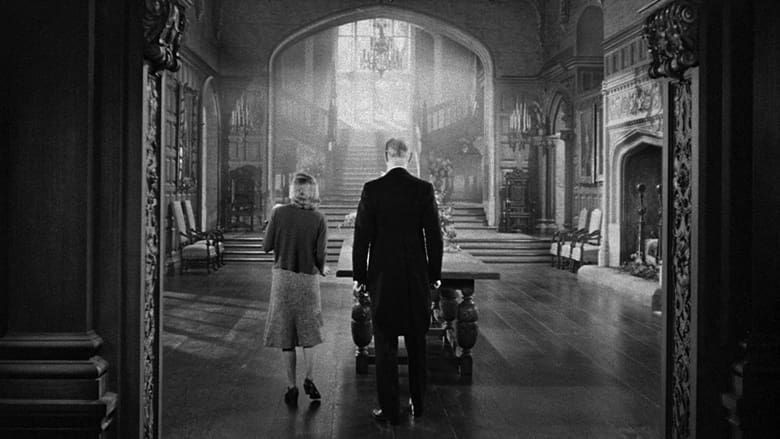
From the iconic opening line, "Last night I dreamt I went to Manderley again," the house is established as a central character. Its vast, shadowy halls, captured by George Barnes' Oscar-winning cinematography, dwarf the protagonist, visually representing her psychological state. The fire that consumes it at the end provides a dramatic and symbolic climax.
The Letter 'R'
The stylized, omnipresent monogram 'R' symbolizes Rebecca's indelible mark on the world and her undying influence. It is a constant visual reminder of the woman who came before, asserting her identity and ownership over everything, even in death. For the new Mrs. de Winter, it is a mark of her own perceived inadequacy and status as an impostor.
The monogram appears throughout Manderley on napkins, stationery, a pillowcase, and other personal items. Producer David O. Selznick even wanted the smoke from the burning Manderley to form a giant 'R' in the sky, though Hitchcock opted for a more subtle burning of a monogrammed lingerie case.
The Sea
The sea represents both Rebecca's untamable nature and the deep, hidden truths of the past. It is the place of her death and the keeper of the secrets surrounding it. It is wild, powerful, and mysterious, much like Rebecca herself. Mrs. Danvers even states that the only thing that ever defeated Rebecca was the sea.
The sea is a constant presence, visible from the windows of Manderley. Rebecca's cottage is by the sea, and it is where her boat and body are eventually discovered, triggering the film's climactic revelations. Its sound is often used to create an unsettling, haunting atmosphere.
Philosophical Questions
Can the past ever be truly escaped?
The film relentlessly explores this question through the haunting of Manderley. Rebecca's memory is so powerful it acts as a character, dictating the actions and emotions of the living. The film suggests that the past, especially when idealized or shrouded in secrets, holds immense power over the present. It is only through a violent, literal destruction of the past's physical embodiment—the burning of Manderley—that the characters can hope to move forward, implying that escaping the past requires a radical, often destructive, break.
What is the nature of identity?
Rebecca poses the question of whether identity is inherent or constructed. The protagonist is nameless, a blank slate onto whom the identity of 'Mrs. de Winter' is projected. She struggles against the powerful, pre-existing identity of Rebecca, which everyone tries to impose upon her. Her journey is a fight to create her own identity rather than simply inhabiting a role. The film suggests that true identity is not a title or a position, but something that must be actively forged through struggle and self-assertion.
How do idealization and reality conflict in relationships?
The entire conflict of the film is built on the chasm between the idealized memory of Rebecca and the sordid reality of her life and marriage to Maxim. The protagonist suffers because she is competing with a perfect phantom, a creation of collective memory. Maxim, in turn, is tortured by the reality he experienced. The film serves as a cautionary tale about the dangers of idealization, showing how false perceptions can be more powerful and destructive than the truth itself.
Core Meaning
The core meaning of Rebecca revolves around the destructive power of the past and the struggle for identity. The film explores how memories, idealizations, and secrets can haunt the present, effectively becoming characters in their own right. It posits that one's sense of self must be forged and asserted against overwhelming external pressures and internal insecurities. The nameless protagonist's journey is a fight to escape the shadow of another and to be seen and loved for who she is, not as a replacement. The film ultimately suggests that true freedom and partnership can only be achieved by confronting and dismantling the idealized phantoms of the past.