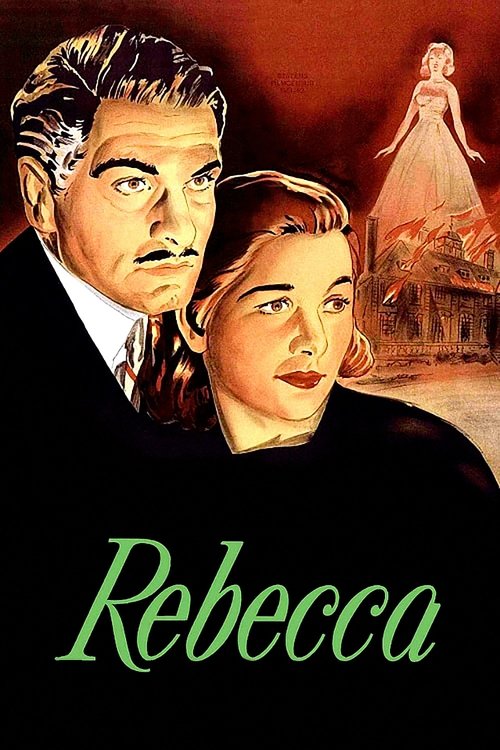
Rebecca
""Last night I dreamt I went to Manderley again...""
Overview
Alfred Hitchcock's first American film, Rebecca, is a masterful gothic romance steeped in psychological suspense. The story follows a shy, unnamed young woman (Joan Fontaine) working as a paid companion in Monte Carlo. She meets the wealthy, brooding widower Maxim de Winter (Laurence Olivier), who sweeps her off her feet. After a whirlwind romance, they marry, and he brings her to his magnificent country estate, Manderley.
Upon arriving, the new Mrs. de Winter finds her life dominated by the ghost of her predecessor, the beautiful and mysterious Rebecca. Manderley itself seems to hold Rebecca's presence in every room, a feeling relentlessly enforced by the sinister and obsessive housekeeper, Mrs. Danvers (Judith Anderson). As the young bride struggles to find her place and navigate her husband's volatile moods, she becomes increasingly tormented by the perfect image of the first Mrs. de Winter, uncovering dark secrets that threaten her sanity and her marriage.
Core Meaning
The core meaning of Rebecca revolves around the destructive power of the past and the struggle for identity. The film explores how memories, idealizations, and secrets can haunt the present, effectively becoming characters in their own right. It posits that one's sense of self must be forged and asserted against overwhelming external pressures and internal insecurities. The nameless protagonist's journey is a fight to escape the shadow of another and to be seen and loved for who she is, not as a replacement. The film ultimately suggests that true freedom and partnership can only be achieved by confronting and dismantling the idealized phantoms of the past.
Thematic DNA
The Power of the Past and Memory
The past is not merely a memory in Rebecca; it is an oppressive, living force. The entire estate of Manderley is a shrine to Maxim's first wife, Rebecca, whose presence is felt in every room and conversation, despite her being dead. This haunting is perpetuated by Mrs. Danvers, who obsessively preserves Rebecca's belongings and routines. The new Mrs. de Winter is constantly compared to an idealized memory, forcing her to battle a ghost for her husband's affection and her own identity.
Identity and Insecurity
The protagonist's struggle with her identity is central to the film; significantly, her first name is never revealed, symbolizing her lack of a solid sense of self. Initially timid and insecure, she is easily intimidated by Manderley's grandeur and Mrs. Danvers' psychological manipulation. Her character arc is defined by her journey from a frightened girl, trying to fill the shoes of another, to a woman who asserts her own agency and place in the world.
Jealousy and Obsession
Jealousy operates on multiple levels. The protagonist is jealous of the dead Rebecca, whom she believes Maxim still loves. Mrs. Danvers' devotion to Rebecca is a dangerous obsession, fueling her psychological torment of the new bride. Her relationship with Rebecca is portrayed with a subtext of homoerotic obsession, making her resentment of the new wife even more venomous. This theme drives much of the film's psychological tension and conflict.
Deception and Appearance vs. Reality
Manderley and its inhabitants are defined by a chasm between appearance and reality. Rebecca, universally remembered as the perfect, charming hostess, is revealed to have been a cruel, manipulative woman. Maxim's aristocratic composure hides a deep-seated trauma and a dark secret about his first marriage. The film slowly peels back these layers of deception, showing that the glittering surface of high society can conceal profound rot and misery.
Character Analysis
The Second Mrs. de Winter
Joan Fontaine
Motivation
Her primary motivation is to win the love and approval of her husband, Maxim, and to feel worthy of her new position as Mrs. de Winter. She desperately wants to build a happy marriage, but this is constantly thwarted by the feeling that she is living in Rebecca's shadow.
Character Arc
She begins as a timid, shy, and deeply insecure paid companion. Thrust into the opulent but oppressive world of Manderley, she is initially overwhelmed and psychologically tormented by Mrs. Danvers and the memory of Rebecca. Her arc is one of maturation; after learning Maxim's secret, she sheds her passivity and fear, transforming into a strong, assertive woman who fights for her husband and her own identity.
Maxim de Winter
Laurence Olivier
Motivation
His motivation is to escape the traumatic memory of his first marriage and find peace and happiness. He marries the protagonist impulsively, seeing her innocence as an antidote to his past. However, he is motivated by a deep-seated fear that the truth about Rebecca's death will be revealed.
Character Arc
Maxim is initially presented as a charming, wealthy, and brooding aristocrat. After returning to Manderley, he becomes moody, distant, and prone to outbursts of anger, tortured by a past his new wife doesn't understand. His arc involves the revelation of his true past: his marriage to Rebecca was a sham, and he has been living with the secret of her death. His confession allows him to shed the tormenting facade and form a genuine bond with his second wife.
Mrs. Danvers
Judith Anderson
Motivation
Her sole motivation is the preservation of Rebecca's memory and legacy. She sees the new Mrs. de Winter as an unworthy usurper and is driven by a deep-seated hatred and resentment to psychologically destroy her and drive her from Manderley.
Character Arc
Mrs. Danvers has no positive arc; she is a static character consumed by her obsession. From her first appearance, she is cold, imposing, and hostile towards the new Mrs. de Winter. Her devotion to the memory of Rebecca is fanatical and has a sinister, psychological depth. As the protagonist grows stronger, Mrs. Danvers' manipulation escalates until her final, destructive act of burning down Manderley, preferring its destruction to seeing it possessed by another.
Jack Favell
George Sanders
Motivation
His motivations are greed and malice. He wants to expose Maxim, not out of a sense of justice for Rebecca, but to extort money from him. He also seems to enjoy causing trouble and disrupting the aristocratic world of Manderley.
Character Arc
Jack Favell is Rebecca's cousin and lover. He is a sleazy, manipulative character who provides a burst of energy and overt villainy. He remains unchanged throughout the film, consistently acting out of self-interest and a desire to profit from the situation. He attempts to blackmail Maxim, believing he murdered Rebecca, and serves as a key catalyst in the final act's investigation.
Symbols & Motifs
Manderley
Manderley symbolizes the inescapable past, Rebecca's lingering power, and the weight of tradition and class. It is both a prison and a prize. For the protagonist, it is an oppressive space filled with the ghost of her predecessor, a place where she feels inadequate and unwelcome. The house's ultimate destruction by fire represents a violent, cleansing release from the past, allowing Maxim and the second Mrs. de Winter to finally be free.
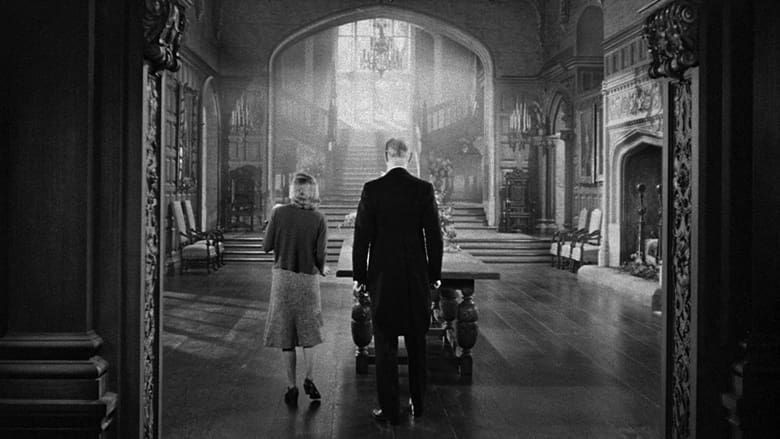
From the iconic opening line, "Last night I dreamt I went to Manderley again," the house is established as a central character. Its vast, shadowy halls, captured by George Barnes' Oscar-winning cinematography, dwarf the protagonist, visually representing her psychological state. The fire that consumes it at the end provides a dramatic and symbolic climax.
The Letter 'R'
The stylized, omnipresent monogram 'R' symbolizes Rebecca's indelible mark on the world and her undying influence. It is a constant visual reminder of the woman who came before, asserting her identity and ownership over everything, even in death. For the new Mrs. de Winter, it is a mark of her own perceived inadequacy and status as an impostor.
The monogram appears throughout Manderley on napkins, stationery, a pillowcase, and other personal items. Producer David O. Selznick even wanted the smoke from the burning Manderley to form a giant 'R' in the sky, though Hitchcock opted for a more subtle burning of a monogrammed lingerie case.
The Sea
The sea represents both Rebecca's untamable nature and the deep, hidden truths of the past. It is the place of her death and the keeper of the secrets surrounding it. It is wild, powerful, and mysterious, much like Rebecca herself. Mrs. Danvers even states that the only thing that ever defeated Rebecca was the sea.
The sea is a constant presence, visible from the windows of Manderley. Rebecca's cottage is by the sea, and it is where her boat and body are eventually discovered, triggering the film's climactic revelations. Its sound is often used to create an unsettling, haunting atmosphere.
Memorable Quotes
Last night I dreamt I went to Manderley again.
— The Second Mrs. de Winter
Context:
The film opens with this line, spoken in voiceover as the camera moves through the ghostly, overgrown ruins of the Manderley estate.
Meaning:
This iconic opening line establishes the film's gothic, dreamlike tone and the central importance of Manderley. It immediately frames the entire story as a memory, colored by nostalgia and trauma, indicating that Manderley, and the past it represents, is a place they can never truly return to but will forever haunt them.
You thought you could be Mrs. de Winter, live in her house, walk in her steps, take the things that were hers! But she's too strong for you. You can't fight her.
— Mrs. Danvers
Context:
Mrs. Danvers delivers these venomous lines to the second Mrs. de Winter in Rebecca's bedroom, after the humiliating costume ball incident. She relentlessly belittles the heroine, pushing her to the brink of suicide.
Meaning:
This quote encapsulates Mrs. Danvers' psychological warfare against the protagonist. It vocalizes the heroine's deepest insecurities, making explicit the idea that she is an unworthy replacement for the perfect Rebecca and that the ghost of the past is an unbeatable foe.
I'm asking you to marry me, you little fool.
— Maxim de Winter
Context:
Maxim says this to the protagonist in Monte Carlo. After she mistakenly believes he is saying goodbye forever, her emotional reaction prompts this abrupt and unconventional marriage proposal.
Meaning:
This line reveals Maxim's complex character: a mixture of genuine affection, aristocratic condescension, and desperation. It's not a traditionally romantic proposal, highlighting the power imbalance in their relationship and hinting at the troubled nature that lies beneath his charming exterior.
Rebecca has won.
— Maxim de Winter
Context:
Maxim says this to his wife after Rebecca's boat is discovered, believing the truth of her death will now come out and ruin them. It precedes his confession about the true nature of their marriage and how she died.
Meaning:
This line expresses Maxim's complete despair and the seemingly total victory of his dead wife's memory over their chance for happiness. It signifies the moment he believes the past has finally caught up with them, and that Rebecca's malignant influence has successfully destroyed their relationship from beyond the grave.
Philosophical Questions
Can the past ever be truly escaped?
The film relentlessly explores this question through the haunting of Manderley. Rebecca's memory is so powerful it acts as a character, dictating the actions and emotions of the living. The film suggests that the past, especially when idealized or shrouded in secrets, holds immense power over the present. It is only through a violent, literal destruction of the past's physical embodiment—the burning of Manderley—that the characters can hope to move forward, implying that escaping the past requires a radical, often destructive, break.
What is the nature of identity?
Rebecca poses the question of whether identity is inherent or constructed. The protagonist is nameless, a blank slate onto whom the identity of 'Mrs. de Winter' is projected. She struggles against the powerful, pre-existing identity of Rebecca, which everyone tries to impose upon her. Her journey is a fight to create her own identity rather than simply inhabiting a role. The film suggests that true identity is not a title or a position, but something that must be actively forged through struggle and self-assertion.
How do idealization and reality conflict in relationships?
The entire conflict of the film is built on the chasm between the idealized memory of Rebecca and the sordid reality of her life and marriage to Maxim. The protagonist suffers because she is competing with a perfect phantom, a creation of collective memory. Maxim, in turn, is tortured by the reality he experienced. The film serves as a cautionary tale about the dangers of idealization, showing how false perceptions can be more powerful and destructive than the truth itself.
Alternative Interpretations
One of the most prominent alternative interpretations of Rebecca involves a queer reading of the relationship between Mrs. Danvers and Rebecca. Critics and viewers have long noted that Mrs. Danvers' devotion to Rebecca transcends that of a loyal servant. Her obsessive preservation of Rebecca's bedroom, her sensual descriptions of Rebecca's belongings, and her venomous jealousy toward the new Mrs. de Winter are often interpreted as signs of a deep, repressed romantic and erotic attachment. In this light, Mrs. Danvers is not just a villain guarding a memory, but a grieving lover lashing out at the woman who has usurped her beloved's place.
Another interpretation challenges the audience's sympathy for Maxim de Winter. Despite the film altering his crime from murder to accidental death, his confession still reveals him to be a man who concealed a body and lied to his new wife. Some readings view him not as a tortured romantic hero, but as a manipulative and controlling upper-class patriarch who marries a naive young woman precisely because she is malleable. His anger and brooding nature can be seen less as tragic and more as the traits of a dangerously possessive man, making the second Mrs. de Winter's happy ending more ambiguous.
Cultural Impact
Rebecca was a significant cultural and cinematic event. As Alfred Hitchcock's first American project, it successfully transitioned his brand of suspense for Hollywood, solidifying his international reputation. The film won the Oscar for Best Picture in 1940, a unique achievement in Hitchcock's celebrated career, though the award technically went to producer David O. Selznick.
Its influence on the gothic romance and psychological thriller genres is immense. The trope of a naive young woman in a grand, mysterious house haunted by the memory of a dead wife became a staple. The film's atmospheric tension, use of shadow, and deep psychological probing set a new standard. Mrs. Danvers, as played by Judith Anderson, became an archetypal villain—the cold, obsessive keeper of secrets whose loyalty to the dead borders on the spectral.
Critically, the film was a major success, praised for its haunting atmosphere, suspense, and strong performances. It resonated with audiences, becoming a commercial hit. The film's style also had an impact on fashion; Joan Fontaine's cardigan in the film became so popular in Spain that cardigans are still sometimes referred to as 'rebecas'. Rebecca remains a cornerstone of classic Hollywood cinema, frequently studied for its masterful direction, complex character psychology, and lasting influence on filmmaking.
Audience Reception
Upon its release in 1940, Rebecca was met with widespread critical and commercial success. Critics praised it as a brilliant adaptation of Daphne du Maurier's novel, highlighting Hitchcock's masterful direction in creating a haunting and suspenseful atmosphere. The performances of the cast were lauded, particularly Joan Fontaine's portrayal of the vulnerable protagonist and Judith Anderson's chilling performance as Mrs. Danvers. The film's Oscar win for Best Picture cemented its prestigious status. While some contemporary reviews noted it was psychologically deep and perhaps too tragic for some audiences, the overall verdict was overwhelmingly positive. Today, Rebecca is considered a masterpiece, holding a 98% approval rating on Rotten Tomatoes, where the consensus calls it a work of "haunting atmosphere, Gothic thrills, and gripping suspense."
Interesting Facts
- This was Alfred Hitchcock's first American film and the only one of his films to win the Academy Award for Best Picture.
- Producer David O. Selznick and Hitchcock famously clashed during production. Selznick insisted on being faithful to the novel, while Hitchcock wanted to make significant changes.
- Due to the Hays Production Code, the film had to change a crucial plot point from the novel. In the book, Maxim murders Rebecca. In the film, her death is accidental to ensure the protagonist did not get away with murder.
- Laurence Olivier wanted his then-fiancée, Vivien Leigh, to be cast as the lead. However, Hitchcock and Selznick ultimately chose Joan Fontaine.
- The protagonist's first name is never mentioned in the film, just as in the novel.
- To keep Joan Fontaine on edge and enhance her character's anxiety, Hitchcock reportedly told her that the rest of the cast and crew disliked her.
- Judith Anderson, who played Mrs. Danvers, rarely blinks on screen. This was a direction from Hitchcock to make her character seem more uncanny and menacing.
- The film was shot entirely in California, despite the story being set in Monte Carlo and Cornwall, England.
Easter Eggs
Alfred Hitchcock's Cameo
As is his signature, Alfred Hitchcock makes a brief appearance in the film. He can be seen walking in the background, with his back to the camera, outside a phone booth just after Jack Favell (George Sanders) makes a call near the end of the movie.
⚠️ Spoiler Analysis
Click to reveal detailed analysis with spoilers
Frequently Asked Questions
Explore More About This Movie
Dive deeper into specific aspects of the movie with our detailed analysis pages
Comments (0)
No comments yet. Be the first to share your thoughts!