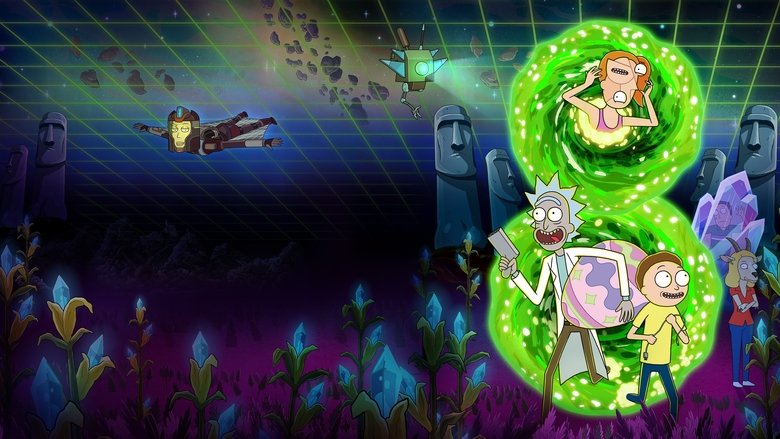
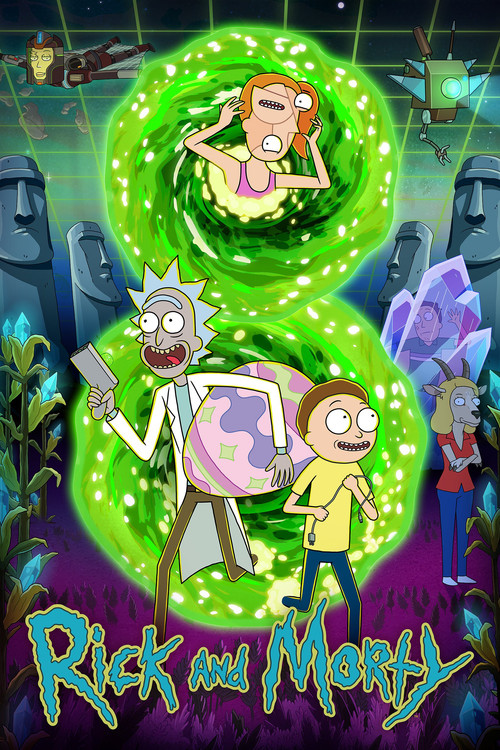
"Science makes sense, family doesn't."
Rick and Morty - Symbolism & Philosophy
Symbols & Motifs
The Portal Gun
Symbolizes freedom, chaos, and escapism. It represents Rick's godlike ability to transcend all boundaries—physical, dimensional, and moral. It is the literal engine of the series' plot and its philosophical explorations.
Used in nearly every episode, the portal gun allows Rick and Morty to abandon realities, explore new worlds, and escape consequences. However, it's also a curse; Rick's ability to flee any problem prevents him from forming lasting connections or facing his own trauma. The destruction of the portal network at the end of Season 5 traps the characters, forcing them to confront the realities they can no longer escape from.
The Central Finite Curve
Symbolizes determinism, ego, and a self-imposed prison. It is a finite collection of universes, walled off from the true infinity, where Rick is the smartest and most powerful being. It represents Rick's ultimate act of cowardice: creating a controlled playground to ensure he is always dominant, rather than facing a true multiverse where he might be insignificant.
Introduced by name in Season 1 but not explained until the Season 5 finale, "Rickmurai Jack." The Ricks of the Citadel created it to isolate themselves. Evil Morty's entire arc is dedicated to escaping it, which he successfully does, breaking the barrier and opening the show up to a multiverse where Rick is not the apex predator.
Pickle Rick
Symbolizes radical, self-destructive avoidance. By turning himself into a pickle to avoid family therapy, Rick demonstrates the absurd lengths he will go to deflect from his emotional problems, choosing hyper-violent, ingenious distraction over simple vulnerability.
The central conceit of the Season 3 episode, "Pickle Rick." The episode juxtaposes Rick's bloody, action-movie-style survival story as a pickle with a therapy session where the rest of the family discusses his toxic influence. The therapist ultimately diagnoses his behavior perfectly, stating he uses his intelligence to avoid the hard work of self-improvement.
Philosophical Questions
Does life have meaning in an infinite universe?
This is the central question of the entire series. The existence of infinite realities, where every choice and outcome is realized, initially suggests that no single life or decision matters. Rick embodies this nihilistic conclusion. However, the show consistently challenges this idea. Through Morty's developing moral compass and Rick's own reluctant attachments, the series explores existentialism—the idea that individuals are free to create their own meaning and purpose through their choices and relationships, even in an indifferent cosmos. The conclusion it seems to reach is that objective, cosmic meaning may not exist, but subjective, personal meaning is what makes life worth living.
What is the relationship between intelligence and happiness?
Rick is the smartest man in the universe, but he is also arguably the most miserable. His omniscience has led him to a state of profound depression, alcoholism, and emotional isolation. He understands the mechanics of the universe so perfectly that he sees no magic or meaning in it. In contrast, the simple-minded Jerry is often blissfully ignorant of the cosmic horrors surrounding him and finds happiness in small, mundane things. The series uses this contrast to question the desirability of ultimate knowledge, suggesting that intelligence without emotional connection or a sense of purpose leads not to fulfillment, but to despair.
Can we escape our own nature?
Many characters are trapped in cycles of self-destructive behavior. Rick cannot escape his trauma and self-loathing. Beth struggles with her father's toxic legacy. Jerry is defined by his insecurity. The show questions whether these characters can truly change. The existence of infinite versions of each character suggests a kind of fatalism, but the slow, incremental growth seen in the main cast—Morty's growing confidence, Beth's self-acceptance, even Jerry's fleeting moments of courage—suggests that change, while difficult and painful, is possible. The concept of Space Beth, who acts on the impulses the main Beth represses, is a literal exploration of this internal struggle.
Core Meaning
At its core, "Rick and Morty" is a profound exploration of existentialism, nihilism, and the search for meaning in a seemingly meaningless universe. The creators, Dan Harmon and Justin Roiland, use the infinite multiverse to ask whether an individual life has purpose when infinite versions of that person exist. The show posits that while life may have no inherent, cosmic meaning, value can be created through personal choices and relationships. Rick's journey from a self-destructive nihilist, who believes love is just a chemical reaction, to someone who grudgingly accepts the importance of his family, embodies this central theme. Ultimately, the series suggests that in the face of cosmic indifference, the connections we choose to forge are the only things that truly matter.