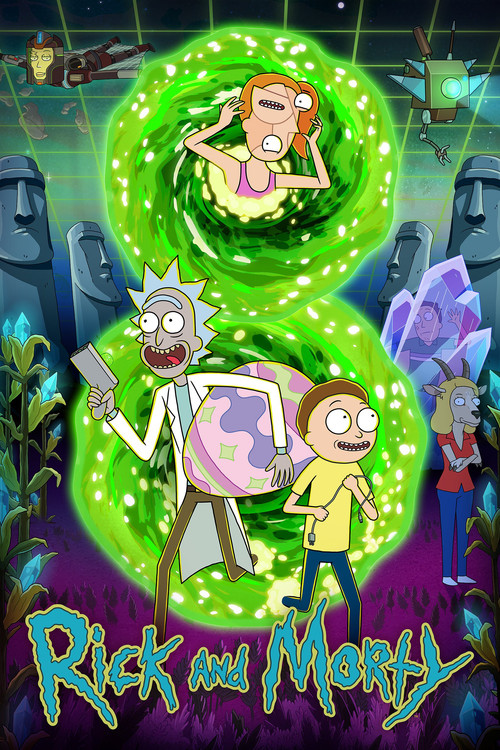
Rick and Morty
"Science makes sense, family doesn't."
Overview
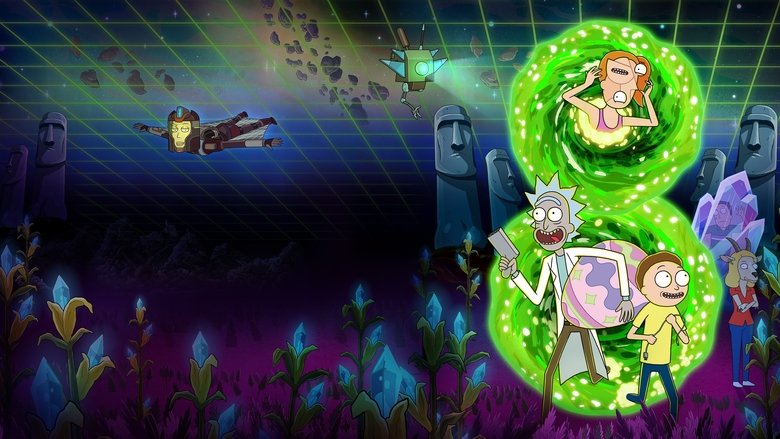
"Rick and Morty" follows the interdimensional misadventures of Rick Sanchez, a cynical, alcoholic scientific genius, and his anxious, good-hearted grandson, Morty Smith. After abandoning his family for years, Rick moves in with his daughter Beth's family, disrupting their mundane suburban life. He commandeers the garage as his personal laboratory and drags Morty on dangerous, bizarre journeys across the multiverse using his portal gun and flying saucer. These adventures often endanger not only themselves but also the entire Smith family—including Morty's insecure father Jerry, his status-obsessed sister Summer, and his horse-surgeon mother Beth.
The series juxtaposes cosmic, high-concept science fiction with the raw, often painful, drama of a deeply dysfunctional family. Across its seasons, the show expands its lore, introducing the Citadel of Ricks (a trans-dimensional society of Ricks and Mortys), the Galactic Federation, and powerful nemeses like Rick Prime and 'Evil Morty.' While early seasons focus on standalone adventures, the overarching narrative gradually reveals Rick's tragic backstory and explores the profound psychological impact his nihilism and recklessness have on Morty and the rest of the family, forcing them to confront their own identities and places in an infinite, absurd universe.
Core Meaning
At its core, "Rick and Morty" is a profound exploration of existentialism, nihilism, and the search for meaning in a seemingly meaningless universe. The creators, Dan Harmon and Justin Roiland, use the infinite multiverse to ask whether an individual life has purpose when infinite versions of that person exist. The show posits that while life may have no inherent, cosmic meaning, value can be created through personal choices and relationships. Rick's journey from a self-destructive nihilist, who believes love is just a chemical reaction, to someone who grudgingly accepts the importance of his family, embodies this central theme. Ultimately, the series suggests that in the face of cosmic indifference, the connections we choose to forge are the only things that truly matter.
Thematic DNA
Existentialism and Nihilism
This is the philosophical backbone of the series. Rick Sanchez embodies the nihilistic viewpoint that life is without objective meaning or value, a belief fueled by his awareness of the infinite multiverse. His catchphrase "Wubba Lubba Dub Dub," which translates to "I am in great pain, please help me," reveals the deep depression underlying his chaotic behavior. Morty, in contrast, begins as a naive boy but is forced to confront these bleak realities, famously stating, "Nobody exists on purpose. Nobody belongs anywhere. Everybody's gonna die. Come watch TV." The show constantly explores the tension between Rick's nihilism and the rest of the family's search for purpose, suggesting that while the universe is absurd and indifferent, finding subjective meaning through choice and connection is a valid, if not the only, way to live.
Family and Dysfunction
Beneath the sci-fi chaos lies a raw and often painful depiction of a dysfunctional family. Beth and Jerry's marriage is perpetually on the verge of collapse, fueled by Jerry's insecurity and Beth's feelings of being trapped. Summer struggles with typical teenage issues amplified by her family's insanity, and Morty bears the psychological scars of Rick's adventures. Rick's presence is a catalyst, exacerbating existing tensions while also, paradoxically, being the force that sometimes pulls them together. The series explores codependency, neglect, and inherited trauma, asking whether this broken family can ever truly heal or if their toxic connections are the only thing holding them together.
Free Will vs. Determinism
The concept of the multiverse inherently questions the significance of individual choice. If every possible decision is played out in an alternate reality, does any single choice matter? The show explores this through various plot devices, such as the "Vat of Acid Episode," where Morty is given a device to save and reset moments, only to learn that his choices have dire consequences in abandoned timelines. The creation of the Central Finite Curve—a walled-off section of the multiverse where Rick is the smartest being—is another exploration of this theme, suggesting the Ricks have engineered a reality to control their own destiny, effectively trapping everyone else within it. Evil Morty's primary goal is to escape this predetermined reality, representing a fight for genuine free will.
Science vs. Morality
Rick's scientific genius is boundless, but he operates almost entirely without a moral compass, viewing beings as tools or obstacles. He creates sentient life simply to power his car battery and commits genocide without a second thought. This puts him in direct conflict with Morty's innate, albeit often weak, sense of morality. The show frequently places them in situations where scientific advancement comes at a horrifying ethical cost, forcing Morty (and the audience) to question the value of knowledge without wisdom or empathy. Rick's worldview is constantly challenged by the emotional connections he claims to despise, suggesting that a purely scientific, detached view of existence is ultimately an empty one.
Character Analysis
Rick Sanchez
Justin Roiland (Seasons 1-6), Ian Cardoni (Season 7-present)
Motivation
Initially, his motivation appears to be pure scientific curiosity and amusement at the expense of others. However, his true, overarching motivation is revealed to be vengeance against Rick Prime for killing his family. After achieving this, his motivation becomes unclear, shifting towards protecting the family he has and finding a new purpose in a meaningless existence.
Character Arc
Rick begins as the epitome of a nihilistic, hedonistic super-genius who drags his grandson on traumatic adventures for selfish reasons. His character is defined by his catchphrase "Wubba Lubba Dub Dub," which secretly means he is in great pain. Initially portrayed as almost invincible and emotionally detached, later seasons gradually peel back his layers. The reveal of his "crybaby backstory"—the murder of his original wife and daughter by another Rick (Rick Prime)—re-contextualizes his behavior as a decades-long, trauma-fueled quest for revenge. His journey is one of slowly and begrudgingly accepting his need for family. While he constantly pushes them away, moments of genuine affection and sacrifice show his evolution. After finally killing Rick Prime in Season 7, his life's purpose is gone, forcing him into a new existential crisis about what to live for now that his vengeance is complete.
Morty Smith
Justin Roiland (Seasons 1-6), Harry Belden (Season 7-present)
Motivation
His initial motivation is simply to survive Rick's adventures and win the affection of his crush, Jessica. As the series progresses, his motivation evolves into a complex desire to protect his family, keep Rick from completely self-destructing, and carve out his own identity separate from his grandfather. He seeks a semblance of normalcy and meaning in a life defined by chaos.
Character Arc
Morty starts as a timid, anxious 14-year-old who is easily manipulated by Rick. He serves as the moral compass, often horrified by Rick's actions. Through countless traumatic experiences, including burying his own corpse after they switch realities ("Rick Potion #9"), Morty becomes jaded, more capable, and increasingly assertive. He develops from a passive sidekick into someone who frequently challenges Rick and even acts independently. While he adopts some of Rick's cynicism, he never fully loses his core empathy. His arc is a coming-of-age story warped by cosmic horror, transforming him from a boy into a hardened survivor who understands the universe's indifference but still chooses to care.
Summer Smith
Spencer Grammer
Motivation
Her primary motivation shifts from seeking social acceptance among her peers to craving adventure and her grandfather's respect. She is driven by a desire to prove her worth and not be left behind. In later seasons, she is also motivated by a fierce, if dysfunctional, loyalty to her family.
Character Arc
Summer begins as a stereotypical teenager obsessed with popularity and her phone. Initially resentful of Rick and Morty's adventures, she eventually demands to be included. She proves to be far more adaptable and ruthless than Morty, often impressing Rick with her cynical and violent tendencies. Her arc involves moving past superficial concerns to become a capable and integral part of the adventures. She develops a deeper, more complex relationship with Rick, sometimes understanding his nihilism better than anyone else. She grows from a background character into a formidable force in her own right, often saving the day herself.
Beth Smith
Sarah Chalke
Motivation
Beth is primarily motivated by a desperate need for Rick's approval and a fear of being ordinary like her husband, Jerry. She constantly seeks validation for her intelligence and life choices. This evolves into a motivation to understand herself and find personal freedom, as represented by the choice between her domestic life and the adventurous life of Space Beth.
Character Arc
Beth is an intelligent horse surgeon plagued by deep-seated abandonment issues stemming from Rick leaving her as a child. Her entire life is a struggle between her desire for her father's approval and her resentment towards him. She is locked in an unhealthy, codependent marriage with Jerry. A major turning point is in "The ABC's of Beth," where Rick offers to clone her, allowing one version to stay with her family while the other explores the universe. The existence of "Space Beth" forces both Beths to confront their identity, desires, and self-worth independent of Rick and their family. Her arc is about accepting her own capabilities and choices, and learning to define herself on her own terms, not just as Rick's daughter or Jerry's wife.
Jerry Smith
Chris Parnell
Motivation
Jerry's motivation is simple: he wants a normal, quiet life and the love and respect of his family. He is driven by his deep-seated insecurities and a desperate desire for approval, particularly from Beth. He consistently tries to assert his role as the family's patriarch, usually with disastrous results.
Character Arc
Jerry is the embodiment of mediocrity, insecurity, and simple-mindedness. He is constantly belittled by Rick and often by his own family. For much of the series, he serves as a comedic punching bag. However, his character undergoes a subtle but significant arc. After his divorce and reconciliation with Beth, he begins to develop a sliver of a backbone and self-worth. Episodes like "Solaricks" show that in some contexts, his simplistic survival skills can make him surprisingly competent. While he remains fundamentally insecure, he evolves from a pathetic figure into a slightly more self-aware, and occasionally respected, member of the family whose defining trait is his unwavering, if pathetic, commitment to his family.
Symbols & Motifs
The Portal Gun
Symbolizes freedom, chaos, and escapism. It represents Rick's godlike ability to transcend all boundaries—physical, dimensional, and moral. It is the literal engine of the series' plot and its philosophical explorations.
Used in nearly every episode, the portal gun allows Rick and Morty to abandon realities, explore new worlds, and escape consequences. However, it's also a curse; Rick's ability to flee any problem prevents him from forming lasting connections or facing his own trauma. The destruction of the portal network at the end of Season 5 traps the characters, forcing them to confront the realities they can no longer escape from.
The Central Finite Curve
Symbolizes determinism, ego, and a self-imposed prison. It is a finite collection of universes, walled off from the true infinity, where Rick is the smartest and most powerful being. It represents Rick's ultimate act of cowardice: creating a controlled playground to ensure he is always dominant, rather than facing a true multiverse where he might be insignificant.
Introduced by name in Season 1 but not explained until the Season 5 finale, "Rickmurai Jack." The Ricks of the Citadel created it to isolate themselves. Evil Morty's entire arc is dedicated to escaping it, which he successfully does, breaking the barrier and opening the show up to a multiverse where Rick is not the apex predator.
Pickle Rick
Symbolizes radical, self-destructive avoidance. By turning himself into a pickle to avoid family therapy, Rick demonstrates the absurd lengths he will go to deflect from his emotional problems, choosing hyper-violent, ingenious distraction over simple vulnerability.
The central conceit of the Season 3 episode, "Pickle Rick." The episode juxtaposes Rick's bloody, action-movie-style survival story as a pickle with a therapy session where the rest of the family discusses his toxic influence. The therapist ultimately diagnoses his behavior perfectly, stating he uses his intelligence to avoid the hard work of self-improvement.
Memorable Quotes
Nobody exists on purpose. Nobody belongs anywhere. Everybody's gonna die. Come watch TV.
— Morty Smith
Context:
Said to Summer in Season 1, Episode 8, "Rixty Minutes," after explaining how he and Rick abandoned their own ruined reality and took the place of their dead counterparts in the current one.
Meaning:
This quote is the perfect encapsulation of the show's absurdist and existentialist philosophy. After a traumatic experience, Morty comforts Summer by articulating the nihilistic realization that life has no inherent meaning. The final line, "Come watch TV," is a crucial addition, suggesting that in the face of this terrifying truth, the best one can do is find small, immediate comforts and connections.
Wubba Lubba Dub Dub!
— Rick Sanchez
Context:
Used frequently by Rick throughout the first season. The true meaning is revealed by Birdperson in the Season 1 finale, "Ricksy Business."
Meaning:
Initially presented as Rick's goofy, meaningless catchphrase, it is later revealed in Birdperson's native language to mean, "I am in great pain, please help me." This revelation reframes Rick's entire character, turning his chaotic antics from pure hedonism into the desperate actions of a man suffering from profound depression and trauma.
To live is to risk it all. Otherwise you're just an inert chunk of randomly assembled molecules drifting wherever the universe blows you.
— Rick Sanchez
Context:
Said to Beth in Season 3, Episode 9, "The ABC's of Beth," when offering her the chance to have a clone take her place so she can be free to explore the universe.
Meaning:
This quote represents Rick's more positive, existentialist counterpoint to his own nihilism. While he believes the universe is random and meaningless, he also believes that the act of choosing to live, to take risks, and to engage with that chaos is what gives life its spark. It's a call to action against passive acceptance of meaninglessness.
What is my purpose?
— Butter Robot
Context:
The robot asks this immediately after Rick creates it for the sole purpose of passing the butter at the breakfast table in Season 1, Episode 9, "Something Ricked This Way Comes."
Meaning:
A simple question from a simple robot that strikes at the very heart of the show's philosophical core. The robot, created for a single, mundane task, has an immediate existential crisis upon activation. Its despair is played for laughs, but it mirrors the central question every character in the series is grappling with.
Episode Highlights
Rick Potion #9
A love potion Morty asks Rick to make goes horribly wrong, infecting the entire planet and turning everyone into monstrous "Cronenbergs" obsessed with Morty. Unable to fix the problem, Rick's solution is not to save the world, but to abandon it entirely. He finds a nearly identical reality where their alternate selves have just died, and they slip in to take their places, burying their own bodies in the backyard.
This is the first episode to demonstrate the show's dark, high-stakes consequences and its commitment to its nihilistic premise. Morty's trauma from burying his own corpse becomes a foundational moment for his character arc, shattering his innocence and introducing the core theme that in an infinite multiverse, individual lives are disposable.
Total Rickall
The Smith family home is infested with telepathic alien parasites that implant themselves into memories, creating a proliferation of fake, quirky friends and family members. The family must figure out who is real and who is a parasite, realizing that the parasites can only create happy memories.
This episode is a masterclass in high-concept storytelling and character development. The solution—that only real family members are sources of both good and bad memories—is a surprisingly poignant statement on the nature of love and family. It also introduces the fan-favorite character Mr. Poopybutthole, whose ambiguous reality leads to a shocking and darkly comedic ending.
The Wedding Squanchers
The family attends the wedding of Rick's best friend, Birdperson, which is revealed to be a sting operation by the Galactic Federation. The wedding ends in a bloody shootout, and the Smith family becomes galactic fugitives. To save them, Rick turns himself in and is imprisoned by the Federation.
A major turning point for the series, this finale dramatically raises the narrative stakes. It's the first time Rick makes a truly selfless sacrifice for his family, showing a deeper layer to his character. It ends the season on a massive cliffhanger, with Earth under Federation control and Rick imprisoned, setting up the arc for Season 3.
The Ricklantis Mixup
While the main Rick and Morty go on an adventure to Atlantis, the episode's focus shifts entirely to the Citadel, a trans-dimensional city populated by countless versions of Ricks and Mortys. The episode follows several interconnected storylines: a rookie Morty cop, a group of Morty students searching for a mythical wishing portal, a factory worker Rick who rebels, and the presidential election of a charismatic Morty candidate.
Widely considered one of the best and most ambitious episodes of the series, it brilliantly expands the show's world-building. The final scene reveals that the newly elected president is the 'Evil Morty' from Season 1, who now controls the Citadel. This twist establishes him as a major, overarching antagonist and a genuine threat to Rick.
The Vat of Acid Episode
After Morty criticizes his "fake vat of acid" escape plan, Rick spitefully invents a "save point" device that allows Morty to retry any moment in his life. Morty uses it to live consequence-free, eventually finding true love. However, Jerry accidentally erases his progress, and Morty learns to his horror that he wasn't creating save points, but shunting himself to new realities, leaving behind countless versions of himself to suffer the consequences of his actions.
This episode won an Emmy and is a perfect example of the show's ability to blend humor, high-concept sci-fi, and devastating emotional gut-punches. It's a brutal exploration of consequence, free will, and morality, and serves as another deeply traumatic, character-defining experience for Morty.
Rickmurai Jack
The episode finally reveals Rick's full backstory through a mind-scan: his wife Diane and a young Beth were killed by another Rick (Rick Prime), sending him on a path of vengeance that led him to help create the Citadel and the Central Finite Curve. In the present, Evil Morty successfully executes his plan to destroy the Citadel and escape the Curve.
This episode is a massive payoff for years of fan theories and foreshadowing. It confirms Rick's tragic origin story, explains the true purpose of the Central Finite Curve, and brings Evil Morty's character arc to a stunning conclusion. By shattering the Curve, it fundamentally changes the status quo of the series' multiverse.
Unmortricken
Evil Morty lures Rick C-137 and his Morty into a trap to finally track down Rick Prime. The episode culminates in a brutal, universe-spanning confrontation where Rick C-137, with help from Evil Morty, finally corners and kills Rick Prime, the man who murdered his wife and daughter.
This episode subverts all expectations by resolving the show's main plot line—Rick's quest for revenge—midway through a season. Rick's victory is hollow, leaving him adrift without the purpose that has driven him for decades. It fundamentally alters Rick's character, forcing him to confront a future without his all-consuming hatred and setting a new, uncertain direction for the series.
Philosophical Questions
Does life have meaning in an infinite universe?
This is the central question of the entire series. The existence of infinite realities, where every choice and outcome is realized, initially suggests that no single life or decision matters. Rick embodies this nihilistic conclusion. However, the show consistently challenges this idea. Through Morty's developing moral compass and Rick's own reluctant attachments, the series explores existentialism—the idea that individuals are free to create their own meaning and purpose through their choices and relationships, even in an indifferent cosmos. The conclusion it seems to reach is that objective, cosmic meaning may not exist, but subjective, personal meaning is what makes life worth living.
What is the relationship between intelligence and happiness?
Rick is the smartest man in the universe, but he is also arguably the most miserable. His omniscience has led him to a state of profound depression, alcoholism, and emotional isolation. He understands the mechanics of the universe so perfectly that he sees no magic or meaning in it. In contrast, the simple-minded Jerry is often blissfully ignorant of the cosmic horrors surrounding him and finds happiness in small, mundane things. The series uses this contrast to question the desirability of ultimate knowledge, suggesting that intelligence without emotional connection or a sense of purpose leads not to fulfillment, but to despair.
Can we escape our own nature?
Many characters are trapped in cycles of self-destructive behavior. Rick cannot escape his trauma and self-loathing. Beth struggles with her father's toxic legacy. Jerry is defined by his insecurity. The show questions whether these characters can truly change. The existence of infinite versions of each character suggests a kind of fatalism, but the slow, incremental growth seen in the main cast—Morty's growing confidence, Beth's self-acceptance, even Jerry's fleeting moments of courage—suggests that change, while difficult and painful, is possible. The concept of Space Beth, who acts on the impulses the main Beth represses, is a literal exploration of this internal struggle.
Alternative Interpretations
One of the most prominent alternative readings of the series is the "Rick is an older Morty" theory. This interpretation suggests that the Rick we see is actually a future version of Morty who has become jaded, brilliant, and alcoholic after a lifetime of trauma and loss, and has traveled back in time. Proponents point to their similar anxieties and Rick's occasional flashes of protective behavior as evidence of a deeper connection than just grandfather and grandson.
Another interpretation focuses on the series as an allegory for creative burnout and the pressures of storytelling. Rick, the all-knowing creator-figure, is bored by the infinite possibilities at his disposal and struggles to find novelty or meaning, reflecting the challenge writers face in a serialized narrative. The Central Finite Curve can be seen as a metaphor for a show's canon—a walled garden of controlled stories, which Evil Morty (representing a dissatisfied audience or a rebellious writer) seeks to break out of to find something truly new.
Cultural Impact
"Rick and Morty" premiered in 2013 and quickly evolved from a cult favorite into a cultural juggernaut, significantly impacting adult animation and pop culture. Its unique blend of high-concept science fiction, dark, cynical humor, and genuine philosophical depth set it apart from contemporaries. The show is credited with popularizing complex philosophical ideas like absurdism and existential nihilism for a mainstream audience, sparking countless online discussions, video essays, and academic analyses.
Its influence on television can be seen in the wave of adult animated shows that blend serialized storytelling with complex, often darker themes. The show's success also led to a massive 70-episode renewal from Adult Swim in 2018, an unprecedented order for an animated series that demonstrated the network's faith in its cultural cachet. The series has also had a tangible real-world impact; its mention of a discontinued McDonald's Szechuan sauce in the Season 3 premiere led to a massive fan campaign that resulted in McDonald's briefly bringing the sauce back. The reception by critics has been overwhelmingly positive for most of its run, though some later seasons have faced criticism for perceived dips in quality. More recently, the show's legacy has been complicated by the 2023 firing of co-creator and star Justin Roiland amid serious allegations, forcing the show to continue with new voice actors and Dan Harmon as the sole showrunner.
Audience Reception
"Rick and Morty" has enjoyed massive popularity with audiences, becoming a cultural phenomenon. Early seasons were met with near-universal praise for their creativity, sharp humor, and philosophical depth. The show developed a passionate, and at times notorious, fanbase. The period between Season 2 and Season 3 saw the show's popularity explode, leading to immense anticipation and pressure.
While Seasons 3 and 4 were also well-received, some audience members began to criticize a perceived shift in tone or quality, a common issue for long-running series. Season 5 received a more polarized response, with some fans feeling it was inconsistent compared to earlier seasons. A major point of controversy arose in 2023 with the firing of Justin Roiland. This news divided the fanbase; some felt it was a necessary decision, while others worried the show could not survive without its original co-creator and voice actor. The reception to Season 7, the first without Roiland, was closely watched. Many viewers and critics praised the new voice actors, Ian Cardoni and Harry Belden, for their seamless performances and noted a renewed focus on serialized storytelling. Despite the controversies and fluctuating reception, the show retains a large and dedicated audience.
Interesting Facts
- The show originated from a short animated parody of "Back to the Future" called "The Real Animated Adventures of Doc and Mharti," created by Justin Roiland for a short film festival co-founded by Dan Harmon.
- All of Rick's burps in the first six seasons were real. Voice actor Justin Roiland would often drink beer or soda in the recording booth to achieve the effect authentically.
- Co-creator Dan Harmon has utilized several actors from his previous show, "Community," for guest roles, including John Oliver, Gillian Jacobs, Joel McHale, and Jim Rash.
- The theme song by Ryan Elder was originally composed for a different, unaired pilot that Justin Roiland had created called "Dog World."
- For the episode "Vindicators 3: The Return of Worldender," Justin Roiland got genuinely drunk on tequila to voice a blackout-drunk Rick, a method encouraged by Dan Harmon.
- In January 2023, co-creator and lead voice actor Justin Roiland was fired from the show following domestic abuse allegations and reports of toxic workplace behavior. The roles of Rick, Morty, and others he voiced were recast starting with Season 7.
Easter Eggs
The opening sequence features a brief shot of Rick, Morty, and Summer on the couch with a Cthulhu-like monster and its baby.
This is a direct reference to the works of H.P. Lovecraft. The show's themes of cosmic horror, where humanity is insignificant in the face of ancient, overwhelmingly powerful entities, are heavily influenced by Lovecraftian philosophy.
In the episode "The Whirly Dirly Conspiracy," the resort where Rick and Jerry go has a sign in an alien language that translates to "Come for the Whirly Dirly, stay for the cookies. We have the best cookies."
This is a fun, hidden joke for dedicated fans who take the time to decode the show's alien languages, rewarding close viewing and engagement with the show's detailed world-building.
The character of Gravity Falls, Bill Cipher, makes a cameo appearance on a monitor in the episode "Close Rick-Counters of the Rick Kind."
This is a nod to the friendship between "Rick and Morty" co-creator Justin Roiland and "Gravity Falls" creator Alex Hirsch. The shows have exchanged several small easter eggs, suggesting a friendly connection between their respective universes.
⚠️ Spoiler Analysis
Click to reveal detailed analysis with spoilers
Frequently Asked Questions
Explore More About This Movie
Dive deeper into specific aspects of the movie with our detailed analysis pages
Comments (0)
No comments yet. Be the first to share your thoughts!