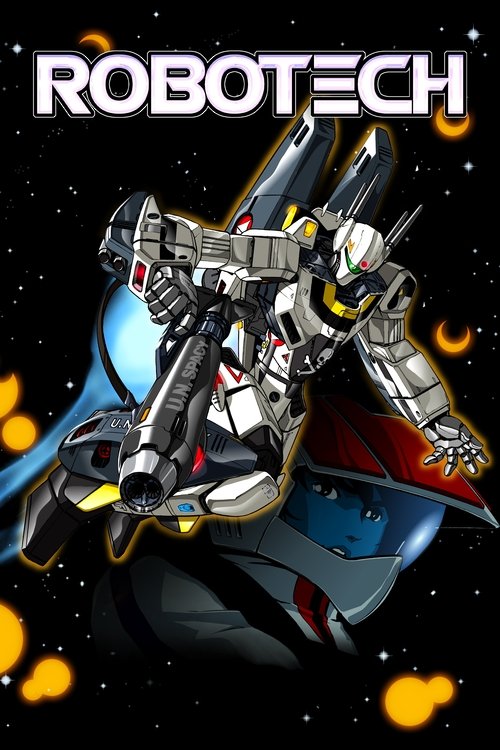
Robotech
Overview
Robotech is an 85-episode American animated series that premiered in 1985. It tells a multi-generational story spanning several decades, chronicling humanity's struggle for survival against a series of alien invasions. The saga begins when a massive alien warship, later christened the Super Dimension Fortress One (SDF-1), crash-lands on Earth. This event unifies the warring planet and jumpstarts a new era of advanced 'Robotechnology.' Ten years later, as humanity prepares to launch the restored SDF-1, its original owners—a race of giant warriors called the Zentraedi—arrive to reclaim it, sparking the First Robotech War.
The series is divided into three distinct parts or 'sagas': The Macross Saga, The Robotech Masters, and The New Generation. Following the devastating war with the Zentraedi, the story shifts focus to the arrival of the Robotech Masters, the creators of the Zentraedi and the mysterious energy source known as Protoculture. This Second Robotech War pushes humanity's new forces to their limits. The final saga jumps forward in time to an Earth conquered by another alien race, the Invid, who were drawn to the planet by the remnants of Protoculture. A small band of freedom fighters, led by a soldier from an off-world expeditionary force, must traverse the desolate landscape to liberate the planet. Across all three sagas, Robotech is notable for its mature themes, complex character relationships, and the idea that war has profound and lasting consequences.
Core Meaning
The core meaning of Robotech is an exploration of humanity's resilience, adaptability, and the enduring power of culture and love in the face of overwhelming, cyclical conflict. The series posits that war is not merely a physical struggle but a battle of ideologies and ways of life. Across three generations, the primary message is that understanding, rather than brute force, is the ultimate key to victory and survival. The Zentraedi, a warrior race, are ultimately defeated not by superior firepower alone, but by their exposure to human emotions, relationships, and especially music, which introduces concepts of love and individuality that their sterile, militaristic society cannot comprehend. This theme evolves through the subsequent wars, suggesting that even in the darkest of times, it is humanity's capacity for connection, art, and perseverance that ensures its continuation and provides hope for a future free from endless conflict.
Thematic DNA
War and its Consequences
Robotech presents a stark, unglamorous view of war. Unlike many cartoons of its era, it shows the devastating cost of conflict, including the near-annihilation of Earth's population and the death of major characters. The story spans generations, emphasizing the cyclical nature of violence and how each war directly sows the seeds for the next. The First Robotech War's end leaves a ravaged planet, the Second War is a direct result of the Masters seeking the Protoculture lost in the first, and the Third War is caused by the Invid being drawn to the 'Flower of Life' spores spread during the second. It explores the psychological toll on soldiers and civilians, forcing characters to grapple with loss, trauma, and the moral ambiguities of combat.
The Power of Culture and Music
A central and unique theme is the idea that culture can be a more powerful weapon than military might. In the first saga, Lynn Minmay's pop songs become an ideological weapon that bewilders and ultimately pacifies the Zentraedi warrior race, who have no concept of art or love. Her music introduces emotion and individuality, causing widespread dissent and defection among the enemy ranks. This illustrates the series' message that shared cultural experiences and emotional connection can bridge even the most profound divides, offering a path to peace where violence has failed.
Love and Human Relationships
Robotech is as much a soap opera as it is a space epic, with complex romantic entanglements driving much of the character development. The famous love triangle between the pilot Rick Hunter, the pop idol Lynn Minmay, and the bridge officer Lisa Hayes is the emotional core of the first saga, exploring themes of duty versus personal desire, and immature infatuation versus mature partnership. This focus on relationships continues through the subsequent generations, including the first human-Zentraedi marriage between Max Sterling and Miriya Parina, symbolizing the potential for unity between warring peoples. These relationships highlight how personal connections and love are what characters fight for and what ultimately gives their struggle meaning.
Generational Struggle and Legacy
By structuring the narrative across three distinct generations, Robotech examines how the actions and failures of one generation directly impact the next. The children of the First Robotech War's heroes become the soldiers of the second. The final saga follows a new group of heroes trying to reclaim a world lost by their predecessors. This structure creates a sprawling, epic feel and reinforces the long-term consequences of war. It explores the burden of legacy and the hope that each new generation can learn from the mistakes of the past to finally break the cycle of destruction.
Character Analysis
Rick Hunter
Tony Oliver
Motivation
Initially, Rick's motivation is purely personal: protecting Lynn Minmay. As the war progresses, his motivation evolves into a sense of duty to his comrades, particularly after the death of his mentor, Roy Fokker. He fights to protect the civilian city within the SDF-1 and eventually for the survival of Earth itself. His relationship with Lisa Hayes matures his perspective, shifting his motivation towards a desire to build a lasting peace and a future, rather than just surviving the present.
Character Arc
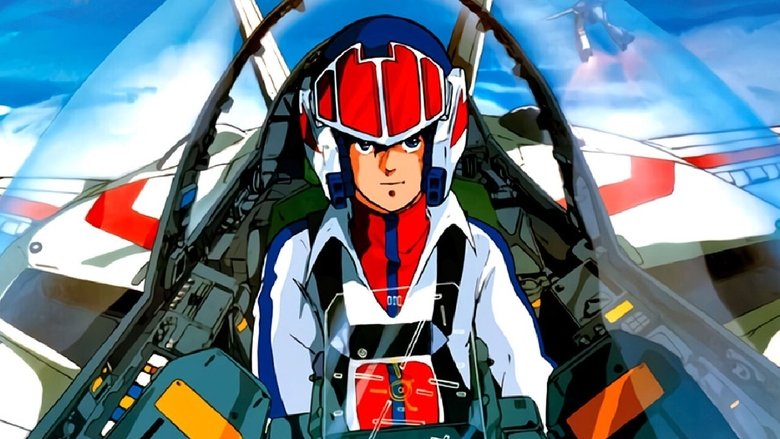
Rick Hunter begins the series as a carefree, civilian stunt pilot with no interest in the military. He is thrust into the First Robotech War by circumstance when he takes control of a Veritech fighter to rescue Lynn Minmay. His arc throughout the first saga is one of maturation through immense trial and loss. Initially driven by his infatuation with Minmay, he evolves into a dedicated and brilliant squadron leader, shouldering increasing responsibility and grappling with the brutal realities of war. By the end of the first saga, he has become a seasoned commander. In the wider lore of the series, he eventually becomes an Admiral, leading the Robotech Expeditionary Force into deep space to seek out the Robotech Masters, cementing his transformation from a boy to a legendary leader of humanity.
Lisa Hayes
Melanie MacQueen
Motivation
Lisa's primary motivation is a deep-seated sense of duty to the military and the protection of Earth. This is also tied to a desire to prove herself to her estranged father, Admiral Hayes. Over time, her motivation becomes more personal as she develops a profound connection with Rick Hunter and the crew of the SDF-1. She fights not just for a strategic objective, but for the people she has come to care for, ultimately seeking a future where they can live in peace.
Character Arc
Lisa Hayes starts as a stern, duty-obsessed, and somewhat emotionally repressed First Officer of the SDF-1. Her life is defined by her military career and the shadow of her famous father. Initially, she clashes with the impulsive Rick Hunter, seeing him as undisciplined. Throughout the first saga, the immense pressures of the war and her developing feelings for Rick force her to confront her own emotional vulnerabilities. She grows from a rigid officer into a compassionate and decisive leader, eventually taking command of the SDF-1 and becoming a key architect of humanity's victory and its future defense. Her journey is one of learning to balance duty with love and to lead with her heart as well as her mind.
Lynn Minmay
Reba West
Motivation
Minmay is motivated by a youthful desire for fame and adoration. She genuinely wants to make people happy with her singing, and this simple wish is weaponized into a tool of war. Her motivations are largely personal and sometimes selfish, focusing on her career and her vacillating feelings for Rick and her cousin, Lynn Kyle. While her songs have a massive impact, her personal motivation is rarely about the grander conflict, which creates a dramatic contrast with the soldiers fighting and dying around her.
Character Arc
Lynn Minmay's journey is a tragic deconstruction of fame. She begins as a naive and cheerful young waitress who dreams of becoming a star. After being rescued by Rick, she wins the 'Miss Macross' pageant and becomes a pop idol, a symbol of hope and culture for the besieged inhabitants of the SDF-1. However, her meteoric rise to fame comes at a cost. She becomes increasingly self-absorbed and struggles to cope with the pressures of being a cultural icon in the midst of a brutal war. Her arc sees her evolve from an innocent girl into a global phenomenon whose art helps end the war, but she ultimately finds herself emotionally lost, unable to reconcile her public persona with her personal feelings and losing her chance at a normal life with Rick.
Scott Bernard
Gregory Snegoff
Motivation
Scott's initial motivation is pure revenge against the Invid for killing his fiancée and his comrades. This is coupled with a strong sense of military duty to carry out his mission at any cost. As he travels with his band of rebels, his motivation evolves. He is inspired by their spirit and their fight for their homes, and his mission transforms from one of vengeance to one of genuine liberation and protecting his new-found friends.
Character Arc
Introduced at the start of the third saga, 'The New Generation,' Scott Bernard is a young Veritech pilot with the Robotech Expeditionary Force sent to liberate Earth from the Invid. His arc begins with tragedy and vengeance; he is the sole survivor of his unit, and he witnesses the death of his fiancée, Marlene, during their failed atmospheric entry. Initially a lone, hardened soldier focused solely on his mission to reach and destroy the Invid's main hive at Reflex Point, his journey across the desolate Earth forces him to assemble and lead a ragtag band of freedom fighters. Through his interactions with this new 'family,' he slowly rediscovers his humanity, learning to fight for a future and for the people beside him, not just for revenge for those he lost.
Symbols & Motifs
Protoculture
Protoculture symbolizes the duality of power and creation. It is both a potent energy source that fuels the aliens' technology and military might, and the product of a biological organism, the Flower of Life. In the American adaptation, it was changed from a cultural concept in Macross to this tangible energy source to link the three series. It represents a coveted, life-altering power that can be used for creation and advancement but is constantly sought for purposes of domination and war, making it the central catalyst for all three Robotech Wars.
Protoculture is the central MacGuffin of the entire 85-episode arc. The Zentraedi are sent to retrieve the SDF-1 because it contains a lost Protoculture matrix. The Robotech Masters invade Earth to reclaim the last known source of producing it. Finally, the Invid are drawn to Earth to harvest the Flower of Life, the organic source of Protoculture, which was spread across the planet at the end of the second war.
The SDF-1
The Super Dimension Fortress One (SDF-1) symbolizes humanity's unintended leap into a galactic community and its resilience in the face of the unknown. A crashed alien vessel rebuilt by human hands, it is a hybrid of alien technology and human ingenuity. It represents a sanctuary and a new society, as it carries the civilian population of Macross City on its journey. The ship itself becomes a melting pot, forcing humans and, eventually, Zentraedi defectors to coexist.
The entire first saga revolves around the SDF-1. Its crash on Earth triggers the events of the series. Its accidental 'space fold' transports it and the surrounding island to the edge of the solar system, forcing a long journey home. The ship is both a military fortress and a civilian city, the setting for most of the first saga's battles and character drama.
Veritech Fighters
The Veritech (Variable Technology) Fighters symbolize adaptability and the fusion of different ideas. These mecha can transform between a jet fighter, a humanoid robot (Battloid), and a hybrid form (Guardian/Gerwalk). This transformative ability mirrors humanity's need to adapt to new and overwhelming threats. It also represents the blend of military functions—the speed of a fighter with the ground combat capabilities of a giant robot—which is essential to humanity's survival.
Veritech Fighters are the primary weapon used by human forces throughout all three sagas of Robotech. From Rick Hunter's VF-1 Valkyrie in The Macross Saga to the VHT-1 Hover Tanks in The Masters and the VFA-6 Alpha Fighters in The New Generation, transformable mecha are a constant visual and thematic element of the series, defining its unique aesthetic and action sequences.
Memorable Quotes
It's not a toy, it's a Veritech fighter!
— Rick Hunter
Context:
This is said in Season 1, Episode 2, "Countdown," after Rick has piloted the Veritech for the first time during the initial Zentraedi attack on Macross Island.
Meaning:
This quote signifies Rick Hunter's initial immersion into the world of military conflict. He says this to Lynn Minmay when she naively refers to his advanced fighter plane as a toy, highlighting the stark contrast between his civilian past and the deadly reality he has just been forced to confront.
And now, for the first time in my life, I'm fighting for a world that I may never see.
— Captain Henry Gloval
Context:
This quote is from Season 1, Episode 18, "Farewell, Big Brother," as the SDF-1 is forced to leave Earth. The crew has just suffered a devastating battle and the loss of Roy Fokker.
Meaning:
This poignant line from the captain of the SDF-1 captures the despair and sense of duty felt by the crew. After being banished from Earth by a fearful and treacherous government, Captain Gloval must lead his crew and the civilian refugees back into battle, fighting to protect a home that has rejected them. It speaks to the highest form of heroism: fighting for an ideal even when you have lost everything personally.
Your primitive emotions are a weakness... They are no match for a Zentraedi warrior!
— Khyron
Context:
Khyron expresses sentiments like this multiple times throughout the first saga, often during his relentless attacks on the SDF-1, demonstrating his contempt for human culture.
Meaning:
This quote perfectly encapsulates the Zentraedi's initial worldview. As a race of clones bred only for war, they see human emotions like love, fear, and compassion as fundamental flaws. Khyron, a recurring antagonist, holds this belief fanatically, making him a perfect foil for the human characters whose emotions are often their greatest strength.
We may be an army of fools, but we're a very determined army.
— Scott Bernard
Context:
This line is indicative of Scott's leadership style throughout Season 3 as he encourages his group of freedom fighters during their long and perilous journey to Reflex Point.
Meaning:
Spoken by the leader of the small resistance group in the final saga, this quote embodies the spirit of 'The New Generation.' Despite being vastly outnumbered and outgunned by the ruling Invid, Scott's band of rebels continues to fight on. It's a statement of resilience and hope against impossible odds, acknowledging their desperate situation but refusing to surrender.
Episode Highlights
Boobytrap
The inaugural episode sets the entire saga in motion. It establishes the central premise: the crash of an alien fortress, the decade-long global effort to rebuild it as the SDF-1, and the arrival of the Zentraedi. It introduces key characters like Rick Hunter, a civilian visitor who is immediately swept up in the chaos. The episode is significant for launching the grand, serialized narrative that was uncommon in American animation at the time.
This episode is the cornerstone of the entire 85-episode arc. It establishes the core technology ('Robotechnology'), the primary conflict, and introduces the main protagonist of the first saga, setting the stage for the epic journey of the SDF-1.
The Long Wait
This episode is a pivotal character piece that contains almost no mecha combat. Rick Hunter and Lynn Minmay are trapped in a forgotten, cavernous section of the SDF-1 for days. The forced isolation strips away the chaos of war and focuses entirely on their budding relationship, revealing Minmay's naivete and Rick's burgeoning feelings and sense of responsibility.
It establishes the emotional core of the first saga's central love triangle. By focusing solely on character drama, it signaled that Robotech was a different kind of show, prioritizing emotional depth alongside action, which helped it appeal to a broader audience, including female viewers.
Force of Arms
The climactic battle of the First Robotech War. Zentraedi Supreme Commander Dolza arrives with an armada of over four million warships to sterilize the Earth. The episode is a stunning spectacle of destruction, with most of Earth's surface being obliterated. In a desperate gambit, the SDF-1 and its new Zentraedi allies broadcast Minmay's singing across the battlefield, causing mass confusion among the enemy fleet, while executing a daring maneuver to destroy Dolza's command ship.
This is arguably the most memorable and impactful episode of the entire series. It showcases the ultimate fusion of the show's main themes: the horror of war and the power of culture. The near-total destruction of Earth raised the stakes to a level rarely seen in animation and had lasting consequences for the rest of the franchise.
Dana's Story
This episode marks the beginning of the second saga, 'The Robotech Masters.' It jumps forward 15 years and introduces a new protagonist: Dana Sterling, the half-human, half-Zentraedi daughter of ace pilots Max and Miriya from the first saga. The episode establishes the new military organization, the Army of the Southern Cross, and Dana's rebellious, energetic personality as she leads the 15th Alpha Tactical Armored Corps. It sets the stage for the arrival of the Robotech Masters.
Crucial for bridging the generational gap in the story. It introduces a new cast and conflict while maintaining continuity through Dana's heritage. Her hybrid nature physically embodies the union of two species that was a major theme of the first saga and explores the concept of the 'middle generation' child.
The Invid Invasion
The start of the third and final saga, 'The New Generation.' The episode depicts the swift and brutal conquest of Earth by the Invid, who are drawn by the Flower of Life. A liberation force sent by Admiral Rick Hunter's deep space fleet is almost entirely wiped out upon arrival. The sole survivor, Scott Bernard, is stranded on the conquered planet, his heart filled with vengeance after witnessing his fiancée's death.
It effectively reboots the series with a new, darker premise: Earth has already fallen. It establishes a post-apocalyptic setting and introduces the final protagonist, Scott Bernard, whose quest to reach Reflex Point drives the narrative of the last 25 episodes.
Symphony of Light
The series finale. The remaining freedom fighters, aided by the return of the Robotech Expeditionary Force, launch a final assault on the Invid's main hive, Reflex Point. As the battle rages, the Invid Regis reveals her true form and her desire to find a new world for her children to evolve. Simultaneously, Admiral Hunter's fleet, now commanded by Lisa Hayes, prepares to bombard the planet. The Invid Regis ultimately departs Earth with her race, and Scott Bernard is left to contemplate his future as the survivors begin to rebuild.
It provides a dramatic and somewhat ambiguous conclusion to the 85-episode saga. The departure of the Invid, rather than their total destruction, reinforces the theme of finding non-violent solutions. The ending leaves the fate of Admiral Rick Hunter and the SDF-3 unresolved, a cliffhanger that has fueled fan speculation for decades and was intended to lead into the aborted sequel series, Robotech II: The Sentinels.
Philosophical Questions
Can culture and art be more powerful than weapons in resolving conflict?
The series explores this question most directly in 'The Macross Saga.' The Zentraedi are a genetically engineered warrior race, superior to humans in every military aspect. However, their society is sterile, lacking art, love, or any form of entertainment. When they are exposed to Lynn Minmay's singing, it acts as a cultural shockwave, introducing concepts they cannot process and leading to mass confusion and defection. The series argues that what defines a civilization is not its strength, but its culture. While military force is necessary for defense, the ultimate victory is achieved through understanding and connection, suggesting that shared emotional experiences can triumph where violence would only lead to mutual destruction.
What is the true cost of war across generations?
Robotech meticulously documents how war's impact is not limited to a single battle or generation. The First Robotech War ends with Earth almost completely destroyed. The survivors spend 15 years rebuilding, only to face the Robotech Masters. This second war leaves the planet vulnerable to the Invid. The series demonstrates that each conflict creates new enemies and new reasons to fight. It explores the idea that the soldiers of one war are often the children of the previous one, inheriting a legacy of violence and loss. The question is never fully answered with a solution, but serves as a constant, cautionary theme throughout the epic.
What does it mean to be human?
This question is explored through the contrast between humans and the alien races. The Zentraedi are warriors who lack individuality and emotion. The Robotech Masters are decadent, amoral creators who view life as a resource. The Invid are a biological hive mind. Against these foils, humanity is defined by its flaws and virtues: love, jealousy, ambition, creativity, and the capacity for both incredible self-sacrifice and self-destruction. The series suggests that to be human is to embrace this complex emotional spectrum, and it is this very 'weakness' that ultimately becomes humanity's greatest strength for survival and connection.
Alternative Interpretations
One of the most prominent alternative interpretations of Robotech revolves around its commentary on cultural imperialism. The story can be read as an allegory for the Cold War and the fear of foreign influence. The Zentraedi, a monolithic, militaristic culture, are 'defeated' not by force, but by the seductive power of Earth's culture—pop music, relationships, and consumerism. This can be interpreted as a celebration of Western cultural soft power, but also as a critique of it, showing how exposure to a new culture can eradicate an old one, as the Zentraedi way of life is effectively destroyed.
Another interpretation, particularly focusing on the second and third sagas, views the series as a study of generational trauma. Each successive generation of heroes inherits a world ruined by their parents' conflicts. Dana Sterling is a literal product of a war-time union, forced to fight her creators' battles. Scott Bernard's generation fights to reclaim a planet they've never known, a home that exists only in stories. In this reading, the series is less about alien invasions and more about the cyclical nature of human conflict and the seemingly impossible task of breaking free from the destructive legacies of the past.
Cultural Impact
Robotech's cultural impact, particularly in North America, is immense and cannot be overstated. Premiering in 1985, it served as a gateway to Japanese animation for an entire generation of Western viewers. At a time when American cartoons were largely episodic and aimed at selling toys, Robotech presented a complex, serialized space opera with mature themes such as love, death, and the devastating consequences of war. This sophisticated storytelling, which treated its audience with intelligence, was revolutionary and helped popularize anime in the West, paving the way for the anime boom of the 1990s.
The series was a 'Frankenstein's monster,' skillfully adapted by Carl Macek and Harmony Gold from three unrelated Japanese series to meet syndication requirements. This act of 'domestication,' while controversial among anime purists, created a unique, multi-generational epic that resonated deeply with its audience. The show's influence can be seen in its introduction of the 'mecha' genre to mainstream American audiences and its focus on character-driven drama. The central love triangle of the first saga was as compelling as any live-action drama, attracting a diverse viewership. Decades later, Robotech maintains a dedicated fanbase and its legacy endures through comic books, novels, and video games, cementing its status as a landmark series that fundamentally changed the landscape of animation in the United States.
Audience Reception
Upon its release in 1985, Robotech was a massive success and a cultural phenomenon. For many American viewers, it was their first exposure to the complex, serialized storytelling of anime. Audiences were captivated by its mature themes, character deaths, and romantic subplots, which stood in stark contrast to the simplistic, episodic nature of other cartoons of the era. 'The Macross Saga' is almost universally praised and remains the most iconic part of the series. The reception to the subsequent sagas, 'The Robotech Masters' and 'The New Generation,' is more mixed. Some fans found the shift in characters and tone jarring, particularly with the less popular 'Masters' saga. However, 'The New Generation' is often appreciated for its post-apocalyptic feel and compelling cast of rebels.
Over the decades, Robotech has maintained a fiercely loyal cult following, but it has also become a point of controversy. Many modern anime fans, with access to the original Japanese source material, criticize the series for its extensive edits and the merging of three unrelated shows, viewing it as a diluted 'Americanization.' Despite this, the original audience largely defends the series, arguing that Carl Macek's adaptation, whatever its flaws, created a unique and powerful epic that stands on its own merits and was instrumental in bringing anime to the West.
Interesting Facts
- Robotech was created by producer Carl Macek by combining three separate and unrelated Japanese anime series: 'Super Dimension Fortress Macross', 'Super Dimension Cavalry Southern Cross', and 'Genesis Climber MOSPEADA'.
- The primary reason for merging the three shows was a requirement for American television syndication at the time, which demanded a minimum of 65 episodes for a daily weekday broadcast. 'Macross' only had 36 episodes.
- The name 'Robotech' was originally used by the model company Revell for a line of imported Japanese mecha model kits, including some from 'Macross', before Harmony Gold adapted the series for television.
- Producer Carl Macek and his team of American writers rewrote the dialogue and created the overarching narrative of Protoculture and the generational wars to connect the three disparate series into a single cohesive epic.
- The concept of 'Protoculture' was significantly changed for Robotech. In the original 'Macross', it referred to an ancient, progenitor civilization. In Robotech, Macek changed it to be a powerful energy source to serve as a plot device linking all three sagas.
- Many fans of the original Japanese series have criticized 'Robotech' for its extensive edits, re-written dialogue, and the 'Frankenstein' nature of its creation, making Carl Macek a controversial figure in the anime community.
- A sequel series, 'Robotech II: The Sentinels', was planned and entered production. However, due to a crash in the Yen/Dollar exchange rate and the withdrawal of the toy partner Matchbox, production was cancelled after only three episodes were completed.
- The show's mature themes, serialized plot, and character deaths were groundbreaking for American children's television in the 1980s and helped it attract a significant older and female audience, much like a soap opera.
⚠️ Spoiler Analysis
Click to reveal detailed analysis with spoilers
Frequently Asked Questions
Explore More About This Movie
Dive deeper into specific aspects of the movie with our detailed analysis pages
Comments (0)
No comments yet. Be the first to share your thoughts!