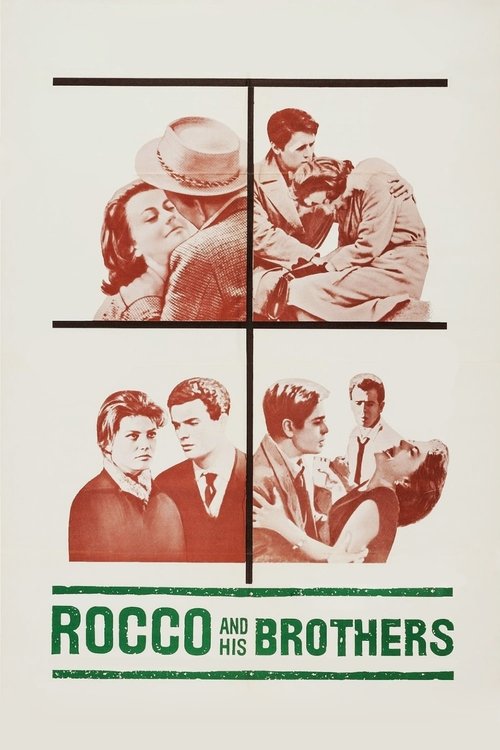
Rocco and His Brothers
A neorealist opera of familial bonds dissolving under the harsh lights of an industrial city, charting the soulful tragedy of loyalty and corruption.
Rocco and His Brothers

Rocco e i suoi fratelli

"DARING in its realism. STUNNING in its impact. BREATHTAKING in its scope."

07 October 1960 France 178 min ⭐ 8.0 (631)
Director: Luchino Visconti
Cast: Alain Delon, Renato Salvatori, Annie Girardot, Katina Paxinou, Alessandra Panaro
Drama Romance
Family Disintegration and a New Society Corruption of Innocence The North-South Divide in Italy Destructive Masculinity and Jealousy

Rocco and His Brothers - Ending Explained

⚠️ Spoiler Analysis

The plot's central tragedy is driven by the escalating rivalry between Rocco and Simone over the prostitute Nadia. After Rocco begins a tender relationship with Nadia during his military service, Simone's jealousy explodes. In the film's most infamous scene, Simone, with the help of his friends, corners Rocco and Nadia. He brutally rapes Nadia while forcing a helpless Rocco to watch, irrevocably shattering the bond between the brothers and setting the stage for the final tragedy.

Despite this horrific act, Rocco's commitment to family loyalty leads him to sacrifice his love for Nadia, encouraging her to return to Simone in a misguided attempt to save his brother. This only pushes Simone further into despair and debt. To pay off Simone's debts, Rocco signs a long-term, restrictive boxing contract, effectively selling his future.

The film's climax is a devastating intercutting of two events. While Rocco is in the ring, fighting and winning a championship bout that he hopes will save the family, Simone confronts Nadia one last time. When she tells him how much she hates him for ruining the one good thing in her life, he viciously stabs her to death near the Ponte della Ghisolfa. Simone returns to the family's celebration, bloody and broken, and confesses to the murder. Rocco, in his ultimate act of flawed forgiveness, still wants to protect him. However, Ciro, representing the new world's morality, refuses and leaves to call the police, sealing the family's tragic fate and signaling the final disintegration of their old-world values.

Alternative Interpretations

One significant alternative reading focuses on the character of Rocco, viewing his saintliness not as a virtue but as a profound moral failure. While on the surface he is a Christ-like figure of forgiveness, some critics argue that his refusal to judge Simone and his constant sacrifices are a form of moral abdication. By consistently enabling his brother's destructive behavior—paying his debts, returning stolen goods, and even giving up Nadia—Rocco becomes complicit in the tragedy. In this interpretation, his final plea to "help him, not judge him" is not a sign of grace but a pathological inability to confront evil, making his self-sacrifice a destructive force that perpetuates the family's downfall rather than redeeming it.

Another interpretation explores a homoerotic subtext in the brothers' relationships, particularly between Rocco and Simone. Their intense bond, rivalry, and physical interactions—from sparring in the boxing ring to their final, sobbing embrace on a bed after Simone's confession—can be viewed through a lens of repressed desire. Simone's violence towards Nadia could be interpreted as an externalization of his rage and turmoil over his complex, co-dependent bond with Rocco. This reading is supported by director Luchino Visconti's own identity as a gay man and the subtle coding of other characters, such as the predatory boxing promoter.