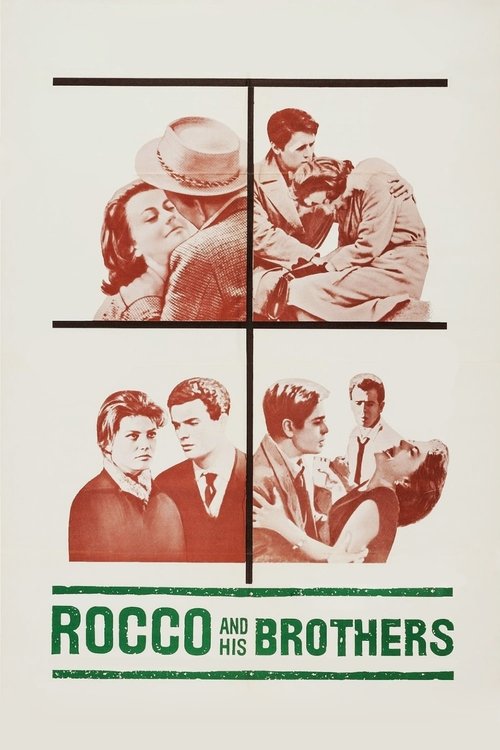
Rocco and His Brothers
Rocco e i suoi fratelli
"DARING in its realism. STUNNING in its impact. BREATHTAKING in its scope."
Overview
"Rocco and His Brothers" chronicles the tragic saga of the Parondi family, a widow and her five sons, who migrate from the impoverished rural South of Italy to the industrial northern city of Milan in search of a better life. The family's arrival, described as being "like an earthquake," immediately exposes them to the cultural and economic clashes between their traditional, agrarian values and the modern, alienating urban environment. The story unfolds in chapters, each focusing on one of the brothers, as they navigate their new world.
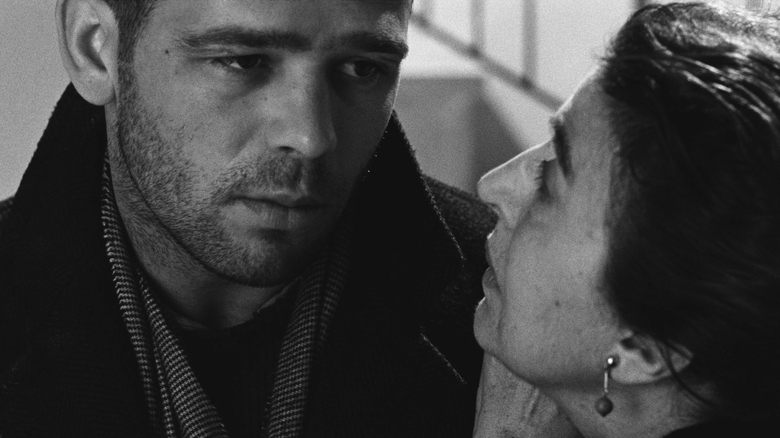
The central drama revolves around the intense and destructive rivalry between two brothers: the gentle, self-sacrificing Rocco (Alain Delon) and the impulsive, brutish Simone (Renato Salvatori). Both fall for the same woman, a prostitute named Nadia (Annie Girardot), whose presence acts as a catalyst, exacerbating their differences and driving a wedge through the family. As Simone's boxing career falters and he descends into alcoholism and crime, Rocco's saintly efforts to save him only lead to greater tragedy, forcing the family to confront the disintegration of their bonds and the steep price of their ambition.
Core Meaning
"Rocco and His Brothers" is a profound exploration of the disintegration of traditional family values under the corrupting pressures of modern, industrial society. Director Luchino Visconti uses the story of the Parondi family's migration from the rural South to urban Milan to dramatize the devastating consequences of this societal shift. The film argues that the pursuit of individual success and wealth in the city comes at the cost of communal bonds, honor, and spiritual well-being. Through the contrasting paths of the brothers—Rocco's Christ-like self-sacrifice, Simone's moral decay, and Ciro's pragmatic assimilation—Visconti questions whether old-world virtues can survive in a new world driven by capital and alienation. The core message is a tragic lament for a lost paradise and a critique of a society that unmoors individuals from their roots, leading inevitably to moral and emotional ruin.
Thematic DNA
Family Disintegration and a New Society
The central theme is the tragic dissolution of the Parondi family unit when confronted with the pressures of urban life in Milan. Coming from the rural South with strong, traditional bonds—the mother Rosaria calls her sons "the five fingers of my hand"—the family is gradually torn apart by individual ambitions, jealousy, and the alienating nature of the industrial North. Each brother represents a different response to this new world: Vincenzo assimilates through marriage, Simone is corrupted by it, Rocco tries to uphold old values through self-sacrifice, and Ciro adapts by embracing its rules and finding steady work. This clash between agrarian past and industrial future leads to the ultimate breakdown of their sacred familial ties.
Corruption of Innocence
The film powerfully depicts how the city corrupts the inherent innocence of the brothers, particularly Simone and, in a different way, Rocco. Simone, once a promising boxer, is quickly consumed by greed, lust, and violence, leading to his complete moral collapse. Rocco, often compared to Dostoevsky's Prince Myshkin, is a figure of saint-like goodness. However, his unwavering forgiveness and attempts to save his brother ultimately enable Simone's destructive behavior and trap Rocco himself in a life he detests, sacrificing his own happiness and love for Nadia to pay for Simone's sins. The city, therefore, destroys innocence both through outright corruption and by making virtue untenable.
The North-South Divide in Italy
Visconti uses the Parondi family's journey as a microcosm for the immense socio-economic and cultural divide between Italy's poor, agrarian South (Mezzogiorno) and the prosperous, industrialized North. Upon arriving in Milan, the family faces prejudice and is seen as an uncouth clan of outsiders. The film explores the profound alienation and the challenges faced by Southern migrants trying to adapt to a society with vastly different values. Rocco's final, nostalgic speech about their homeland—"the land of olive trees, of moon sickness, and of rainbows"—highlights this sense of spiritual exile and the irreplaceable loss of identity.
Destructive Masculinity and Jealousy
The narrative is driven by a toxic rivalry between Simone and Rocco, fueled by jealousy over boxing success and their love for Nadia. Simone's masculinity is expressed through aggression, possessiveness, and violence. His inability to accept Nadia's love for Rocco leads him to commit a horrifying act of rape in front of his brother, an event that marks the point of no return for the family's destruction. The film serves as a devastating critique of a patriarchal mindset where women are seen as possessions and honor is tied to dominance, ultimately leading to tragedy for all involved.
Character Analysis
Rocco Parondi
Alain Delon
Motivation
His primary motivation is an almost saintly devotion to his family, especially his mother and his self-destructive brother, Simone. He is driven by a belief in forgiveness and the sanctity of family bonds, values rooted in his southern upbringing, which prove tragically incompatible with the new world of Milan.
Character Arc
Rocco begins as a gentle, optimistic, and deeply loyal brother. His core identity is rooted in preserving the family at any cost. His arc is tragic; his goodness and unwavering forgiveness, particularly towards Simone, become his fatal flaw. By sacrificing his love for Nadia and his own future to shoulder Simone's debts and crimes, he enables further destruction. He ends the film a broken man, victorious in the boxing ring but spiritually defeated, having failed to save his brother or his family's honor.
Simone Parondi
Renato Salvatori
Motivation
Simone is motivated by a desperate and ultimately lazy desire for fame and wealth, encouraged by his mother. His actions are driven by insecurity, intense jealousy of Rocco, and an obsessive, possessive love for Nadia. He lacks the moral foundation to resist the corrupting influences around him, constantly choosing the easiest, most destructive path.
Character Arc
Simone starts as the family's best hope for success, a charismatic and physically powerful figure pursuing a boxing career. However, he is quickly corrupted by the city's temptations, spiraling into alcoholism, debt, and violence. His jealousy of Rocco's success and relationship with Nadia consumes him, leading him to rape Nadia and ultimately murder her. His arc is a steep descent from flawed ambition to irredeemable villainy, embodying the most destructive effects of the urban environment on a weak character.
Nadia
Annie Girardot
Motivation
Initially motivated by survival, Nadia's core desire becomes a longing for a genuine connection and a better life, which she believes she can find with Rocco. After being abandoned by him, her motivations become more complex, a mix of despair and a desire to hasten Simone's downfall. Ultimately, she is a victim whose agency is tragically stripped away.
Character Arc
Nadia is introduced as a cynical prostitute, a product of the city's harsh realities. Her relationship with the brutish Simone is transactional and volatile. Rocco's kindness and innocence inspire a genuine change in her; she falls in love and sees a chance at redemption. Tragically, this redemption is stolen from her. After Rocco sacrifices their relationship for Simone's sake, she falls back into her old life, only to be brutally murdered by Simone. Her arc is a tragic journey from jaded survival to hopeful love and back to victimhood, making her the ultimate casualty of the brothers' conflict.
Ciro Parondi
Max Cartier
Motivation
Ciro is motivated by a desire for stability and to build a respectable life for himself within the new system. He believes in progress and order, and his actions are guided by a strong moral compass that aligns with civic duty rather than blind family allegiance.
Character Arc
Ciro represents the path of successful, if unsentimental, assimilation. He is diligent, attends night school, and secures a stable job at the Alfa Romeo factory. Unlike Rocco, who clings to the past, and Simone, who is destroyed by the present, Ciro adapts to the new social order. His arc culminates in him rejecting Rocco's plea to protect Simone after Nadia's murder. He chooses the law and the values of his new society over the flawed, traditional loyalty of his family, representing a definitive break with the past.
Rosaria Parondi
Katina Paxinou
Motivation
Her primary motivation is a fierce desire to see her sons succeed and escape the poverty that defined their life in the South. However, her understanding of success is materialistic, and she often favors the son she believes will bring the most prosperity, contributing to the rivalry and ultimate tragedy.
Character Arc
Rosaria is the forceful, domineering mother who instigated the family's move to Milan to escape poverty. Her arc is one of tragic disillusionment. Initially, she encourages Simone's boxing ambitions as a quick path to wealth, but she is unable to control the destructive forces she unleashes. As her family disintegrates, her authority wanes, and she is left to witness the devastating consequences of her ambition, clinging to a broken family and lamenting their fate.
Symbols & Motifs
The City of Milan
Milan represents the promise of modernity, opportunity, and economic prosperity, but also the reality of moral corruption, alienation, and the destruction of traditional values. Its dazzling lights initially marvel the brothers, but its cold, competitive environment ultimately devours their family bond. It is a crucible that tests each brother, rewarding pragmatic assimilation while punishing both brute ambition and saintly innocence.
The city is a constant presence, from the family's arrival at the bustling train station to the bleak housing projects on the outskirts and the corrupt world of the boxing gym. The modern architecture and industrial landscapes, like the Alfa Romeo factory where Ciro works, contrast sharply with the family's memories of their rural homeland, symbolizing the inescapable forces of change.
Boxing
Boxing serves as a metaphor for the struggle for survival and upward mobility in the harsh urban environment. It is presented as a quick, albeit brutal, path to fame and fortune for disadvantaged young men. For Simone, it becomes a path to corruption and self-destruction, while for Rocco, it represents a form of martyrdom—he sacrifices his body and soul in the ring to pay for his brother's sins. The boxing ring is an arena where fraternal bonds are ultimately broken.
The boxing gym is a key location where the brothers' differing characters are revealed. Simone's undisciplined approach contrasts with Rocco's natural talent. The film's climax intercuts Rocco's championship fight with Simone's murder of Nadia, directly linking Rocco's physical punishment in the ring to the tragic consequences of his family's moral decay.
The Land (Lucania)
The family's rural southern homeland, Lucania, symbolizes a lost paradise—a place of tradition, honor, and spiritual grace that has become an idealized memory. It represents the past and the traditional values the family has left behind, a world to which they can never truly return, as Ciro explains to Luca in the final scene.
The South is primarily present through the characters' dialogue and nostalgia. In the final act, after the family has been shattered by tragedy, Rocco gives a moving speech to his youngest brother, Luca, about their homeland, describing it as "the land of olive trees, of moon sickness, and of rainbows," cementing its status as a mythical, irretrievable Eden.
Memorable Quotes
Remember, Luca, ours is the land of olive trees, of moon sickness, and of rainbows.
— Rocco Parondi
Context:
Near the end of the film, after Simone has confessed to murder and the family is in ruins, Rocco speaks these words to his youngest brother, Luca. He is trying to impart the memory of their heritage, a world that now seems impossibly distant and pure compared to the corruption of Milan.
Meaning:
This quote encapsulates the theme of nostalgia and the idealized memory of the family's Southern homeland. It's a poetic and tragic lament for a lost world of innocence and natural beauty, spoken at a time when the family has been completely shattered by the harsh realities of their new urban life. It signifies the spiritual exile felt by the characters.
Have faith and have no fear. Great faith.
— Rocco Parondi
Context:
During their first real conversation away from Milan, after Nadia has been released from prison, Rocco senses her fear and hopelessness. He takes her hand and offers these words of encouragement, which become the foundation of their brief, tender relationship.
Meaning:
This line reveals the core of Rocco's saint-like character: his boundless, almost naive optimism and belief in the good of others. He says this to Nadia, inspiring her to believe in a better future and in him. It highlights his role as a savior figure, but also foreshadows the tragedy that his faith cannot conquer the world's evils.
Rocco's a saint, but what can he do in this world? He won't defend himself. He's so forgiving. But one mustn't always forgive.
— Ciro Parondi
Context:
This is said near the end of the film, likely during the family's final confrontation after Simone's crime is revealed. Ciro uses these words to justify his decision to turn Simone in to the police, rejecting Rocco's plea to protect him and choosing the rule of law over blind family loyalty.
Meaning:
This quote, spoken by the pragmatic Ciro, serves as a direct critique of Rocco's defining philosophy. It articulates the film's central moral conflict: the clash between Christian ideals of forgiveness and the practical necessities of justice in a fallen world. Ciro recognizes that Rocco's virtue is also his weakness, a quality that is unsustainable and ultimately destructive in their new environment.
Philosophical Questions
Can absolute forgiveness be a destructive force?
The film deeply explores this question through Rocco's character. His unwavering, Christ-like forgiveness of his brother Simone's transgressions is portrayed as both a noble virtue and a fatal flaw. Rocco sacrifices his own happiness, his love, and his future in the belief that he can save his brother. However, his actions repeatedly shield Simone from the consequences of his behavior, arguably enabling his descent into further violence and crime. The tragic climax, where Simone murders Nadia, forces the audience to question whether Rocco's refusal to condemn Simone was a form of complicity. Ciro's decision to call the police stands in stark contrast, suggesting that in the real world, justice must sometimes override unconditional familial love and forgiveness.
Is character destiny, or are individuals shaped by their environment?
"Rocco and His Brothers" presents a complex dialogue between inherent nature and external influence. The industrial city of Milan acts as a powerful, corrupting force that magnifies each brother's strengths and weaknesses. Simone's moral failings seem innate, but they are catastrophically amplified by the city's temptations. Conversely, Ciro thrives by adapting to the new social order. The film suggests that while environment provides the context and the pressures, it is the individual's inner character that determines their ultimate fate. As one critic noted, the film ultimately favors the idea that "character is destiny," arguing that it is not poverty or social forces alone that destroy the family, but the inherent flaws within its members.
What is the true meaning of 'home' and can it ever be reclaimed?
The concept of 'home' in the film is an idealized, almost mythical past represented by the family's rural life in the South. Rocco clings to the dream of returning, believing it will restore their lost grace and purity. However, the film questions the viability of this dream. The final conversation between Ciro and Luca suggests that the past cannot be reclaimed; progress is inevitable, and the South itself is changing. 'Home' becomes less a physical place and more a state of spiritual belonging that the family has lost forever in their pursuit of a new life, turning their story into a profound meditation on displacement and the irreversible nature of time.
Alternative Interpretations
One significant alternative reading focuses on the character of Rocco, viewing his saintliness not as a virtue but as a profound moral failure. While on the surface he is a Christ-like figure of forgiveness, some critics argue that his refusal to judge Simone and his constant sacrifices are a form of moral abdication. By consistently enabling his brother's destructive behavior—paying his debts, returning stolen goods, and even giving up Nadia—Rocco becomes complicit in the tragedy. In this interpretation, his final plea to "help him, not judge him" is not a sign of grace but a pathological inability to confront evil, making his self-sacrifice a destructive force that perpetuates the family's downfall rather than redeeming it.
Another interpretation explores a homoerotic subtext in the brothers' relationships, particularly between Rocco and Simone. Their intense bond, rivalry, and physical interactions—from sparring in the boxing ring to their final, sobbing embrace on a bed after Simone's confession—can be viewed through a lens of repressed desire. Simone's violence towards Nadia could be interpreted as an externalization of his rage and turmoil over his complex, co-dependent bond with Rocco. This reading is supported by director Luchino Visconti's own identity as a gay man and the subtle coding of other characters, such as the predatory boxing promoter.
Cultural Impact
"Rocco and His Brothers" is a landmark of Italian cinema, representing a crucial bridge between the neorealism of the postwar era and the more personal, stylized filmmaking of the 1960s. Released in 1960 alongside Fellini's "La Dolce Vita" and Antonioni's "L'Avventura," it was part of a monumental year for Italian film. While rooted in the neorealist tradition of focusing on social issues—specifically the mass migration of Southern Italians to the industrial North—Visconti infused the film with an operatic, melodramatic grandeur that was his signature.
The film was met with significant controversy and censorship in Italy for its stark depiction of violence, particularly the rape and murder scenes, which were unprecedented in their brutality for the time. Despite this, it was a critical success internationally, winning the Special Jury Prize at the Venice Film Festival. Its influence has been profound and long-lasting. Directors like Martin Scorsese and Francis Ford Coppola have cited it as a major inspiration, particularly for its epic portrayal of a family saga, its blending of the personal and the social, and its exploration of fraternal conflict and moral decay within an Italian cultural context. The film's themes of alienation in modern urban life, the loss of traditional values, and the dark side of ambition continue to resonate with audiences and filmmakers today.
Audience Reception
Audience reception for "Rocco and His Brothers" has generally been powerful, with many viewers hailing it as a masterpiece of Italian cinema. Viewers frequently praise the film's emotional intensity, its epic scope, and the devastatingly effective performances, particularly by Alain Delon as the saintly Rocco, Renato Salvatori as the tormented Simone, and Annie Girardot as the tragic Nadia. The film is often described as a gut-wrenching and unforgettable experience, with its themes of family loyalty, moral decay, and the struggles of immigration resonating universally. The beautiful black-and-white cinematography by Giuseppe Rotunno and Nino Rota's haunting score are also commonly cited as high points.
The main points of criticism or difficulty for audiences often revolve around the film's nearly three-hour runtime and its relentlessly bleak and tragic narrative. Some find the melodrama to be overplayed at times, bordering on theatrical. The film's most controversial moments remain its scenes of brutal violence, especially Simone's rape of Nadia, which many viewers find shocking and difficult to watch even by modern standards.
Interesting Facts
- The film's title is a combination of Thomas Mann's novel "Joseph and His Brothers" and the name Rocco Scotellaro, an Italian poet who wrote about the plight of Southern peasants.
- Actors Renato Salvatori (Simone) and Annie Girardot (Nadia) fell in love during filming and were married two years later, a real-life romance that critics felt added to their powerful on-screen chemistry.
- The film was highly controversial in Italy upon its release due to its violence and themes. Censors demanded cuts to several scenes, most notably the brutal rape of Nadia and her subsequent murder.
- Director Luchino Visconti considered "Rocco and His Brothers" to be his personal favorite among his films.
- The film's operatic score by Nino Rota was so influential that it reportedly inspired Francis Ford Coppola to hire Rota for "The Godfather".
- Visconti's bold casting included hiring Renato Salvatori, who was primarily known for comedic roles, to play the dark and tragic character of Simone.
- The film is seen as a spiritual sequel to Visconti's 1948 neorealist film "La Terra Trema," which also depicted the struggles of a Southern Italian family.
- To achieve a sense of authenticity, the film was shot on location in Milan, including at the Duomo cathedral and the central railway station.
- The film had a significant influence on later directors, particularly Martin Scorsese, whose films like "Raging Bull" and "Goodfellas" explore similar themes of cohesive family units destabilized by internal and external forces.
⚠️ Spoiler Analysis
Click to reveal detailed analysis with spoilers
Frequently Asked Questions
Explore More About This Movie
Dive deeper into specific aspects of the movie with our detailed analysis pages
Comments (0)
No comments yet. Be the first to share your thoughts!