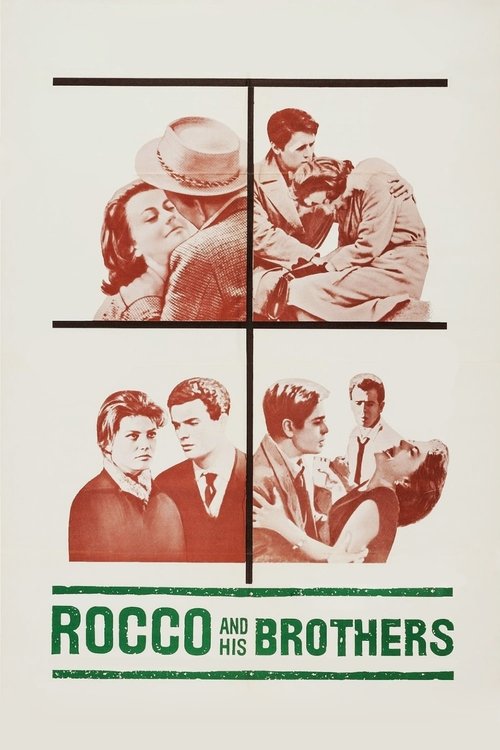
Rocco e i suoi fratelli
"DARING in its realism. STUNNING in its impact. BREATHTAKING in its scope."
Director: Luchino Visconti
Cast: Alain Delon, Renato Salvatori, Annie Girardot, Katina Paxinou, Alessandra Panaro
Rocco and His Brothers — Movie Quotes
Memorable Quotes
Remember, Luca, ours is the land of olive trees, of moon sickness, and of rainbows.
Context
Near the end of the film, after Simone has confessed to murder and the family is in ruins, Rocco speaks these words to his youngest brother, Luca. He is trying to impart the memory of their heritage, a world that now seems impossibly distant and pure compared to the corruption of Milan.
Meaning
This quote encapsulates the theme of nostalgia and the idealized memory of the family's Southern homeland. It's a poetic and tragic lament for a lost world of innocence and natural beauty, spoken at a time when the family has been completely shattered by the harsh realities of their new urban life. It signifies the spiritual exile felt by the characters.
Have faith and have no fear. Great faith.
Context
During their first real conversation away from Milan, after Nadia has been released from prison, Rocco senses her fear and hopelessness. He takes her hand and offers these words of encouragement, which become the foundation of their brief, tender relationship.
Meaning
This line reveals the core of Rocco's saint-like character: his boundless, almost naive optimism and belief in the good of others. He says this to Nadia, inspiring her to believe in a better future and in him. It highlights his role as a savior figure, but also foreshadows the tragedy that his faith cannot conquer the world's evils.
Rocco's a saint, but what can he do in this world? He won't defend himself. He's so forgiving. But one mustn't always forgive.
Context
This is said near the end of the film, likely during the family's final confrontation after Simone's crime is revealed. Ciro uses these words to justify his decision to turn Simone in to the police, rejecting Rocco's plea to protect him and choosing the rule of law over blind family loyalty.
Meaning
This quote, spoken by the pragmatic Ciro, serves as a direct critique of Rocco's defining philosophy. It articulates the film's central moral conflict: the clash between Christian ideals of forgiveness and the practical necessities of justice in a fallen world. Ciro recognizes that Rocco's virtue is also his weakness, a quality that is unsustainable and ultimately destructive in their new environment.
Explore More About This Movie
Dive deeper into specific aspects of the movie with our detailed analysis pages