
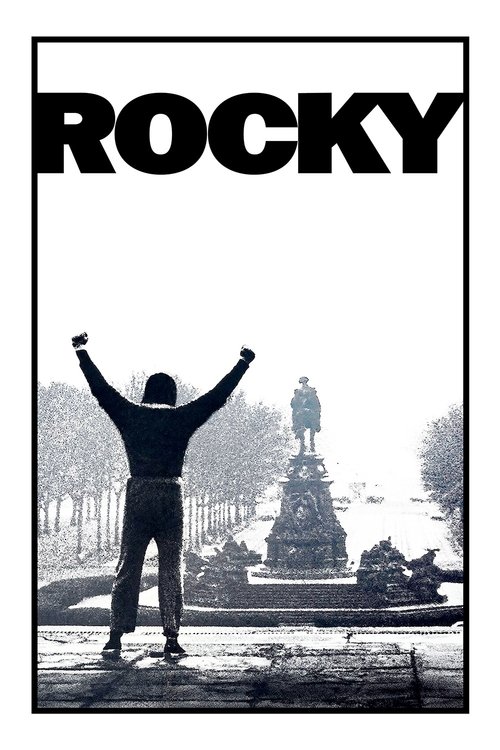
"His whole life was a million-to-one shot."
Rocky - Symbolism & Philosophy
Symbols & Motifs
The Philadelphia Museum of Art Steps
Symbolizes the arduous journey to success and the physical manifestation of Rocky's rising self-esteem. Reaching the top represents a perspective shift from being trapped in the slums to overlooking the entire city.
Used during the iconic training montages; initially, Rocky fails to run up them easily, but by the climax, he sprints and dances at the summit.
Raw Eggs
Represents unrefined potential and the "raw" nature of Rocky's training compared to Apollo Creed's polished, high-tech preparation.
Rocky drinks five raw eggs at 4:00 AM, a visceral scene emphasizing the gritty, unglamorous reality of his commitment.
Cuff and Link (Turtles)
Symbolize Rocky's slow but steady progress and his own solitary, protective nature.
They are Rocky's only companions at home early in the film, reflecting his isolation and humble life.
The Broken Nose
Symbolizes legitimacy and the true test of character. Rocky notes he never had his nose broken in 64 fights, implying he hadn't yet faced a challenge that truly tested his limits.
Apollo breaks Rocky's nose in the first round, signifying that this is the first fight where Rocky is truly "going the distance" with greatness.
Philosophical Questions
What constitutes a 'win' in a life where the odds are mathematically stacked against you?
The film explores the concept of the Internal Victory. It suggests that if the external world is rigged or superior, the individual finds meaning by setting their own metric for success—in Rocky's case, simply remaining upright until the end.
Is the American Dream a reality or a promotional gimmick?
Through the character of Apollo Creed, the film shows the "Land of Opportunity" being used as a marketing tool. However, Rocky’s genuine effort suggests that while the system may be cynical, the human response to opportunity can still be sincere and transformative.
Core Meaning
The core message of Rocky is that victory is defined by personal dignity rather than the final score. Director John G. Avildsen and writer/star Sylvester Stallone present a narrative where the protagonist's triumph lies in his refusal to stay down. The film argues that "going the distance"—surviving the full fifteen rounds with the best in the world—is a valid and noble form of success, asserting that self-respect and love are the ultimate prizes of the human struggle.