Roman Holiday - Symbolism & Philosophy
Symbols & Motifs
Vespa Scooter
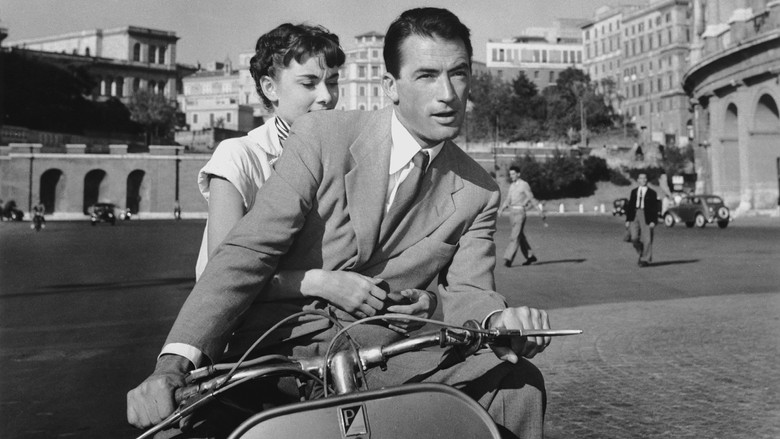
The Vespa represents freedom, spontaneity, and the youthful, carefree spirit of their day in Rome. It allows Ann and Joe to navigate the city on their own terms, weaving through traffic and exploring hidden corners. The image of them on the scooter has become an enduring symbol of Italian romance and the joy of breaking free from constraints.
During their tour of Rome, Joe rents a Vespa. Ann, in a moment of playful rebellion, takes the handlebars and drives recklessly through the city's streets, leading to a comical chase and a run-in with the police. This scene encapsulates the exhilarating and slightly dangerous nature of her newfound freedom.
The Mouth of Truth (Bocca della Verità)
This ancient stone carving serves as a potent symbol of honesty, trust, and the underlying deception in Ann and Joe's relationship. The legend that it will bite off the hand of a liar directly challenges them both. Joe's playful prank and Ann's genuine fear create a moment of authentic connection, despite their hidden truths. It's a test of their burgeoning feelings and the moment their relationship deepens.
Joe takes Ann to see the Mouth of Truth and tells her the legend. To test her, he has her put her hand in. When it's his turn, he pretends his hand has been bitten off, eliciting a real scream of terror from Ann, followed by relief and laughter. This iconic scene was famously improvised by Gregory Peck.
Philosophical Questions
Can a single day of freedom fundamentally change a person's life?
The film argues a resounding "yes." Princess Ann's 24 hours of anonymity in Rome are not just a simple escape but a profound journey of self-discovery. The experiences she has—from getting a haircut on a whim to falling in love—allow her to understand herself outside of her rigid royal identity. She returns to her duties fundamentally changed, more mature, confident, and with a deeper understanding of life and her place in it. The film posits that it is the quality and authenticity of experience, not the duration, that shapes us.
Is it nobler to pursue personal happiness or to fulfill one's duty to others?
"Roman Holiday" presents this as its central dilemma without offering an easy answer. The film deeply romanticizes Ann and Joe's brief love affair, making the audience yearn for them to choose personal happiness together. However, it ultimately portrays Ann's decision to return to her duties as a noble and mature sacrifice. The film suggests that responsibility and duty have their own profound value and that true character is shown in honoring one's commitments, even at great personal cost. The poignancy of the ending lies in the fact that both choices—love and duty—are presented as valid and honorable.
Core Meaning
The central message of "Roman Holiday" revolves around the conflict between personal desire and public duty, and the bittersweet nature of cherished memories. The director, William Wyler, explores the idea that true freedom is not about escaping responsibility, but about having the autonomy to make one's own choices, even if those choices lead back to duty. The film suggests that a single day of authentic experience and genuine connection can be more profound and life-altering than a lifetime of prescribed routine. Ultimately, it conveys that some of the most beautiful moments in life are fleeting, and their value lies not in their permanence but in the lasting impact they have on who we become. The ending, where love is sacrificed for duty, underscores a mature and poignant understanding of love and responsibility.