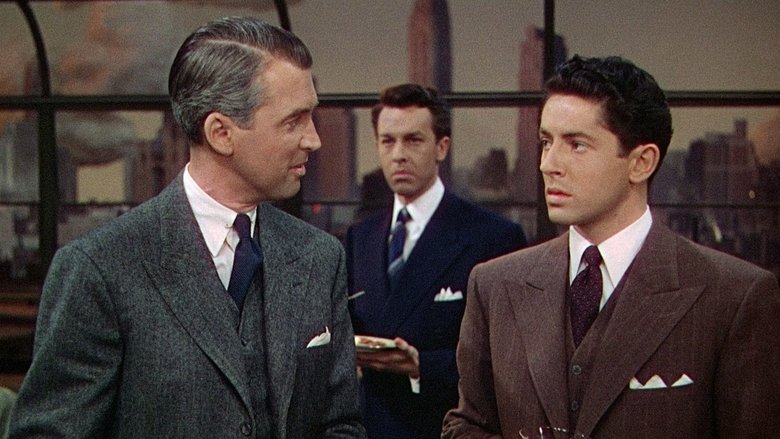
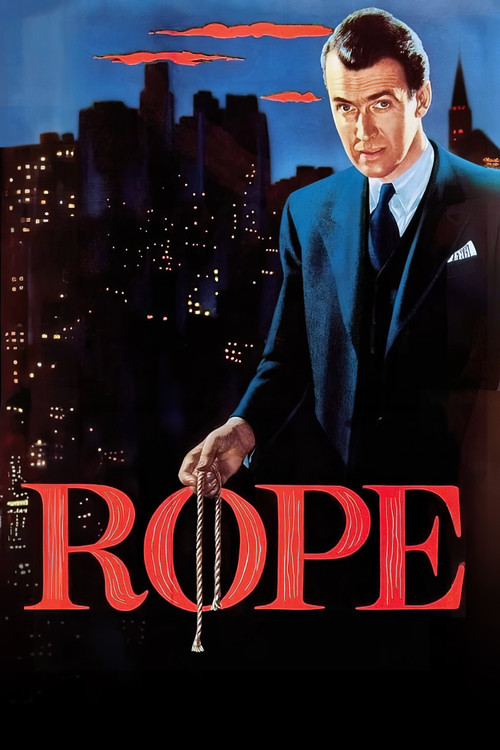
"It begins with a shriek...it ends with a shot! From beginning to end, nothing ever held you like Alfred Hitchcock's ROPE!"
Rope - Symbolism & Philosophy
Symbols & Motifs
The Rope
The titular rope is a multifaceted symbol. On a literal level, it is the murder weapon. Metaphorically, it represents the bond between Brandon and Phillip, a connection forged in violence that ultimately leads to their downfall. It also symbolizes the perversion of an ordinary object into an instrument of death, reflecting how the murderers have twisted intellectual concepts into a justification for their crime. When Brandon uses the rope to tie a bundle of books for David's father, it becomes a symbol of his cruel and audacious deception.
The rope is used to strangle David Kentley at the beginning of the film. It is then hidden, but its presence is felt throughout the dinner party. In a particularly tense moment, Brandon uses the same rope to tie up a collection of rare books he gives to David's father as a gift.
The Chest
The antique wooden chest that contains David's body symbolizes the coffin and the dark secret at the heart of the seemingly sophisticated gathering. Its use as a buffet table for the dinner party is a grotesque symbol of Brandon's hubris and his contempt for human life and social conventions. It also represents the literal and metaphorical "closet" in which Brandon and Phillip's transgression is hidden in plain sight.
The chest is a prominent piece of furniture in the apartment and is the focal point of many shots. The dinner is served on top of it, and there are several moments of high tension where it seems the body will be discovered.
Light and Darkness
Light and darkness are used to symbolize knowledge and ignorance, as well as good and evil. The film begins with the murder committed behind drawn blinds, in the dark. Brandon's insistence on opening the blinds and letting in the light represents his desire to bring their deed into the open, in a perverse way. The changing light of the sunset outside the apartment window marks the passage of time and the dimming hope of the murderers getting away with their crime.
After the murder, Brandon throws open the curtains, letting daylight stream into the room. As the evening progresses, the apartment grows darker, and the neon signs from the city outside cast an eerie glow. The final scene, with Rupert firing a gun out the window to attract attention, is a symbolic act of bringing the crime to light.
Philosophical Questions
Do ideas have consequences, and what is the responsibility of an intellectual?
The film directly confronts this question through the character of Rupert Cadell. He casually discusses the theory of the superior man having the right to kill, treating it as an abstract intellectual exercise. However, when he discovers that his students, Brandon and Phillip, have taken his words literally and committed murder, he is horrified. This forces both Rupert and the audience to consider the real-world impact of abstract ideas. The film argues that intellectuals and educators have a profound responsibility for the ideas they promote, as these concepts can be dangerously misinterpreted and lead to horrific actions when divorced from empathy and morality.
What is the nature of good and evil, and are some individuals 'above' conventional morality?
"Rope" is a sustained exploration of this question. Brandon explicitly states that concepts of good and evil are for the "inferior" masses. He and Phillip attempt to live out this philosophy by committing a murder without guilt, believing their intellect places them beyond the reach of conventional moral laws. However, the film systematically dismantles this notion. Phillip's overwhelming guilt and the ultimate failure of their "perfect crime" serve as a powerful refutation of their beliefs. Rupert's final speech confirms the film's stance: that there is a fundamental moral order and that all individuals, regardless of their perceived intelligence, are subject to it.
Core Meaning
"Rope" serves as a powerful critique of intellectual arrogance and the dangerous real-world consequences of abstract philosophical theories when taken to their extreme. Director Alfred Hitchcock explores the corrupting nature of the belief in one's own superiority, a concept loosely derived from Nietzsche's idea of the "Übermensch" or "Superman." The film argues that such philosophies, when divorced from morality and empathy, can lead to monstrous acts. It's a cautionary tale about the responsibility that comes with knowledge and the inherent value of every human life. Rupert Cadell's horror and shame upon discovering the murder underscore the film's central message: that no individual has the right to decide the fate of another, and that civilized society is built on a foundation of mutual respect and moral obligation, not on the dangerous delusions of self-proclaimed supermen.