Rope
A claustrophobic thriller that unravels intellectual arrogance into chilling suspense, like a perfectly tightening knot around the viewer's throat.
Rope

Rope

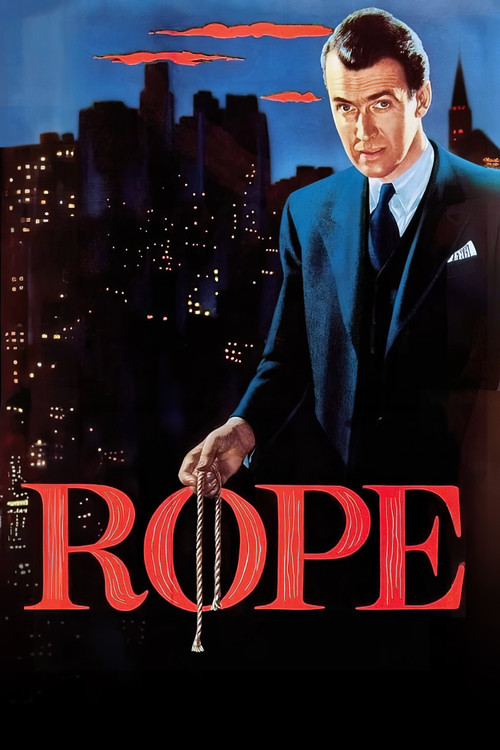
"It begins with a shriek...it ends with a shot! From beginning to end, nothing ever held you like Alfred Hitchcock's ROPE!"

11 March 1948 United States of America 81 min ⭐ 7.9 (2,863)
Director: Alfred Hitchcock
Cast: James Stewart, John Dall, Farley Granger, Cedric Hardwicke, Constance Collier
Drama Crime Thriller
Intellectual Arrogance and the Übermensch Guilt and Conscience The Nature of Murder Homosexuality and Social Transgression
Budget: $1,500,000
Box Office: $2,200,000

Overview

Alfred Hitchcock's "Rope" is a daring psychological thriller that unfolds in a single New York City apartment in what appears to be real-time. The film opens with two wealthy and intellectually arrogant young men, Brandon Shaw and Phillip Morgan, murdering their former classmate, David Kentley, for the sheer thrill of committing the "perfect crime." They believe themselves to be superior beings, inspired by the philosophical ramblings of their old prep-school housemaster, Rupert Cadell.

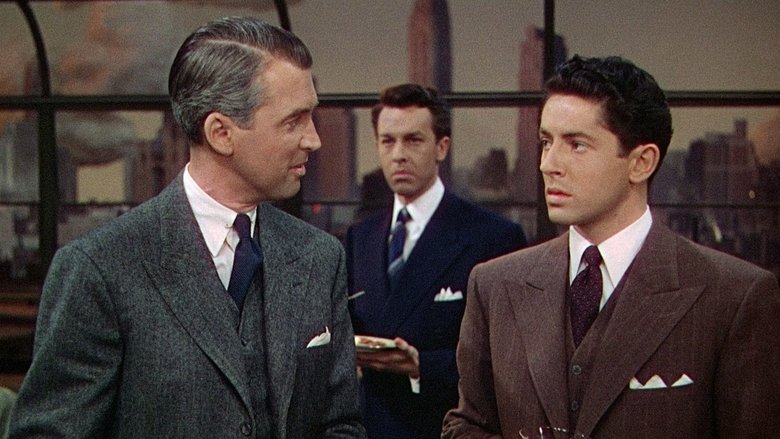
To further prove their intellectual superiority, they hide David's body in a large wooden chest in their living room and proceed to host a dinner party. The guests include David's unsuspecting father, his fiancée, and other friends. The most anticipated guest is Rupert Cadell himself, played by James Stewart. Throughout the evening, Brandon subtly taunts his guests with clues about the murder, enjoying the morbid irony of serving food from a buffet laid out on the makeshift coffin.

As the party progresses, Phillip, the more sensitive of the two murderers, becomes increasingly agitated and guilt-ridden, his anxiety threatening to expose their horrific secret. Rupert, an astute observer, begins to notice the strange atmosphere and the inconsistencies in Brandon and Phillip's behavior, leading him to suspect that something is terribly wrong. The tension builds to an almost unbearable level as Rupert's suspicions grow, culminating in a gripping climax where the truth is finally revealed.
Core Meaning

"Rope" serves as a powerful critique of intellectual arrogance and the dangerous real-world consequences of abstract philosophical theories when taken to their extreme. Director Alfred Hitchcock explores the corrupting nature of the belief in one's own superiority, a concept loosely derived from Nietzsche's idea of the "Übermensch" or "Superman." The film argues that such philosophies, when divorced from morality and empathy, can lead to monstrous acts. It's a cautionary tale about the responsibility that comes with knowledge and the inherent value of every human life. Rupert Cadell's horror and shame upon discovering the murder underscore the film's central message: that no individual has the right to decide the fate of another, and that civilized society is built on a foundation of mutual respect and moral obligation, not on the dangerous delusions of self-proclaimed supermen.

Thematic DNA

Intellectual Arrogance and the Übermensch 35%
Guilt and Conscience 25%
The Nature of Murder 20%
Homosexuality and Social Transgression 20%

Intellectual Arrogance and the Übermensch

The central theme revolves around the protagonists' misinterpretation of Friedrich Nietzsche's concept of the "Übermensch" (Superman). Brandon and Phillip believe their superior intellect gives them the right to murder someone they deem inferior. This theme is explored through their conversations, particularly Brandon's chilling justifications for their crime. Their former teacher, Rupert Cadell, who casually espoused these ideas in an academic setting, is horrified to see them put into brutal practice, highlighting the dangerous gap between theoretical intellectualism and real-world morality.

Guilt and Conscience

The theme of guilt is primarily manifested through the character of Phillip. While Brandon remains cool and confident, Phillip is wracked with anxiety and remorse from the moment the crime is committed. His increasing nervousness, heavy drinking, and slips of the tongue create much of the film's suspense. Phillip's internal conflict serves as a moral counterpoint to Brandon's sociopathic detachment, suggesting that even those who attempt to transgress societal norms cannot entirely escape the grasp of their own conscience.

The Nature of Murder

"Rope" dissects the act of murder not as a passionate crime, but as a cold, intellectual exercise. Brandon views the murder as a work of art, a testament to his and Phillip's superiority. The film forces the audience to confront the chilling idea of murder for sport. The casual, almost celebratory atmosphere of the dinner party, held just feet from the hidden corpse, creates a deeply unsettling juxtaposition that questions the very foundations of civilized behavior.

Homosexuality and Social Transgression

While never explicitly stated due to the production codes of the era, a strong homosexual subtext exists between Brandon and Phillip. The actors who played them, John Dall and Farley Granger, were gay and bisexual respectively, and the screenwriter, Arthur Laurents, was also gay. Their crime can be interpreted as a metaphorical representation of their transgression against societal norms. The shared secret of the murder binds them together in a way that mirrors the secrecy of a forbidden relationship in the 1940s.

Character Analysis

Rupert Cadell

James Stewart

Archetype: Mentor/Detective
Key Trait: Intellectual

Motivation

Initially, Rupert is motivated by intellectual curiosity and a desire to engage in stimulating debate. As his suspicions grow, his motivation shifts to a need to uncover the truth. Finally, he is driven by a sense of moral responsibility to expose the crime and to atone for his own role in inspiring it.

Character Arc

Rupert Cadell begins as a cynical intellectual who entertains dangerous philosophical ideas for sport. Initially, he seems to admire Brandon's audacity. However, as he pieces together the truth, he is forced to confront the horrifying real-world implications of his own rhetoric. His arc is one of disillusionment and moral awakening. He ultimately rejects his former nihilistic views and reasserts the value of human life and societal responsibility, becoming the agent of justice.

Brandon Shaw

John Dall

Archetype: Antihero/Villain
Key Trait: Arrogant

Motivation

Brandon's primary motivation is to prove his intellectual and existential superiority by committing the "perfect murder." He is also driven by a desire for excitement and the thrill of transgression. The dinner party is a way for him to flaunt his crime and revel in the dramatic irony of the situation.

Character Arc

Brandon Shaw is the dominant and charismatic of the two murderers. He remains cool, calculating, and seemingly without remorse throughout the film. His arc is largely static; he is a sociopath who is convinced of his own superiority until the very end. He sees the murder as an artistic and intellectual achievement. His downfall comes not from a change of heart, but from his hubris in underestimating Rupert and his need for an audience to appreciate his "masterpiece."

Phillip Morgan

Farley Granger

Archetype: The Accomplice/The Weak Link
Key Trait: Anxious

Motivation

Phillip's initial motivation seems to be a desire to please Brandon, with whom he has a complex and dependent relationship. After the murder, his motivation becomes self-preservation and a desperate, albeit ineffectual, attempt to conceal their crime. He is driven by fear rather than conviction.

Character Arc

Phillip Morgan is the more submissive and guilt-ridden of the pair. His arc is a descent into paranoia and fear. While he participates in the murder, he is immediately consumed by guilt and the terror of being caught. His increasing instability and emotional outbursts serve as a constant threat to Brandon's carefully constructed plan and ultimately contribute to their exposure.

Symbols & Motifs

The Rope

Meaning:

The titular rope is a multifaceted symbol. On a literal level, it is the murder weapon. Metaphorically, it represents the bond between Brandon and Phillip, a connection forged in violence that ultimately leads to their downfall. It also symbolizes the perversion of an ordinary object into an instrument of death, reflecting how the murderers have twisted intellectual concepts into a justification for their crime. When Brandon uses the rope to tie a bundle of books for David's father, it becomes a symbol of his cruel and audacious deception.

Context:

The rope is used to strangle David Kentley at the beginning of the film. It is then hidden, but its presence is felt throughout the dinner party. In a particularly tense moment, Brandon uses the same rope to tie up a collection of rare books he gives to David's father as a gift.

The Chest

Meaning:

The antique wooden chest that contains David's body symbolizes the coffin and the dark secret at the heart of the seemingly sophisticated gathering. Its use as a buffet table for the dinner party is a grotesque symbol of Brandon's hubris and his contempt for human life and social conventions. It also represents the literal and metaphorical "closet" in which Brandon and Phillip's transgression is hidden in plain sight.

Context:

The chest is a prominent piece of furniture in the apartment and is the focal point of many shots. The dinner is served on top of it, and there are several moments of high tension where it seems the body will be discovered.

Light and Darkness

Meaning:

Light and darkness are used to symbolize knowledge and ignorance, as well as good and evil. The film begins with the murder committed behind drawn blinds, in the dark. Brandon's insistence on opening the blinds and letting in the light represents his desire to bring their deed into the open, in a perverse way. The changing light of the sunset outside the apartment window marks the passage of time and the dimming hope of the murderers getting away with their crime.

Context:

After the murder, Brandon throws open the curtains, letting daylight stream into the room. As the evening progresses, the apartment grows darker, and the neon signs from the city outside cast an eerie glow. The final scene, with Rupert firing a gun out the window to attract attention, is a symbolic act of bringing the crime to light.

Memorable Quotes

Good and evil, right and wrong were invented for the ordinary average man, the inferior man, because he needs them.

— Brandon Shaw

Context:

Brandon says this to Phillip early in the film, after they have committed the murder and are discussing their motivations. It is a key moment that establishes the philosophical underpinnings of their actions.

Meaning:

This quote encapsulates the core of Brandon's twisted philosophy. It reveals his belief in a master-slave morality, where superior individuals like himself are not bound by the conventional moral codes that govern the rest of society. It is a direct and chilling expression of his intellectual arrogance and the justification for his crime.

Did you think you were God, Brandon?

— Rupert Cadell

Context:

Rupert utters this line in the film's climax, standing over the open chest containing David's body. He is filled with a mixture of horror, shame, and fury as he confronts Brandon and Phillip with the reality of what they have done.

Meaning:

This is the culminating question of the film, delivered by Rupert after he has discovered the body. It cuts to the heart of Brandon's delusion, exposing his act not as a display of intellectual superiority, but as an unforgivable act of hubris. It signifies Rupert's complete rejection of the philosophy he once espoused and his condemnation of his former students' actions.

Cat and mouse, cat and mouse. But which is the cat and which is the mouse?

— Phillip Morgan

Context:

Phillip says this during the dinner party, as he becomes increasingly intoxicated and unnerved by Rupert's probing questions and Brandon's reckless taunts.

Meaning:

Phillip's drunken and desperate exclamation captures the shifting power dynamics of the evening. Initially, he and Brandon are the cats, playing with their unsuspecting guests, the mice. However, as Rupert's suspicions grow, the roles begin to reverse. The quote highlights the psychological tension and the feeling of being trapped that is central to the film's suspense.

Philosophical Questions

Do ideas have consequences, and what is the responsibility of an intellectual?

The film directly confronts this question through the character of Rupert Cadell. He casually discusses the theory of the superior man having the right to kill, treating it as an abstract intellectual exercise. However, when he discovers that his students, Brandon and Phillip, have taken his words literally and committed murder, he is horrified. This forces both Rupert and the audience to consider the real-world impact of abstract ideas. The film argues that intellectuals and educators have a profound responsibility for the ideas they promote, as these concepts can be dangerously misinterpreted and lead to horrific actions when divorced from empathy and morality.

What is the nature of good and evil, and are some individuals 'above' conventional morality?

"Rope" is a sustained exploration of this question. Brandon explicitly states that concepts of good and evil are for the "inferior" masses. He and Phillip attempt to live out this philosophy by committing a murder without guilt, believing their intellect places them beyond the reach of conventional moral laws. However, the film systematically dismantles this notion. Phillip's overwhelming guilt and the ultimate failure of their "perfect crime" serve as a powerful refutation of their beliefs. Rupert's final speech confirms the film's stance: that there is a fundamental moral order and that all individuals, regardless of their perceived intelligence, are subject to it.

Alternative Interpretations

One of the most prominent alternative interpretations of "Rope" views the entire film as a metaphor for the homosexual experience in the repressive 1940s. In this reading, the murder is not just a crime but a symbolic representation of a hidden, socially unacceptable act—their homosexuality. The chest containing the body becomes the "closet" where this truth is concealed. The characters' anxiety and fear of exposure are interpreted as mirroring the constant fear of being "found out" as gay in a homophobic society. Brandon's desire to reveal the crime can be seen as a defiant wish to "come out," to have his true nature acknowledged, regardless of the consequences.

Another interpretation focuses on Rupert Cadell's character, suggesting that he may also be gay and that his initial intellectual arguments in favor of murder are a coded defense of homosexuality. His eventual horror and condemnation of Brandon and Phillip could then be seen as a form of self-loathing or a retreat back into the safety of societal convention when confronted with the raw reality of transgression. This reading adds another layer of complexity to Rupert's character, portraying him not just as a moral authority but as a hypocrite grappling with his own repressed identity.

Cultural Impact

"Rope" holds a significant place in film history, primarily for its audacious technical experimentation. Alfred Hitchcock's attempt to shoot a feature film in what appears to be a single, continuous take was revolutionary for its time and has been influential on subsequent generations of filmmakers. While Hitchcock himself was later critical of the experiment, it remains a landmark in the development of cinematic language, prefiguring the long-take virtuosity of directors like Alejandro G. Iñárritu.

Culturally, the film was controversial upon its release due to its dark subject matter and, more pointedly, its strong undercurrent of homosexuality. In an era when the Hays Code heavily censored depictions of sexuality, "Rope" pushed boundaries with its portrayal of the intense, implicitly romantic relationship between Brandon and Phillip. This has made it a key film in the study of queer cinema, analyzed for its use of subtext and coding to navigate censorship.

The film's exploration of Nietzschean philosophy and the dangers of intellectual elitism also resonated in a post-World War II world grappling with the horrors of Nazi ideology, which had similarly twisted concepts of a "master race." The film received mixed reviews upon its initial release, with some critics finding the technical gimmickry distracting, but its reputation has grown over time. It is now widely regarded as a bold and fascinating entry in Hitchcock's filmography, a claustrophobic and intellectually charged thriller that continues to be studied and debated for both its form and its thematic content.

Audience Reception

Upon its release in 1948, "Rope" received a mixed critical reception and was not a major box office success. Many critics found Alfred Hitchcock's experimental use of long takes to be a "stunt" or a "gimmicky" novelty that ultimately detracted from the narrative's tension rather than enhancing it. Bosley Crowther of The New York Times, for instance, called the film a "thin exercise in suspense." There was also an undercurrent of audience uneasiness, which screenwriter Arthur Laurents attributed to the film's thinly veiled homosexual themes.

Over the years, however, the film's reputation has significantly improved. Contemporary audiences and critics are more likely to praise the film's technical audacity and its brave exploration of controversial themes. Roger Ebert, while acknowledging Hitchcock's own dissatisfaction with the film, called it "one of the most interesting experiments ever attempted by a major director." Audiences today often praise the film's claustrophobic atmosphere, the sharp dialogue, and the compelling psychological dynamic between the three main characters. While some still find the long-take technique to be somewhat stilted, many now see it as effectively contributing to the real-time tension and theatrical feel of the story.

Interesting Facts

  • "Rope" was Alfred Hitchcock's first color film.
  • The film is famous for its use of long takes, edited together to give the impression of a single, continuous shot. Each take lasts up to ten minutes, the maximum length of a film camera magazine at the time.
  • To achieve the seamless camera movement, the set walls were built on rollers and could be silently moved out of the way to allow the large Technicolor camera to pass through.
  • The story is inspired by the real-life 1924 Leopold and Loeb murder case, in which two wealthy and intelligent University of Chicago students murdered a 14-year-old boy to commit the "perfect crime."
  • James Stewart, who played Rupert Cadell, reportedly disliked his performance in the film and considered it a miscasting.
  • Hitchcock himself later dismissed the film as an "experiment that didn't work out," feeling that the long-take technique limited his ability to use his signature editing style to create suspense.
  • The New York City skyline seen from the apartment window was a massive and detailed cyclorama, one of the largest ever used at the time. It included twinkling lights and smoking chimneys to create a realistic effect as day turned to night.
  • The film's screenwriter, Arthur Laurents, was gay, as were actors John Dall and Farley Granger (who was bisexual), which contributed to the film's palpable homoerotic subtext.
  • The sound was recorded live on set, which was unusual for the time and added to the technical challenges of the production.

Easter Eggs

Alfred Hitchcock's cameo appearance

True to his signature style, Alfred Hitchcock makes a brief appearance in the film. His cameo is unique in "Rope" due to the film's confined setting. His profile appears on a red neon sign for "Reduco," a fictional weight-loss product, that is visible from the apartment window about 55 minutes into the film. This was a clever way for him to include his cameo in a film that offered no opportunity for him to walk through a scene.

⚠️ Spoiler Analysis

Click to reveal detailed analysis with spoilers

Frequently Asked Questions

Explore More About This Movie

Dive deeper into specific aspects of the movie with our detailed analysis pages

Comments (0)

Leave a comment

No comments yet. Be the first to share your thoughts!