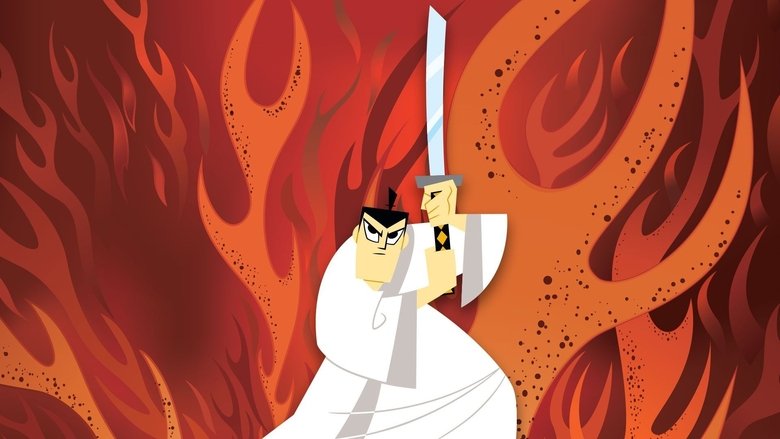
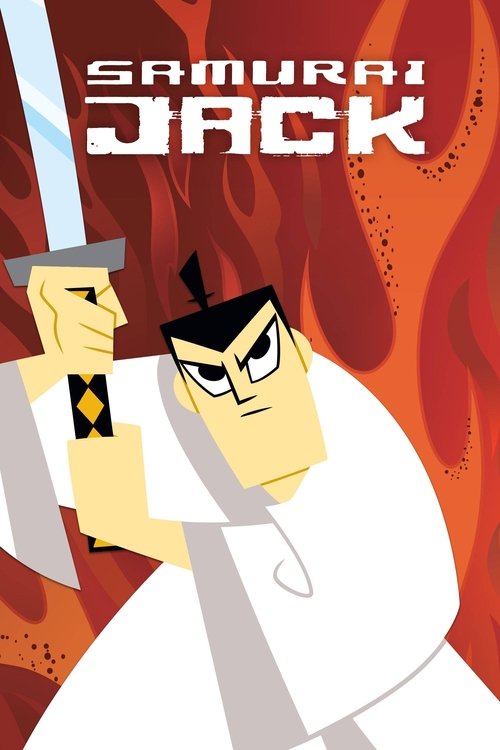
"Death is failure."
Samurai Jack - Episode Highlights
Episode Highlights
The Premiere Movie (Episodes I, II, & III)
This three-part opener masterfully establishes the entire world of the series. It details Aku's origin, Jack's childhood and training across the globe, his initial battle with Aku, and his traumatic arrival in the dystopian future. It sets the tone, visual style, and narrative foundation for everything that follows.
It's the essential introduction to the characters, conflict, and core premise. Genndy Tartakovsky himself stated that watching these three episodes gives you a sense of the entire series. It showcases the show's cinematic scope and ambition from the very beginning.
Jack and the Three Blind Archers
In pursuit of a wishing well that could send him home, Jack must overcome three seemingly invincible archers who rely on their hearing. The episode is a masterclass in minimalist storytelling, with very little dialogue and a stark, white-on-white visual palette. Jack must blind himself to heighten his other senses to win.
This episode is frequently cited as a series high point that perfectly demonstrates the show's philosophy of "show, don't tell." Its brilliant use of sound design and visual tension cemented 'Samurai Jack' as a uniquely artistic and cinematic cartoon.
The Birth of Evil
A two-part epic that serves as a prequel, detailing the origin of Aku from a cosmic evil and the forging of Jack's sword by the gods Odin, Ra, and Vishnu. It shows Jack's father, the Emperor, as the first to wield the sword and imprison Aku.
This Emmy-winning episode provides crucial lore for the series, elevating the conflict between Jack and Aku to a mythic, cosmic scale. It establishes the divine nature of the sword and the ancient history of the struggle against this primordial evil.
Samurai vs. Ninja
Jack is hunted by a robotic ninja assassin who is a master of darkness and shadow. Their climactic duel is animated almost entirely in stark black and white silhouettes, pitting Jack's light against the ninja's shadow.
The episode is celebrated for its breathtakingly stylish and inventive final fight sequence. It is one of the most visually iconic moments of the series, perfectly symbolizing the core conflict of light versus darkness in its purest form.
XCIII
This episode marks a turning point in the darker, serialized fifth season. A wounded and hunted Jack faces off against the Daughters of Aku, resulting in him taking a human life for the first time. The episode runs a parallel narrative of a lone white wolf, also wounded and hunted, mirroring Jack's struggle.
It powerfully establishes the higher stakes and mature tone of the final season. Jack's desperation and psychological trauma are brought to the forefront, and it introduces his complex relationship with Ashi, the sole surviving assassin.
CI (Finale)
The series finale. After being captured by an Aku-possessed Ashi, Jack is saved by all the allies he has made over 50 years. Ashi breaks free of Aku's control and uses her inherited powers to send Jack back to the past, where he finally destroys the demon.
It provides a definitive, albeit bittersweet, conclusion to Jack's epic quest. The final moments, where Ashi fades from existence as a consequence of Aku's death, are both tragic and poignant, cementing the theme of sacrifice and leaving audiences with a powerful, emotionally complex ending.