椿三十郎
"You cut well, but the best sword stays in its sheath!"
Director: Akira Kurosawa
Cast: Toshirō Mifune, Tatsuya Nakadai, Keiju Kobayashi, Yūzō Kayama, Reiko Dan
Sanjuro — Characters & Cast
Character Analysis
Sanjuro Tsubaki
Toshirō Mifune
Motivation
His initial motivation seems to be a mix of pity for the inept young samurai and perhaps a desire for food and money. However, he is driven by an underlying, albeit deeply buried, sense of justice and responsibility. He feels compelled to help those who cannot help themselves, even as he insults and berates them.
Character Arc
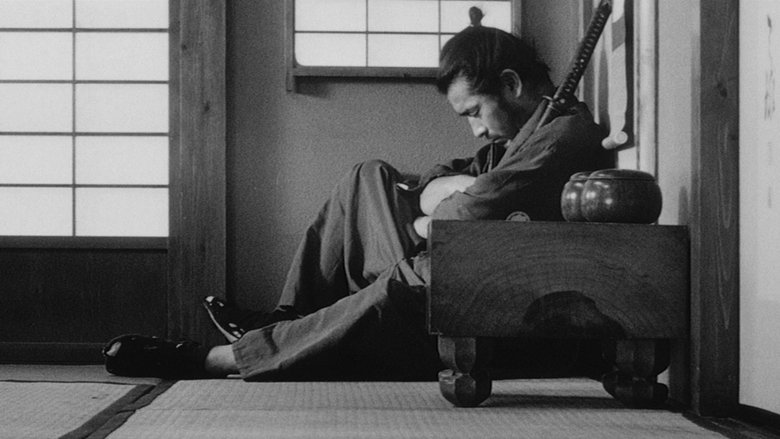
Initially the same cynical, pragmatic ronin from "Yojimbo," Sanjuro undergoes a subtle but significant evolution. Forced into the role of a reluctant mentor, he is repeatedly confronted by the naive idealism of the young samurai and the profound, peaceful wisdom of the Chamberlain's wife. Her critique of him as an "unsheathed sword" forces him to reflect on his violent nature. By the end, after killing his rival Muroto, he doesn't celebrate but expresses anger and regret, demonstrating that he has absorbed the lesson that violence is a tragic flaw, not a virtue.
Hanbei Muroto
Tatsuya Nakadai
Motivation
Muroto is motivated by ambition and a rigid adherence to his own twisted sense of warrior honor. After being publicly and repeatedly fooled by Sanjuro's schemes, his motivation shifts to a personal vendetta, believing that defeating Sanjuro is the only way to reclaim his lost dignity.
Character Arc
Muroto serves as a dark mirror to Sanjuro. He is intelligent, highly skilled, and pragmatic, quickly recognizing Sanjuro's abilities and seeing him as a peer. However, his skills serve a corrupt and selfish cause. His arc is one of escalating frustration and obsession. After being repeatedly outwitted by Sanjuro, his honor is so deeply wounded that he sees killing Sanjuro in a duel as the only way to restore it, leading to his own demise.
Iori Izaka
Yūzō Kayama
Motivation
His primary motivation is a pure, if misguided, desire to root out corruption in his clan and restore honor. He is driven by a strong sense of loyalty to his uncle, the Chamberlain, and a rigid adherence to the samurai code as he understands it.
Character Arc
Izaka is the leader of the nine young samurai. He starts the film with a naive and simplistic view of honor and corruption, leading his group into a trap. Throughout the film, he and his comrades are forced to follow Sanjuro's unconventional and often un-samurai-like methods. His arc is one of learning; he slowly begins to grasp the complexities of the situation and the wisdom behind Sanjuro's abrasive guidance. By the end, he and the others have learned to see beyond appearances, kneeling in respect for their messy, cynical master.
Chamberlain's Wife
Takako Irie
Motivation
Her motivation is to uphold a code of peaceful, civilized conduct, even in the most dangerous of circumstances. She believes in restraint, compassion, and true honor, which she defines not through killing but through wisdom and control. She gently tries to impart this wisdom to Sanjuro.
Character Arc
The Chamberlain's wife is a static but deeply impactful character. She does not change, but instead acts as the catalyst for Sanjuro's change. Despite being a refined, genteel lady seemingly out of place in the violent conflict, she embodies the film's central philosophy. Her polite but firm critiques of violence and her calm wisdom provide the moral compass of the story, challenging the protagonist's worldview and ultimately shaping the film's message.
Cast
Explore More About This Movie
Dive deeper into specific aspects of the movie with our detailed analysis pages