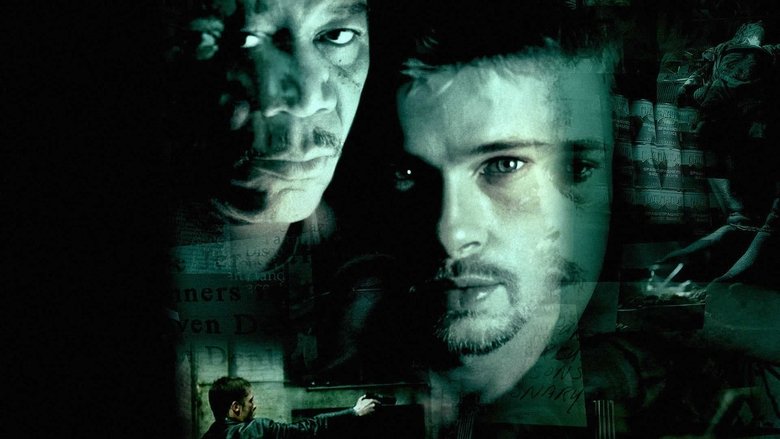
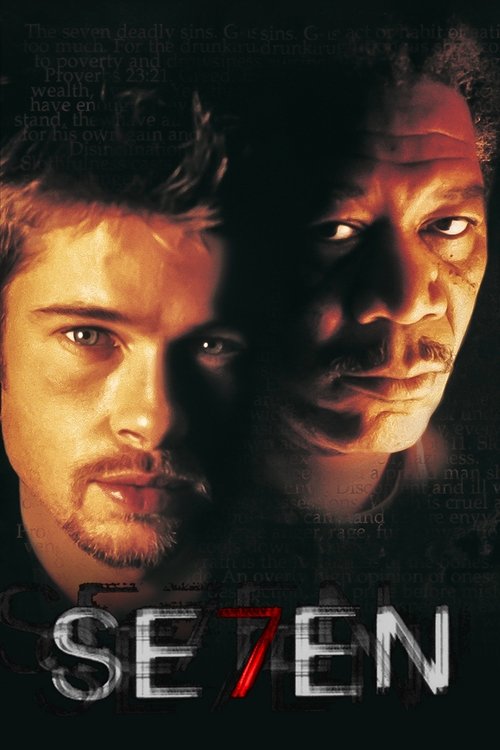
"Gluttony. Greed. Sloth. Envy. Wrath. Pride. Lust."
Se7en - Symbolism & Philosophy
Symbols & Motifs
The Unnamed City
The city, which is never named, symbolizes a universal urban purgatory. Its anonymity makes it a stand-in for any modern metropolis succumbing to crime, decay, and indifference. It represents a hellish landscape where moral and physical squalor are intertwined.
Throughout the film, the city is portrayed as dark, oppressive, and dirty. The production design emphasizes cluttered spaces, decaying buildings, and a general sense of claustrophobia, mirroring the psychological state of the characters trapped within it.
Constant Rain
The incessant rain functions as a symbol of the oppressive, suffocating atmosphere of the city and the pervasiveness of sin. It visually represents the moral bleakness and the feeling of a world being washed, not clean, but in filth. It also serves as a classic neo-noir trope, enhancing the sense of gloom and foreboding.
Nearly every outdoor scene is drenched in rain, contributing to the film's dark, de-saturated color palette. The rain stops only at the film's climax when the detectives drive out to the desert, a stark, open landscape where the final, terrible revelation occurs under a harsh, unforgiving sun.
John Doe's Diaries
The hundreds of meticulously handwritten journals discovered in John Doe's apartment symbolize the killer's patient, obsessive, and twisted psychology. They represent the inner workings of a brilliant but deranged mind, filled with his philosophical justifications for the murders. The sheer volume and detail underscore his methodical nature and long-term commitment to his 'work'.
Detectives Somerset and Mills find the diaries in Doe's apartment. The books are filled with his writings, drawings, and thoughts on sin and society. The creation of these props was a massive undertaking for the production, with each page being written and drawn by hand to reflect the character's obsessive personality.
Philosophical Questions
In a world saturated with violence and indifference, is apathy a justifiable response?
The film explores this question through the opposing viewpoints of its two lead detectives. Somerset argues that apathy is a necessary defense mechanism, a logical "solution" to the overwhelming and relentless nature of human cruelty. Mills represents the opposite view, that one must actively fight against evil, no matter the odds. John Doe's murders are a violent condemnation of societal apathy, suggesting it is a sin worthy of the most extreme punishment. The film never provides a simple answer, ultimately suggesting that while apathy may be the easier path, the choice to remain engaged and "fight for" the world is a more meaningful, albeit painful, existence.
Can extreme evil serve a moral purpose?
This is the central question posed by John Doe's character and his meticulously planned "sermons." He sees his horrific acts not as crimes but as a necessary evil to awaken a morally slumbering society. He believes his work will be "puzzled over and studied and followed," forcing a moral reckoning. The film forces the audience to grapple with this uncomfortable proposition. While his methods are monstrous, the film acknowledges the validity of his diagnosis of societal ills. However, by revealing his own sin of Envy, the film ultimately undermines his claim to moral superiority, portraying him not as a messiah but as another flawed human, albeit one who has weaponized his moral outrage.
What is the true nature of justice?
Se7en contrasts the slow, methodical process of legal justice with John Doe's swift, brutal, and biblical form of retribution. The detectives work within a flawed system, gathering evidence and following procedures, while Doe acts as judge, jury, and executioner. His actions raise the question of whether his victims, who are guilty of moral sins, "deserved" their fate. The film's ending is a brutal commentary on justice, where the legal system is ultimately bypassed. Mills's act of killing Doe is not legal justice but personal vengeance—an act of pure wrath. This final act suggests that the human desire for retribution can easily overpower the detached principles of the law, blurring the line between justice and sin itself.
Core Meaning
The core meaning of Se7en revolves around an exploration of apathy as the ultimate sin and a profound questioning of morality in a decaying, indifferent world. Director David Fincher presents a universe saturated with cruelty and moral decay, where the lines between right and wrong are dangerously blurred. The film's antagonist, John Doe, doesn't see himself as a monster but as an instrument of divine will, whose horrific crimes are sermons designed to shock a complacent society out of its apathy. He believes that in a world where lesser sins are tolerated on every corner, only a sledgehammer-like impact can make people listen.
The film argues that the true battle is not just against an external evil like John Doe, but against the internal decay of the human spirit. This is embodied in the central conflict between the retiring, disillusioned Detective Somerset, who believes apathy is a necessary survival mechanism, and the hopeful, idealistic Detective Mills, who believes he can make a difference. Ultimately, the film suggests that while the world may be a dark and corrupt place not worth fighting for, the fight itself—the refusal to succumb to despair and indifference—is what gives humanity its meaning.