Se7en
A rain-drenched, neo-noir descent into urban decay, this psychological thriller is a haunting meditation on apathy, punctuated by the chilling precision of a moral crusader's horrific sermon.
Se7en

Se7en

"Gluttony. Greed. Sloth. Envy. Wrath. Pride. Lust."

22 September 1995 United States of America 127 min ⭐ 8.4 (22,157)
Director: David Fincher
Cast: Morgan Freeman, Brad Pitt, Gwyneth Paltrow, John Cassini, Peter Crombie
Crime Thriller Mystery
Apathy and Moral Decay Idealism vs. Cynicism The Nature of Sin Order vs. Chaos
Budget: $33,000,000
Box Office: $327,311,859

Overview

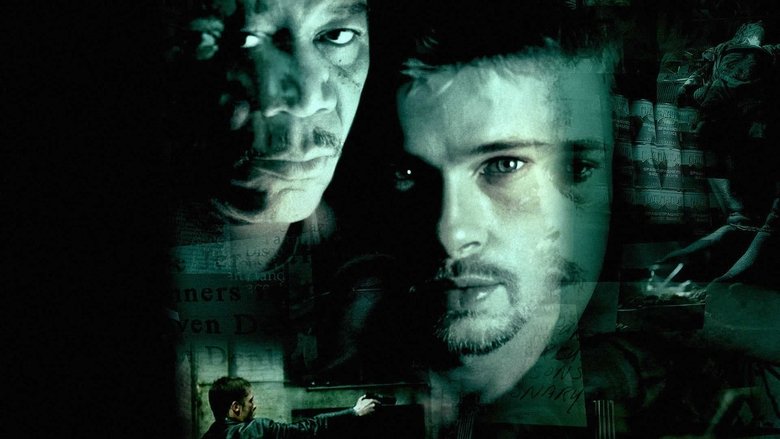
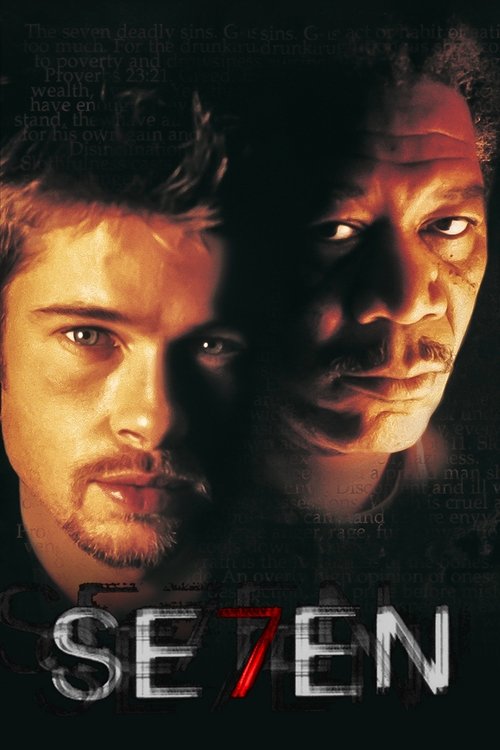
Se7en is a dark and methodical psychological crime thriller directed by David Fincher. The story follows two homicide detectives at opposite ends of their careers: the world-weary and soon-to-retire William Somerset (Morgan Freeman) and the idealistic, hot-headed newcomer David Mills (Brad Pitt). Set in a perpetually rainy, unnamed, and decaying city, the film establishes a mood of inescapable moral rot and bleakness.

The detectives are partnered on a disturbing new case involving a serial killer who bases his murders on the seven deadly sins. The killer, who becomes known as John Doe, orchestrates each crime as a gruesome and symbolic tableau, forcing his victims to personify sins such as Gluttony and Greed. As the methodical and intellectual Somerset delves into religious texts to understand the killer's mindset, the impulsive Mills grows increasingly frustrated and horrified by the escalating brutality of the crimes. Their investigation becomes a desperate race against time to stop a murderer who is not just killing, but delivering a terrifying sermon to a world he sees as apathetic.
Core Meaning

The core meaning of Se7en revolves around an exploration of apathy as the ultimate sin and a profound questioning of morality in a decaying, indifferent world. Director David Fincher presents a universe saturated with cruelty and moral decay, where the lines between right and wrong are dangerously blurred. The film's antagonist, John Doe, doesn't see himself as a monster but as an instrument of divine will, whose horrific crimes are sermons designed to shock a complacent society out of its apathy. He believes that in a world where lesser sins are tolerated on every corner, only a sledgehammer-like impact can make people listen.

The film argues that the true battle is not just against an external evil like John Doe, but against the internal decay of the human spirit. This is embodied in the central conflict between the retiring, disillusioned Detective Somerset, who believes apathy is a necessary survival mechanism, and the hopeful, idealistic Detective Mills, who believes he can make a difference. Ultimately, the film suggests that while the world may be a dark and corrupt place not worth fighting for, the fight itself—the refusal to succumb to despair and indifference—is what gives humanity its meaning.

Thematic DNA

Apathy and Moral Decay 35%
Idealism vs. Cynicism 30%
The Nature of Sin 25%
Order vs. Chaos 10%

Apathy and Moral Decay

The film is set in a grim, unnamed city perpetually soaked in rain, a visual representation of the pervasive moral decay and spiritual emptiness of its inhabitants. Detective Somerset is the embodiment of world-weary resignation, believing the city is beyond saving and that apathy is a rational response to overwhelming evil. The killer, John Doe, positions his grotesque murders as a direct assault on this societal indifference, seeking to punish both the sinners and the society that tolerates them. The film's bleak conclusion reinforces this theme, suggesting that evil can triumph when good men are pushed to their limits by a corrupt world.

Idealism vs. Cynicism

The central partnership of Mills and Somerset is a study in contrasting worldviews. Mills is young, impulsive, and idealistic, believing in clear distinctions between good and evil and in his own ability to enforce justice. Somerset, on the verge of retirement, is cynical and methodical, seeing the world in shades of grey and viewing his job as merely documenting the inevitable slide into chaos. Their philosophical debates throughout the film explore whether it's better to fight a seemingly losing battle against darkness or to retreat from it entirely. The film tragically resolves this conflict by having Mills's idealism shattered, while Somerset is pulled back from the brink of complete withdrawal.

The Nature of Sin

The film's structure is built around the seven deadly sins, using them as a narrative device to explore the nature of human transgression. John Doe acts as a self-appointed messiah, punishing victims whose lives exemplify each sin. However, the film questions Doe's moral authority, portraying him not just as a punisher but as a participant in sin, particularly Envy. The murders are not just about punishing the victims but are staged as elaborate, horrific "sermons" for the world, blurring the line between righteous judgment and monstrous cruelty. The ending forces the audience to confront the idea that these sins, especially Wrath, reside within everyone, even the heroes.

Order vs. Chaos

Se7en presents a world where the forces of order, represented by the police, are constantly struggling against an encroaching, intelligent chaos. John Doe's crimes are meticulously planned and executed with a chilling precision that mocks the detectives' efforts. He is always several steps ahead, turning their investigation into a part of his grand design. This theme is highlighted by the contrast between Somerset's patient, intellectual approach and Mills's desire for direct, physical confrontation. The film's climax is the ultimate victory for chaos, as Doe successfully manipulates the law enforcement officers into completing his masterpiece, demonstrating the fragility of the systems meant to protect society.

Character Analysis

Detective William Somerset

Morgan Freeman

Archetype: The Mentor / The Sage
Key Trait: Methodical and World-Weary

Motivation

His primary motivation is to survive his last week on the job with his sanity intact and escape the city he believes is irredeemable. However, his intellectual curiosity and a deeply buried sense of duty compel him to meticulously unravel the complex puzzle presented by John Doe.

Character Arc

Somerset begins the film as a deeply jaded and disillusioned man, a week away from retirement, who has emotionally detached himself from the horrors of his job as a survival mechanism. Initially reluctant to engage with the new case or his new partner, he is drawn in by the intellectual challenge posed by the killer. Through his investigation and his burgeoning, albeit reluctant, friendship with Mills and Tracy, he begins to question his complete withdrawal. The film's horrific conclusion shatters any remaining hope for a clean victory, yet it galvanizes him. He abandons his plan to retire and disappear, choosing instead to stay and fight, embodying his final line: "I'll be around."

Detective David Mills

Brad Pitt

Archetype: The Hero / The Hothead
Key Trait: Impulsive and Idealistic

Motivation

Mills is driven by a straightforward desire to catch the bad guys and enforce justice. He is eager to prove himself and believes that direct action can solve problems. He is also motivated by his love for his wife, Tracy, and the future they plan to build together.

Character Arc

Mills starts as an idealistic, ambitious, and impulsive young detective who has transferred to the city seeking action and to make a name for himself. He believes in a black-and-white world of good and evil and is frustrated by Somerset's cautious, intellectual approach. Throughout the film, he is confronted with a level of depravity that challenges his simplistic worldview. His arc is a tragic descent from hopeful hero to a broken man. In the end, he is completely manipulated by John Doe, and his idealism is annihilated when he gives in to pure emotion, becoming the embodiment of Wrath and the final piece in the killer's masterpiece.

John Doe

Kevin Spacey

Archetype: The Shadow / The Nihilistic Villain
Key Trait: Patient and Methodical

Motivation

Doe is motivated by a profound disgust with the sin and apathy he sees in the world. He believes he has been chosen by a higher power to create a work that will shock people out of their complacency. His goal is not simply to kill but to "set the example" and have his crimes studied and followed forever, thereby achieving a twisted form of immortality. His final act is motivated by his envy of Mills's simple, happy life.

Character Arc

John Doe is a static character who remains an enigma for most of the film. He is not a character who develops but one who is gradually revealed. He is a patient, intelligent, and independently wealthy man who has dedicated his life to creating a series of murders as a form of moral sermon. When he finally appears, he is calm, articulate, and completely in control, manipulating the detectives and the legal system to ensure his plan reaches its intended conclusion. His arc is one of self-actualization through monstrous acts, culminating in his own martyrdom to complete his work.

Tracy Mills

Gwyneth Paltrow

Archetype: The Innocent
Key Trait: Hopeful and Vulnerable

Motivation

Tracy is motivated by her love for her husband and her desire to build a family. She seeks connection and happiness but is overwhelmed by the oppressive environment she finds herself in. Her motivation is to find a way to cope with her new life and decide whether it's a suitable place to bring a child into the world.

Character Arc

Tracy's arc is brief but pivotal. She moves to the grim city to support her husband's career but finds herself unhappy and isolated. She forms a connection with the lonely Somerset, confiding in him her fears about raising a child in such a bleak environment. Her character represents the hope and normalcy that stands in stark contrast to the city's decay. Her tragic arc concludes off-screen, as she becomes the ultimate victim, her death serving as the catalyst for the film's devastating climax and the completion of John Doe's plan.

Symbols & Motifs

The Unnamed City

Meaning:

The city, which is never named, symbolizes a universal urban purgatory. Its anonymity makes it a stand-in for any modern metropolis succumbing to crime, decay, and indifference. It represents a hellish landscape where moral and physical squalor are intertwined.

Context:

Throughout the film, the city is portrayed as dark, oppressive, and dirty. The production design emphasizes cluttered spaces, decaying buildings, and a general sense of claustrophobia, mirroring the psychological state of the characters trapped within it.

Constant Rain

Meaning:

The incessant rain functions as a symbol of the oppressive, suffocating atmosphere of the city and the pervasiveness of sin. It visually represents the moral bleakness and the feeling of a world being washed, not clean, but in filth. It also serves as a classic neo-noir trope, enhancing the sense of gloom and foreboding.

Context:

Nearly every outdoor scene is drenched in rain, contributing to the film's dark, de-saturated color palette. The rain stops only at the film's climax when the detectives drive out to the desert, a stark, open landscape where the final, terrible revelation occurs under a harsh, unforgiving sun.

John Doe's Diaries

Meaning:

The hundreds of meticulously handwritten journals discovered in John Doe's apartment symbolize the killer's patient, obsessive, and twisted psychology. They represent the inner workings of a brilliant but deranged mind, filled with his philosophical justifications for the murders. The sheer volume and detail underscore his methodical nature and long-term commitment to his 'work'.

Context:

Detectives Somerset and Mills find the diaries in Doe's apartment. The books are filled with his writings, drawings, and thoughts on sin and society. The creation of these props was a massive undertaking for the production, with each page being written and drawn by hand to reflect the character's obsessive personality.

Memorable Quotes

Ernest Hemingway once wrote, 'The world is a fine place and worth fighting for.' I agree with the second part.

— William Somerset

Context:

This line is spoken by Somerset after Mills has been taken away for killing John Doe. It is his final reflection on the horrific events that have transpired, showing that despite the victory of evil in this specific instance, he has chosen not to retreat into apathy but to remain engaged in the world.

Meaning:

This quote, delivered in a voiceover at the very end of the film, encapsulates Somerset's transformation. It signifies his rejection of complete cynicism. While he acknowledges the profound darkness and corruption of the world, he has decided that the act of fighting against it still holds value. It's a bleakly optimistic conclusion, suggesting that hope lies not in winning, but in the refusal to give up.

What's in the box?!

— David Mills

Context:

In the film's climax, a delivery driver brings a box to the remote desert location. Somerset opens it and is visibly horrified, warning Mills to stay away. John Doe begins to taunt Mills, alluding to the box containing the head of his wife, Tracy. Mills's repeated, increasingly frantic screams of this question lead up to him finally succumbing to his rage and killing Doe.

Meaning:

This line has become iconic in pop culture, representing a moment of pure, agonizing suspense and horrific realization. It is the raw, desperate cry of a man on the precipice of understanding a truth so terrible it will destroy him. The power of the line lies in the fact that the audience, along with Mills, is forced to imagine the horror before it is confirmed.

Wanting people to listen, you can't just tap them on the shoulder anymore. You have to hit them with a sledgehammer.

— John Doe

Context:

John Doe says this to Mills and Somerset while they are driving to the location of the final two victims. He is calmly explaining his rationale, presenting himself not as a madman but as a teacher and a moral crusader delivering a necessary, if brutal, lesson to the world.

Meaning:

This quote is the core of John Doe's twisted philosophy and his justification for his horrific crimes. He believes that modern society is so desensitized and apathetic that only an act of extreme, theatrical violence can capture its attention and force it to confront its own sinfulness.

Apathy is the solution. I mean, it's easier to lose yourself in drugs than it is to cope with life. It's easier to steal what you want than it is to earn it. It's easier to beat a child than it is to raise it. Hell, love costs: it takes effort and work.

— William Somerset

Context:

Somerset delivers this monologue to Mills during one of their early conversations. He is explaining why he is retiring and why he can no longer bear to live in a city that he feels "nurtures apathy as if it was a virtue."

Meaning:

This speech reveals the depth of Somerset's cynicism and disillusionment early in the film. He argues that apathy is not just a weakness but a logical and easier choice in a world full of pain and difficulty. It establishes his character's philosophical starting point, which is challenged throughout the narrative.

Philosophical Questions

In a world saturated with violence and indifference, is apathy a justifiable response?

The film explores this question through the opposing viewpoints of its two lead detectives. Somerset argues that apathy is a necessary defense mechanism, a logical "solution" to the overwhelming and relentless nature of human cruelty. Mills represents the opposite view, that one must actively fight against evil, no matter the odds. John Doe's murders are a violent condemnation of societal apathy, suggesting it is a sin worthy of the most extreme punishment. The film never provides a simple answer, ultimately suggesting that while apathy may be the easier path, the choice to remain engaged and "fight for" the world is a more meaningful, albeit painful, existence.

Can extreme evil serve a moral purpose?

This is the central question posed by John Doe's character and his meticulously planned "sermons." He sees his horrific acts not as crimes but as a necessary evil to awaken a morally slumbering society. He believes his work will be "puzzled over and studied and followed," forcing a moral reckoning. The film forces the audience to grapple with this uncomfortable proposition. While his methods are monstrous, the film acknowledges the validity of his diagnosis of societal ills. However, by revealing his own sin of Envy, the film ultimately undermines his claim to moral superiority, portraying him not as a messiah but as another flawed human, albeit one who has weaponized his moral outrage.

What is the true nature of justice?

Se7en contrasts the slow, methodical process of legal justice with John Doe's swift, brutal, and biblical form of retribution. The detectives work within a flawed system, gathering evidence and following procedures, while Doe acts as judge, jury, and executioner. His actions raise the question of whether his victims, who are guilty of moral sins, "deserved" their fate. The film's ending is a brutal commentary on justice, where the legal system is ultimately bypassed. Mills's act of killing Doe is not legal justice but personal vengeance—an act of pure wrath. This final act suggests that the human desire for retribution can easily overpower the detached principles of the law, blurring the line between justice and sin itself.

Alternative Interpretations

While the film's ending is widely seen as a victory for John Doe, there are alternative ways to interpret its meaning. One perspective is that while Doe wins the battle, he doesn't necessarily win the war. Detective Somerset's final decision to stay on the force rather than retire represents a refusal to succumb to the apathy Doe was railing against. By choosing to remain and fight, Somerset embodies the second half of the Hemingway quote, suggesting that even in a fallen world, the struggle itself has value. In this reading, the film's ultimate message is not one of utter hopelessness, but of the necessity of perseverance in the face of evil.

Another interpretation posits that Somerset himself is the film's final victim, representing an eighth sin: despair or apathy. John Doe's entire plan can be seen as an elaborate scheme to shock Somerset out of his detached resignation. By forcing Somerset to witness Mills's downfall, Doe traps him in the very world he longed to escape, condemning him to continue fighting a battle he believes is already lost. This reading suggests a more profoundly pessimistic outcome where even the wisest character is ultimately ensnared by the villain's design.

Cultural Impact

Upon its release in 1995, Se7en was a critical and commercial success that made a significant cultural impact. It grossed over $327 million worldwide against a $33 million budget, solidifying David Fincher's reputation as a masterful director after the troubled production of Alien 3. The film revitalized the serial killer thriller genre, influencing countless subsequent films with its dark, rain-soaked aesthetic, philosophical undertones, and shocking twist ending. Its visual style, achieved through a bleach bypass process, set a new standard for gritty, atmospheric cinematography in crime dramas.

The film's ending, particularly the "What's in the box?" scene, has become one of the most iconic and frequently parodied moments in modern cinema history, cementing its place in the pop culture zeitgeist. Se7en was also notable for helping to transition Brad Pitt from a heartthrob to a serious dramatic actor. Critics praised the film's intelligent script, the strong performances of its cast, and its unflinchingly bleak tone. Despite initial concerns from the studio that its dark themes and horrifying conclusion would alienate audiences, the film resonated deeply, proving that mainstream audiences were receptive to challenging, morally complex narratives. It is now widely regarded as a modern classic and one of the best crime thrillers ever made.

Audience Reception

Audience reception for Se7en was initially marked by shock and disturbance. At early test screenings, the bleak, uncompromising ending left viewers stunned and silent, with some reacting angrily. Brad Pitt recalled the atmosphere at the premiere, where the audience filed out in silence, making him and the director wonder if they had gone too far.

Despite the initial shock, the film went on to become a major box office success and is now widely considered a masterpiece of the genre. Audiences and critics alike praised its intelligent and layered script, the powerful performances by Morgan Freeman and Brad Pitt, and its masterful creation of a dark, oppressive atmosphere. The most controversial aspect of the film remains its devastating ending. Many viewers came out of the theater believing they had seen Gwyneth Paltrow's severed head in the box, a testament to the power of suggestion in the script and editing, as the contents are never actually shown. While criticized by some for its unrelenting grimness and graphic subject matter, the majority of audiences found it to be a gripping, thought-provoking, and unforgettable cinematic experience.

Interesting Facts

  • The film's shocking ending was almost changed by the studio, who found it too bleak. Brad Pitt was instrumental in keeping the original ending, reportedly refusing to do the film if it was altered.
  • Writer Andrew Kevin Walker wrote the script while living in New York City and feeling depressed about his life, channeling his bleak outlook into the story. He knew very little about the seven deadly sins before starting and researched them for the screenplay.
  • During the chase scene in the rain, Brad Pitt slipped, and his arm went through a car windshield, severing a tendon. The injury was genuine and had to be written into the script for the remainder of the shoot.
  • Kevin Spacey's name was deliberately kept out of the opening credits and all promotional material to make the revelation of the killer's identity a genuine surprise for the audience.
  • Denzel Washington was offered the role of David Mills but turned it down, finding the film "too dark and evil." He later admitted to regretting the decision after seeing the finished movie.
  • The hundreds of notebooks belonging to John Doe were created over two months and cost $15,000 to make. They were filled with real, albeit disturbing, writings and drawings.
  • The 'Sloth' victim was played by a 98-pound actor named Michael Reid MacKay. The makeup and prosthetics for the role took 14 hours to apply.
  • The uniquely gloomy and desaturated look of the film was achieved through a chemical process called bleach bypass, which retains some of the silver in the film stock, increasing contrast and crushing blacks.

Easter Eggs

John Doe appears in disguise early in the film.

Kevin Spacey, as John Doe, makes a brief, disguised appearance as a press photographer in the hallway after Mills and Somerset discover the 'Sloth' victim. Mills shoves him out of the way. This subtle cameo places the killer at the scene of the crime long before he is formally revealed, showing him monitoring the investigation up close.

Bizarre headlines appear on newspapers covering the murders.

In a scene showing close-ups of newspapers, the main headlines are about John Doe's crimes, but smaller, surreal headlines can also be seen. These include "Housekeeper Held Hostage By Child's Possessed Gerbil" and "Neighbors Beagle Scares Teen, Cures 8-Year Bout With Hiccups." These absurd stories were likely added by the production team as a small in-joke, providing a moment of dark, almost unnoticeable humor in the otherwise grim film.

The address of the 'Sloth' victim's apartment is 5A.

The number 5 can be seen on the door of the 'Sloth' victim's apartment. In Dante's Inferno, the slothful and sullen are punished in the Fifth Circle of Hell. This is a subtle nod to the literary sources that John Doe himself draws upon for his crimes.

⚠️ Spoiler Analysis

Click to reveal detailed analysis with spoilers

Frequently Asked Questions

Explore More About This Movie

Dive deeper into specific aspects of the movie with our detailed analysis pages

Comments (0)

Leave a comment

No comments yet. Be the first to share your thoughts!